On Krishna Janmāshṭamī—the festival marking the appearance day of Krishna in Hindu tradition—Bader Soma released "The Krishna Song," a fourteen-minute devotional piece that arrives dressed in an arresting simplicity: "Krishna's here / Krishna's there / Krishna Krishna's everywhere." The first verse feels almost childlike, a playground rhyme. But listen deeper, and the song reveals itself as architecture—a precisely engineered scaffold built from sacred texts, numerological intention, and the accumulated wisdom of Hindu philosophy. This is not a random devotional outpouring. It is a love song constructed with the rigor of a master craftsman.
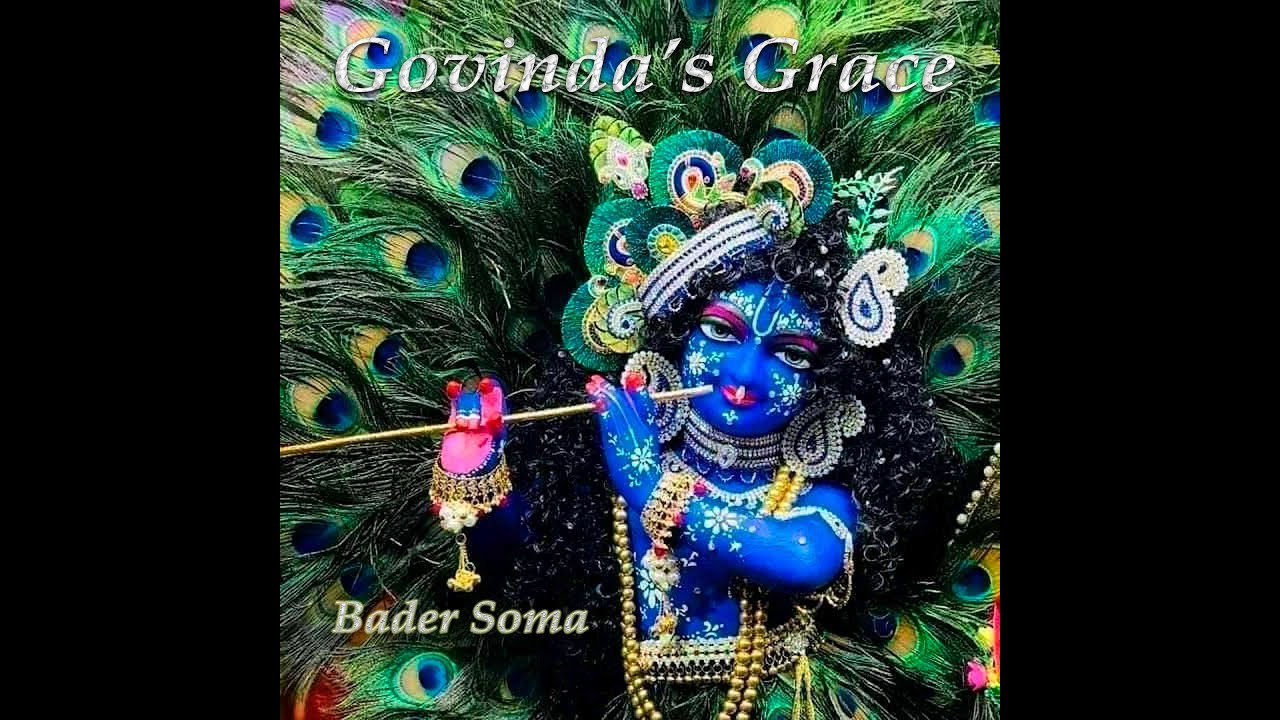
The song appears on Govinda's Grace, an eight-track album recorded in Montreal that totals 88 minutes—both sacred durations in Hindu practice. "The Krishna Song" itself pulses at 108 beats per minute, the number considered auspicious in meditation and chanting traditions. Within its framework, Krishna's name is invoked exactly 45 times. These are not decorative choices. They are the bones of intention, and they announce that every element—from tempo to syllable count—has been considered as an offering.
The genius of "The Krishna Song" lies in its method: a cascading litany of Krishna's qualities that moves systematically through Hindu philosophy's most authoritative texts. The song draws from the Bhagavad-Gita (Krishna's teaching to the warrior Arjuna), the Brahma Samhita (the cosmic vision of Krishna's supremacy), the Isopanishad (meditations on the absolute), and the Siksastakam (prayers of longing). Most centrally, it draws from the Bhakti-rasāmṛta-sindhu (The Nectar of Devotion), which catalogs Krishna's 64 divine qualities.
Rather than deliver a dry theological sermon, Soma uses repetition as a tool of revelation. The opening verses stack qualities in pairs—Krishna is simultaneously "light" and "dark," "up" and "down," "in" and "out"—creating the sense of a being who contains all paradoxes. This isn't mystical hand-waving; it's a rigorous philosophical point: Krishna is understood in Hindu devotional theology not as a localized deity but as the absolute reality pervading all existence, transcending duality. The repetitive structure, which might initially feel reductive, becomes a meditation tool—each invocation piling perception upon perception until the listener grasps the vastness through accumulation.
What distinguishes "The Krishna Song" from more austere philosophical chanting is its tonal range. Alongside verses that catalog Krishna's cosmic roles—establishing dharma (righteous order), dissolving karma, serving as the origin of all incarnations—sit playful domestic images. "Butter churned / Is dear to His heart"; "He prefers rice to / Fettucini." These are not irreverent jokes but genuine teachings embedded in Hindu scripture. In the Bhagavata Purana, Krishna's childhood pastimes involve stealing butter and playing pranks—yet these acts carry theological weight, illustrating the paradox of the infinite expressing itself through finite, intimate actions.
The song catalogs Krishna's incarnations (Rama, Buddha, Narasimha, Kalki) with efficiency and affection. The reference to lifting Govardhan Hill "with his left / Pinky under / By his sweet will" captures a specific moment from Krishna mythology—the divine child's casual display of immeasurable strength—rendered with poetic precision. A tribute to A.C. Bhaktivedanta Swami Prabhupada, the 20th-century philosopher who brought Krishna consciousness to the West, appears midway through, acknowledging the historical lineage through which this knowledge traveled.
For the first half, the song functions as exposition, a loving encyclopedia. But around the midpoint, a tonal shift occurs. "Krishna! Krishna! Where are you? / Krishna! Krishna! I am through!" The singer moves from cataloging Krishna's qualities to confessing spiritual longing. The intellect gives way to the heart. "I looked for you in my heart / But I still / Feel apart."
This is the crucial arc: from philosophy to intimacy, from the cosmic to the personal. The singer admits his predicament—that understanding Krishna intellectually is not the same as experiencing Krishna directly. "I thought control was cool / But now I know I'm a fool." The rationalist's pretense crumbles. What follows is a surrender, expressed through one of devotional Hinduism's most famous verses, sung here in Sanskrit: "Na dhanaṁ, na janaṁ, na sundarīṁ / Na bhukti, na mukti"—neither wealth, nor family, nor beauty; neither material pleasure nor liberation itself—"I want to dance with your shakti / In a trance of sweet bhakti." The speaker seeks not the rewards of spirituality but union itself, the loss of separation.
The musical realization is equally considered. Recorded at Ohm Studios in Montreal and mixed by Rad Crasto, the arrangement pairs Soma's guitar work with violin (Nicolò Bernardi), the traditional frame drum mrdanga (Nrsimha Chaitanya), and layered backing vocals from a collective of singers. This ensemble approach—blending classical Indian percussion with Western instruments, creating textural depth through multiple voices—echoes the song's own blending of form and content. Ancient wisdom and contemporary musicianship are not in tension here; they are woven together.
The song builds toward its conclusion not through climax but through deepening commitment. The final passages repeat "I love you so much, Krishna" with increasing collective weight, as more voices join, until the singular speaker has become "we." The separation trauma that haunted the middle section—"I'm feeling separation trauma"—resolves not into certainty but into shared longing, the individual absorbed into the community of devotion. "Hare Krishna! Hare Rama!"—a call that has echoed through centuries of Hindu practice—becomes the final word.
For those drawn to the intersection of philosophy and music, "The Krishna Song" offers a model: precision in intention, humility before tradition, and the courage to make something both intellectually rigorous and emotionally vulnerable. The full album Govinda's Grace extends this exploration across eight pieces and 88 minutes. The song is available across major streaming platforms, including Spotify, Apple Music, and Soundcloud, and Soma's independent website badersoma.com offers additional context, lyrics, and the broader catalog of his work. For deeper engagement with the texts and teachings referenced—the Bhagavad-Gita, the Brahma Samhita, the Bhakti-rasāmṛta-sindhu—these remain in translation and study worldwide, their relevance extending far beyond any single musical interpretation.