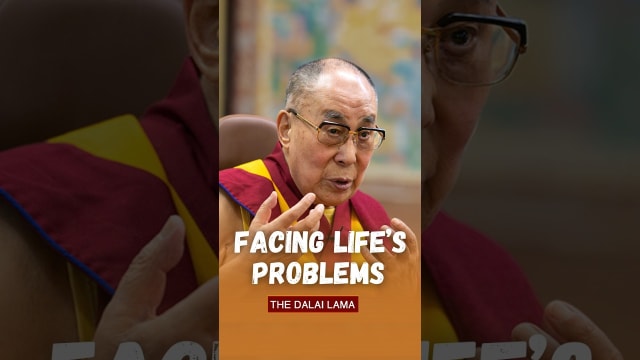
In a short teaching recorded on August 2, 2018, the Dalai Lama takes up a question nearly everyone faces: what to do when a problem lands on you. His answer draws on the Indian master Shantideva and comes down to a plain, realistic discipline. Before reacting with fear or sorrow, examine the problem itself. If it can be overcome, act. If it cannot, stop spending energy on worry. The inner strength that makes this possible, he says, grows from compassion, which he treats as a sound foundation rather than a feeling to be indulged.
The clip's most useful distinction is between two kinds of emotion. Anger, in his account, has "no sound basis, just emotion." Compassion is also an emotion, he acknowledges, "but that based on sound reasons." Compassion cultivated through training, he says, is "a very sound basis." From that footing come inner strength, self-confidence, and what he calls "auto determination, willpower." Crucially, he adds, this comes "not due to blind faith, but through reasoning." Confidence here is earned through understanding, not borrowed from belief.
That reasoning is then applied to problems through Shantideva's method. In the teaching, the Dalai Lama puts it this way:
"When you face some problem you analyze the problem. If the problem can overcome, then no use worry. Make effort. If the reality, the problem cannot overcome, then no use too much or sorrow or so worry. Very realistic."
The logic works as a two-branch test. A solvable problem calls for effort, not anxiety, because anxiety adds suffering without adding a solution. An unsolvable one calls for acceptance, because grief and worry cannot change it either. In both branches, the surplus suffering is the part you can put down. That is what makes the advice "very realistic": it does not ask you to feel nothing or to pretend a problem is smaller than it is. It asks you to sort what can be changed from what cannot, and to spend your energy only on the first.
The teaching also implies a reframe of worry itself. Worry is presented not as proof that you care, but as a cost that buys nothing. Compassion, by contrast, is what supplies the steadiness to look at a hard situation clearly in the first place.
This clip runs about a minute and is drawn from a longer body of teaching. For fuller context on how the Dalai Lama approaches compassion, reasoning, and steadiness in difficulty, look for his longer talks on Shantideva and on training the mind on his official channel. Begin with the question he asks first: can this be overcome?