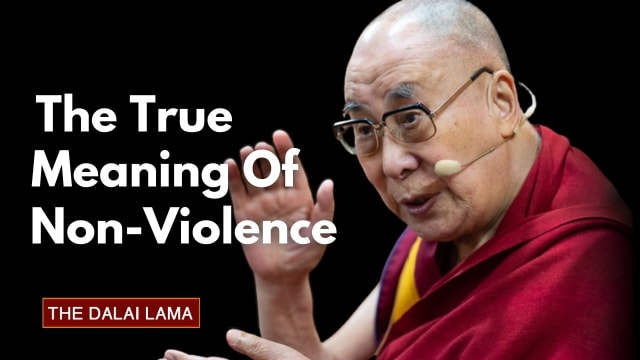
Most of our worrying is useless, and the Dalai Lama says so plainly. In a brief teaching recorded on August 2, 2018, he draws on the Indian master Shantideva to offer a working method for facing life's problems with a steady mind: look at the problem clearly, then decide whether worry has any job to do. The advice is short, but it rests on a distinction that runs through his wider teaching, between emotions that have a sound basis and emotions that do not.
The teaching begins by sorting emotions. Compassion and loving kindness, he says, are strong feelings that rest on sound reasons. Anger, by contrast, has no sound basis; it is simply emotion. Compassion cultivated through training, he explains, gives the mind a firm footing. That footing produces inner strength, then self-confidence, then determination and willpower. The key point is where that strength comes from. It is not blind faith, but reasoning.
From there he moves to the practical core. Shantideva's counsel, as the Dalai Lama presents it, is to analyze the problem when it appears. The analysis splits into two cases. If the problem can be overcome, there is no use in worrying; the right response is to make an effort and address it. If the problem cannot be overcome, there is equally no use in worrying too much. In both cases, worry adds nothing. It takes energy and leaves the situation exactly where it was.
Shantideva's line behind this idea, from his eighth-century work Bodhicaryavatara, is often quoted in exactly this form: if a problem can be remedied, why be unhappy; if it cannot, what good is unhappiness? The Dalai Lama's version keeps the logic and drops the drama. It is less a call to calm than a call to honesty. Ask whether your concern can change anything. If it can, act. If it cannot, stop spending yourself on it.
The clip is only about a minute, so it does not spell out how to apply the test in daily life. Still, the structure is easy to try: name the problem, ask whether you can affect it, then either make the effort or set the worry down. Over time, that habit separates the concern that solves things from the worry that only repeats them.
This short clip is one fragment of a much larger body of teaching. For the fuller context on compassion as a reasoned emotion, and on how the Dalai Lama approaches training the mind, look for his longer talks and books on Shantideva and on the bodhisattva path. Searching the Dalai Lama's official channel for related teachings on compassion, anger, and mental training will lead to the broader material this clip is drawn from.