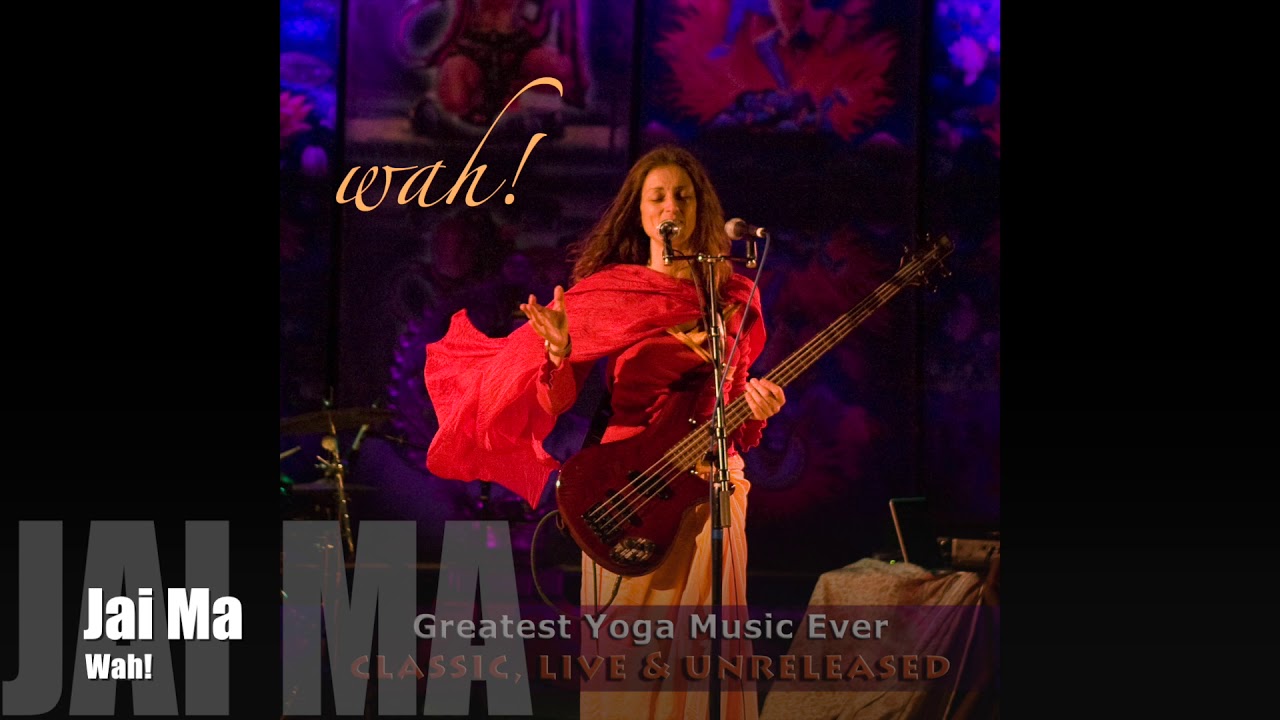
Nearly twenty seconds pass before a voice enters. The first sound is a tone, then a second tone, and then, at 0:21, a single syllable: Om. It arrives without announcement, and the rest of "Savasana – Opening" follows the same logic. A devotional phrase is sung, folded back on itself, lengthened, interrupted, and then sung again until the listener stops expecting a destination. Across 5 minutes and 44 seconds, the video makes a case that the closing rest of a yoga session can be entered through sound rather than instruction. The material available here is the video's title, its description, and its auto-generated caption track, not a spoken explanation from the singer. What follows is an attempt to read that material carefully and to explain the practice it points toward.
The caption track is unusually sparse at the start. Two bracketed music markers appear at 0:08 and 0:18, then the Devanagari syllable for Om at 0:21. The sequence matters. A chant that opens with a sung syllable asks the listener to commit to the voice before any text has been established. Nothing is being explained. The phrases that follow, beginning around 0:27, are long compound words that a listener cannot parse on first hearing, and that is part of the design. You are not meant to translate your way into the room. You are meant to be in it.
The title sets the frame. "Savasana" is the name of the practice at the end of most yoga classes, the pose of lying flat and letting the body stop. The video's title places this chant at its beginning, and the description points listeners to an album called Savasana, available as a download on iTunes and as a CD on CDBaby. So the chant is best understood as an entry point, a threshold for a longer listening experience, and not a standalone lecture.
Savasana is the pose most people rush through. It looks like nothing: a body on the floor, eyes closed, a few minutes of stillness. Yet many teachers treat it as the most demanding part of practice because the mind, freed from the structure of postures, tends to get busy. A chant offers a different kind of structure. Where a posture gives the body a shape to hold, a repeated phrase gives attention something to return to.
That is the logic underneath this recording. The phrases recur. A line that appears at 0:27 comes back in altered form at 1:20, then again at 2:44 and at 4:26. The repetition is not a loop designed to hypnotize. It works more like a handrail. A listener who drifts can come back to the next recognizable cluster of syllables, the way a student in a savasana can return to the breath without needing to remember a whole instruction set. Chant is, among other things, a discipline of returning.
The caption track shows a clear arc, even allowing for the imperfections of automatic transcription. The early section, roughly 0:21 to 0:50, is sparse and fragmented, with the singer moving through single words and short cells. By 0:50 the phrasing begins to widen, and lines such as "श्रीमुखी वात्सल्य अमृत वर्षे" (shrimukhi vatsalya amrit varshe) at 0:44 run longer than anything before them. The middle of the piece, around 1:50 to 2:20, is where the texture thickens. Here the caption track records a bracketed [प्रशंसा], the Devanagari word for praise, at 2:03, 2:09, and 2:13, with music markers between. That tag suggests an audience or a moment of collective response, though the material does not settle the question.
The text then broadens. At 2:44 the caption records गुणनावती (gunanavati), a word that did not appear earlier, and the phrasing expands into a longer line that runs into the name-like epithets भगवती (bhagavati) and मंदास्मित (mandasmit). The later passages, around 4:25 to 5:20, return to the earlier material, now sung in longer cycles. The ending is not a resolution in the musical sense. It is a return to where the piece began, carried a few steps further.
Anyone trying to follow the words should be cautious. The caption engine misspells repeated words in ways that suggest it is guessing. The same epithet appears as सक्ती, सुक्ती, and a truncated सुक् across different passages. That is a limitation of automatic captioning, not a reliable guide to the lyric. Treat the caption as a rough map, not a score.
The final caption line, at 5:29, ends with the Arabic-script word اللہ, which in Arabic is the name of God. The caption track does not indicate whether the singer sang this word or whether the auto-captioner rendered a sung syllable as the closest word it recognized. The material cannot resolve that. What it does show is that the chant's devotional vocabulary is not confined to a single script or tradition at the level of the captions, and the closing word is the caption engine's last attempt to name what is being sung. Whether that reflects intention, mishearing, or chance is left to the listener.
A few suggestions follow from the structure rather than from anything the speaker says in the video. Play the recording at the start of a savasana, lying flat with the lights low, and let the first ninety seconds be simple listening. Do not try to catch every word. When the phrase repeats, notice when your attention wanders and return it to the next recognizable cluster. If you find yourself analyzing the Sanskrit, stop and let the sound do its work. Some people find it useful to play the recording at a low volume so that it sits under the breath rather than over it.
For a longer session, the five-and-a-half-minute length is a natural fit for a short closing rest. It is long enough to settle into and short enough that it does not require you to decide when to stop. The return to the opening phrases near the end gives a built-in sense of closure.
The description lists two ways to hear the full Savasana release: a download from iTunes and a CD through CDBaby, with the artist's own site, wahmusic.com, listed alongside. The video has accumulated roughly 195,689 views since its upload on August 8, 2017, a figure that suggests the recording has found a lasting audience among people looking for something to play at the end of a practice. For anyone encountering the chant for the first time, the album is the natural next step, because a single five-minute opening can only introduce a recording that is meant to be heard as a whole.
Start with the video at a low volume during a closing rest, and listen once without trying to understand the words. Then listen again and notice the moments the phrase returns. If the chant draws you in, the full album is the logical place to continue, and the caption track is worth reading only as a rough guide to the sounds. The most useful thing this recording offers is not information. It is a repeatable way to arrive at stillness, one phrase at a time.