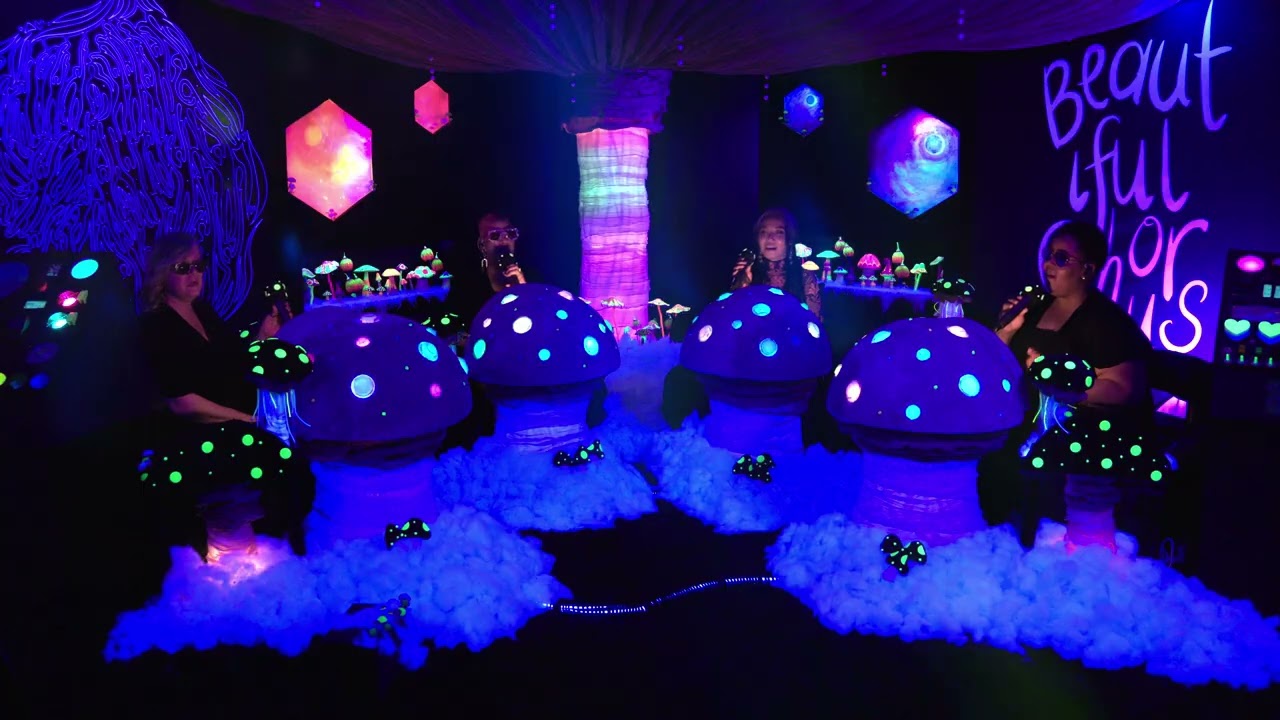
A seven-minute-and-change sung piece built around a single phrase is the whole offering of "Mantra Medicine: Safe," a recent upload from the Beautiful Chorus channel. There is no spoken introduction, no teacher's voice walking you through a practice, and no story told in words. What the video does instead is pose a question in its description, "What if I could feel safe in my day to day life?", and answer it the only way a mantra can: by returning again and again to a short affirmation over sustained music until the words begin to carry more weight than the listener expects. That is a modest format, and it is worth describing honestly, because the value of a recording like this depends entirely on how you use it.
Very little that can be transcribed cleanly. The automated transcript is fragmentary, with most lines broken by musical swells and sustained tones. What can be heard, and what the title points to, is the repeated phrase "I am safe," sung in pieces: "I am sa..." followed by "fe" on the next pass, looping through the first minutes with small variations. Other sung fragments include "I know," returned several times, and a line beginning "If" that the transcript renders only partially. Around the midpoint the phrase "I know" resurfaces in the same melodic shape, then the piece closes on a single spoken-sounding word, "Amen," at about the seven-minute-forty mark.
The opening is almost entirely instrumental and vocal tone. Early on, a long sung vowel and a few isolated syllables establish the sound before the affirmation itself arrives. This is a common architecture for devotional and meditation recordings: the listener is first brought into the sound, and only then given the words to hold onto. It is worth noticing that the words are not delivered as a lecture. They arrive as repetition, which changes what they do to the listener. A sentence you hear once is information. The same sentence heard twenty times over a steady drone becomes a texture you are inside of.
The title, "Mantra Medicine," places the recording inside the language of healing, and the video's tags make the intention more specific: nervous system regulation, healing, meditation music, and high-frequency music. The video does not explain the mechanism behind that framing, and this article will not invent one on its behalf. What can be said, in general terms, is that repetition is one of the oldest tools people have used to slow attention. Repeating a phrase gives a restless mind something to return to, and sung repetition adds breath, pitch, and rhythm, which many listeners find easier to settle into than silence.
The idea behind the title is that a body that has learned to brace may need to hear the message "you are safe" in more than one form. Speaking it once, in your head, is one thing. Hearing it sung, slowly, while the music sustains underneath, asks a different part of the listener to participate. That is the working premise of the recording, and it is a premise you can test for yourself rather than accept on faith.
Treat it as a practice rather than background music. Sit or lie down somewhere you will not be interrupted for the full seven minutes. Let the opening tones arrive without trying to decode them. When the phrase "I am safe" comes in, try repeating it silently along with the singer, keeping your breath slow and even. You will likely notice the moments when you drift into planning or worry, and the moments when your shoulders or jaw tighten. Those noticings are the point. The recording is not a switch that turns safety on; it is a repeated invitation to come back to a body that is, right now, not in immediate danger.
If the affirmation feels untrue to you, that is worth noticing too. You do not have to believe the words to use the repetition. Many people find that the sound itself does the work even when the sentence feels like a stretch, and that the phrase becomes easier to hold on the second or third listen.
Quite a lot, and the gaps are part of an honest reading. The upload contains no lyric sheet, no spoken context about the piece's origin, and no explanation of who sings on it beyond the channel name. The description asks its question, then points to outside links: a linktree for the artist, a distributor's page, a Patreon community called the Inner Circle, and an email list. Those are places to go if you want more, but they are not part of the recording itself, and nothing in the material establishes what they contain beyond their names.
The video has also been seen by a modest audience so far, 1,479 views at the time of writing, which means it is still early in its life. A piece this sparse does not gain depth from the commentary around it. Its depth, if it has any for you, will come from how often you return to it.
"Ask yourself: What if I could feel safe in my day to day life?"
Listen to the full recording once without doing anything, then listen again while repeating the phrase silently. Notice where your attention goes and where your body softens or tightens. If the sung mantra resonates, look for other recordings built on simple affirmations and compare how each one handles repetition, tone, and silence. The question printed in the description is a fair place to end: not whether a song can make you safe, but whether you can give your nervous system a few minutes a day to hear the claim and see what happens.