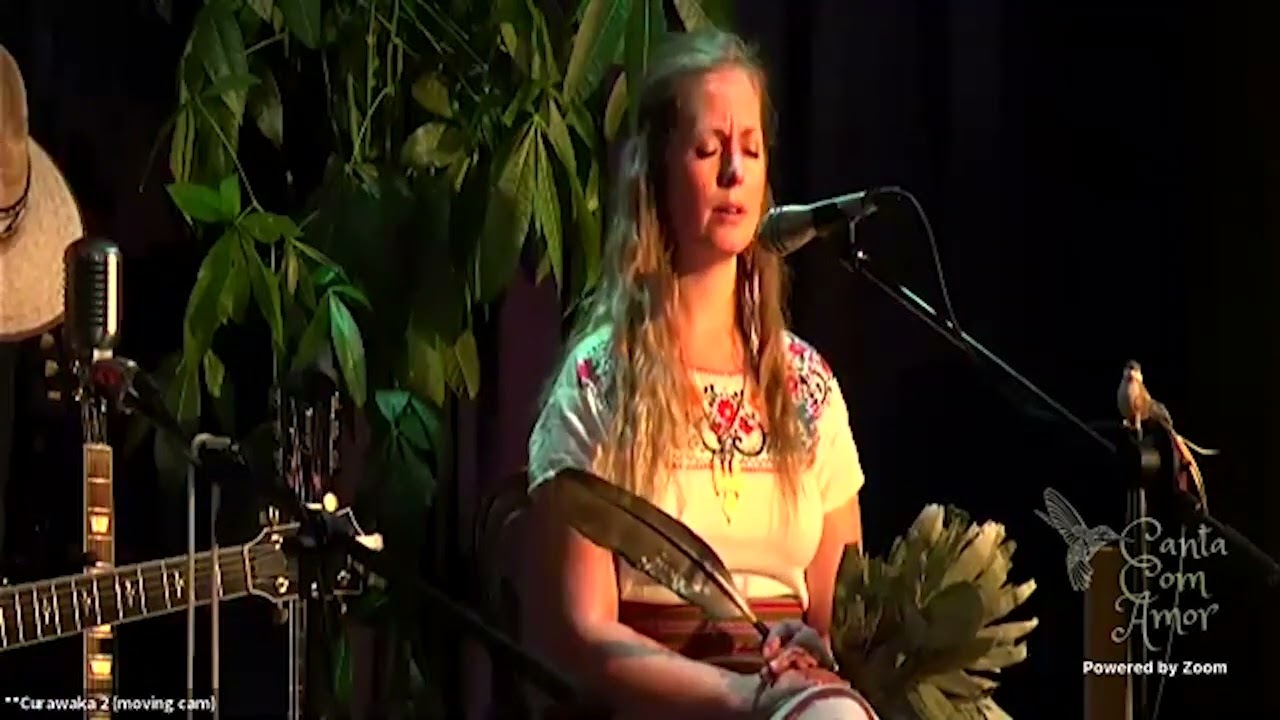
A two-and-a-half-minute clip uploaded by the Curawaka channel in April 2014 shows the singer Bariyani playing with songs drawn from Templo Mae d'Agua, somewhere in Bahia, Brazil, after a ceremony. There is no spoken introduction, no translation, and no visible context beyond that. What the video does offer is the song's Spanish lyrics, posted in full in the description: a dense run of images that moves from eagles and condors to a "miracle drum," from the sun, moon and stars to flowers showing their colors. This piece reads those words closely, explains the vocabulary and the imagery, and is clear about where the available record ends.
The facts are modest and worth stating plainly. The video is titled "Bariyani (Curawaka) - Sagrada Familia," runs 2 minutes and 24 seconds, and was published on April 30, 2014. At the time of this writing it had about 121,000 views. The description identifies Bariyani as a Curawaka singer, says the performance happened "after ceremony work," and places it in Bahia in 2014. It also names Templo Mae d'Agua as the source of the songs being played.
Two things the record does not give us: there is no transcript, so nothing spoken is available to quote, and nothing in the material explains what the ceremony was, what Templo Mae d'Agua is beyond its name, or how Curawaka as a group came to sing these songs. It is also worth noting that "Sagrada Familia" is the title of the famous basilica in Barcelona. The material offers no connection between that building and this song, so any link would be the reader's assumption, not the video's.
With no spoken framing, the words do all the work. The lyric sheet in the description is the closest thing to a score, and it is worth reading as one. The text is written in Spanish, and the posted spelling is informal in places. The line "Un sin fin de flores / muestram sus colores," for example, uses "muestram" where standard Spanish would write "muestran." That small slip is a reminder that this text was passed along by hand and by ear, not typeset by a publisher. The description treats it as a living song, not a finished document.
The song also moves in a particular way. It begins with a figure and a flight, builds through a list of gifts, and closes with a catalogue of color. Read in sequence, the lyrics feel less like a narrative than an invocation: a sequence of names and blessings called out one after another.
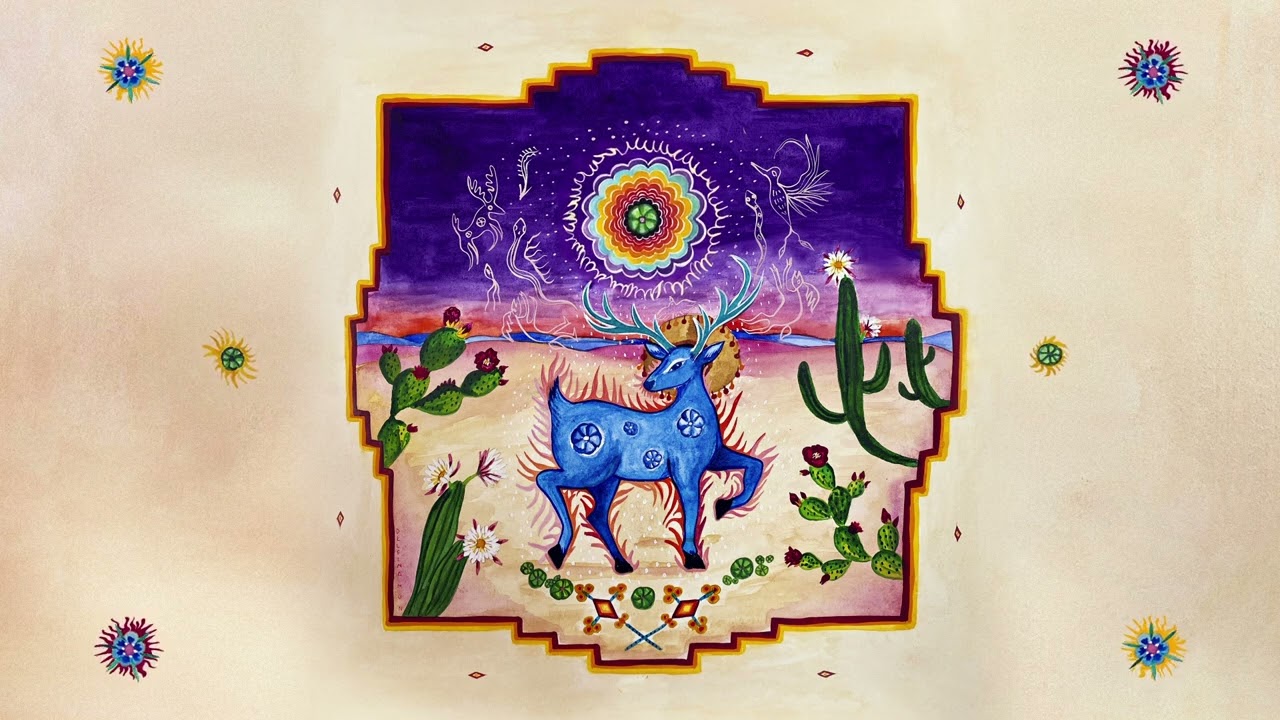
The song opens with "Águila del Norte," the eagle of the north, and then "Vigilante vuelo," a watchful flight, which brings the medicine: "trae la medicina." Later comes "Cóndor de los Andes," the condor of the Andes, followed by "Señor de los cielos," lord of the skies, who speaks to the stars and heals his people. The two birds appear together near the middle: "Águila y Cóndor." Because the lyrics do not explain these figures, we can only describe what they do in the text. One bird is northern and watchful; the other belongs to the mountains. Together they span a wide geography, which the next lines make explicit.
That geography arrives in a triplet: "Sol, luna y Estrella," sun, moon and star, followed by "Sierra, selva y mar," highlands, jungle and sea. Whatever the singers intended, the lyric maps a continent in three pairs of words, from the high ground to the forest to the coast.
The middle of the song is where the lyric becomes most direct about purpose. The drum is a "tambor milagrero," a miracle drum, and its sound "retumba en los montes," rolls through the mountains. It gathers people: "junta los hermanos," it brings the brothers together. It heals: "cura corazones," it cures hearts, and it protects: "proteje los niños," it protects the children, and "trae las bendiciones," it brings blessings.
The words for heart recur. Near the end, "Corazón del fuego" offers a heart of fire, and "misterio da la vida" names the mystery that gives life. A reader does not need a glossary to see the pattern: the drum calls people in, the song heals the heart, and what results is a kind of gathering and renewal. The lyrics make that case without arguing it.
"Tambor milagrero / retumba en los montes / junta los hermanos / cura corazones."
Lyrics as posted in the video description, Curawaka Official, April 30, 2014
The description chooses its verb carefully. It does not say "performing" or "recording." It says Bariyani was "playing around with songs" after ceremony work. That framing matters for how we should watch the clip. A playful, unpolished session is a different object from a studio release: it shows the songs in the hands of a singer who is still moving between them, trying them out, letting the lyric list stretch and repeat. The 2:24 runtime is short enough to feel like a fragment, and the description presents it as exactly that.
It is tempting to fill a short, untranslated video with a neat story, and this article is not going to do that. We do not know what the ceremony was. We do not know the history of Templo Mae d'Agua, the role of the song within the group's practice, or the meaning the singers attach to the eagle and the condor. The lyrics are open to reading, and the reading offered here is interpretation, not testimony from the people who sang them.
The most useful next step is to watch the clip with the lyrics open in front of you, pausing on the lines about the drum and the heart. Then look at the rest of the Curawaka channel's uploads, which the material does not describe in detail but which will show you how the group presents its songs over time. If you read Spanish, the posted lyrics are short enough to translate line by line yourself, and comparing your version to the readings here will reveal where the text is open. Keep the 2014 date in mind: this is a record of one afternoon in Bahia, not a complete account of a band or a tradition.