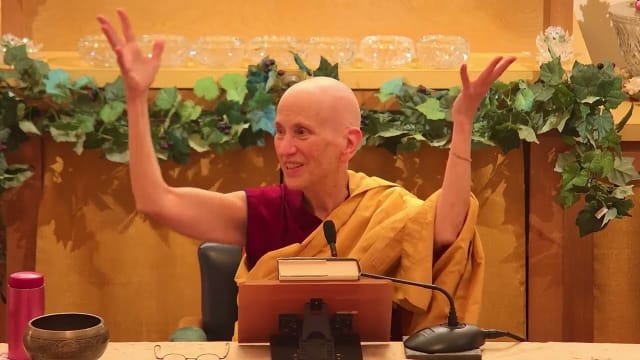
Hope, Venerable Thubten Pema suggests, is one of those words we use loosely until a dark stretch forces us to check what we mean by it. In a talk posted to the Sravasti Abbey YouTube channel, she opens not with doctrine but with a run of stories: people describing depression so deep they could not get out of bed for months, a man diagnosed in adulthood with the manic depression he had carried most of his life, a prisoner denied parole who took his own life, a young man with twenty years left on his sentence who wanted only to know how to get out. Then she asks a harder question than "how do we cheer people up?" What if the answer is not to give up on hope, and not to settle for optimism, but to hope in a way that is grounded in seeing reality clearly? Drawing on traditional Buddhist psychology, she proposes that this kind of hope can be built deliberately, by training five "object-ascertaining mental factors": aspiration, conviction, mindfulness, concentration, and wisdom.
The talk begins with a question that had come up in several settings over a couple of weeks. A participant in one group asked about a line from a Buddhist book that seemed to speak against hope, and what that could possibly mean. Outside the group, people made a case that sounds reasonable on its face: wouldn't it be better not to have hope? Then you won't be disappointed. Better to calm the mind, live in the moment, stop revisiting the past or worrying about the future.
Venerable Thubten Pema does not dismiss this. She calls those practices "a very good temporary solution." Her objection is narrower. The problem is what the word hope is being asked to carry. In English, she notes, hope is "quite wide" and its meaning is "quite vague." Buddhist language has several terms that carry a similar flavor, and most of them are positive. The kind of hope she is describing is not an unrealistic one.
That distinction matters for anyone who has ever been told to "just stay positive" while their life felt like it was caving in. Hope that depends on things turning out a certain way is fragile. Hope that is not clear about the situation is fragile too. The talk's central move is to ask whether there is a third kind: a hope that is steady because it is accurate.
Her answer is specific. Realistic hope, in her framing, is "grounded on being clearer and clearer about seeing reality." It is not a mood you summon by repeating affirmations. It rests on an understanding of how the mind works and what the path actually involves. As she puts it in the talk:
"It's not kind of unrealistic hope. It's not just being optimistic, wishful thinking that it is grounded on being clearer and clearer about seeing reality."
— Venerable Thubten Pema, Sravasti Abbey YouTube talk, approx. 5:02
Her working theory follows from that. If we get clearer and clearer about the mental factors, and understand how they operate in our own minds, we can cultivate them on purpose. The hope that results, she says, is "very stable and very realistic." The shift here is from hope as something that happens to us to hope as a set of qualities we can train, the way a musician trains technique rather than waiting for inspiration to arrive.
In Abhidharma-based Buddhist psychology, mental factors are the qualities that accompany each moment of consciousness and shape how the mind engages with what it perceives. The talk focuses on five of them. She acknowledges that some traditions treat them as universal and others do not, and she sets that debate aside because her interest is practical. For her, these five are the foundation of why hope can be cultivated at all.
1. Aspiration (intention). This is taking real interest in something you want to move toward. For Venerable Thubten Pema, the aim is Buddhahood, which she presents as genuinely possible. Aspiration sets the direction. Without it, the other factors have nowhere to point.
2. Conviction. She notes that this factor is sometimes translated as belief or admiration, but that one of her teachers renders it as conviction: you have examined something and are quite clear about it. Here she links it to a point Geshe Yeshe Topgye made in a talk she recalls, that our confidence in the path rests on a conviction that the afflictions, and everything unsatisfying about samsara, can be abandoned, and that liberation is possible. The path is a blueprint. The task is to build your own Buddhahood "from inside out."
3. Mindfulness. In the talk, mindfulness is "really having that steady mind and not being distracted." Two distractions are named: the eight worldly concerns, and "something else that looks more interesting." This is the factor that keeps you from being pulled off course by every shift in praise, blame, gain, or loss.
4. Concentration. Here the mind fixes itself on the path and grows clear about it. She adds an important qualifier: the concentration should be on something you actually delight in. As practice deepens, she says, the mind starts to become more joyful, and that joy is itself a sign the training is working.
5. Wisdom. She says the Tibetan word for this factor is the same word as wisdom. She describes it in terms of having a broad view and seeing subtly, and she connects it to the Buddhist aim of realizing emptiness. The excerpt moves through this factor quickly, but the logic is clear: the more we cultivate wisdom, the more fully we see situations as they are, and the less we are driven by distorted pictures of them.
Read together, the five form a sequence. Aspiration gives direction. Conviction establishes that the direction is reachable. Mindfulness holds the mind steady, concentration keeps it fixed on what matters, and wisdom makes the picture accurate. Realistic hope is what you have when all five are working together.
One of the more practical points in the talk concerns where our pleasure comes from. Venerable Thubten Pema speaks of being "very careful" about the sources of what she calls our happy hormones, the dopamine-driven good feelings we chase. There are many places to get them, and not all of them serve us. Where we find our satisfaction, she argues, shapes our intention, and our intention determines where our actions go.
This connects back to the idea that anything we do can be part of the path. Her teaching is not that every activity must be formally religious. It is that a mind trained in aspiration and concentration can bring its intention to ordinary work, and ordinary work then becomes part of the training.
The most striking passage in the opening section is a story she recounts from a talk by Geshe Yeshe Topgye, about the teacher's friend and fellow student, a monk known for debating through the night and never seeming to sleep. After the Chinese takeover of Tibet, this friend was imprisoned and put to work in a cement factory. He did the labor exceptionally well, and his captors came to appreciate him. Other prisoners asked him why he worked so well when the work was benefiting the Chinese. His answer, as Venerable Thubten Pema tells it:
"No, I'm benefiting sentient beings. What I'm doing is benefiting sentient beings and that's why I'm putting my best into it."
— Venerable Thubten Pema, recounting Geshe Yeshe Topgye's talk, approx. 9:36
Her reflection on this is what makes the story land. Geshe Yeshe Topgye, she says, asked why we study arts and sciences that have no direct connection to Dharma. The answer is that they benefit sentient beings, and we need many kinds of skill to do that. She relates this to her own enthusiasm for baking, which she describes as a project that grew from wanting to make a Dharma wheel together with her colleague Lisa, still a work in progress. The point is not that the cement factory was a good place to be. It is that the motivation behind an action can transform an ordinary or even hostile circumstance into one that is meaningful.
This is where the talk's idea of hope becomes concrete. The young man who asked how to get out, and who could not say how he kept happy while waiting, was focused on a single outcome, parole, that was not his to control. The imprisoned monk was also in a situation he could not choose, but his aspiration pointed somewhere else. Realistic hope, on this reading, does not require your circumstances to change first. It requires a clear sense of what you are working toward and a mind steady enough to keep doing the work.
The opening of this talk does not resolve every question it raises, and it does not claim to. It offers a reframing: hope is not the opposite of realism, and it is not a feeling that depends on luck. It is a set of qualities you can train. If you are struggling with depression or hopelessness now, the talk is not a substitute for care from a doctor, counselor, or someone you trust, and it is worth reaching out to them.
For those who want to go further, the full recording is available through the teachers' sites at SravastiAbbey.org and ThubtenChodron.org. The practical starting point the talk suggests is simple to state and harder to do: ask what you are aiming at, whether you are convinced it is reachable, where your mind keeps wandering, what your joy is made of, and whether you are seeing your situation as it is. Those questions, Venerable Thubten Pema suggests, are where realistic hope begins.