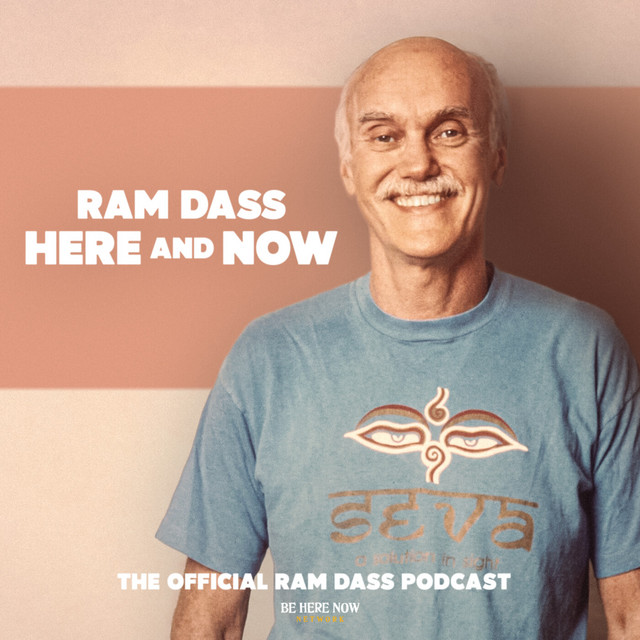
In this 1987 event from Eugene, Oregon, Ram Dass leads a meditation on infinite compassion and conducts a fast-paced Q&A addressing parenting teenagers, reincarnation, world peace, relationships, and humor. He frames the conflict between spiritually-conscious adults and teenagers as "when worlds collide"—a generational mismatch that offers a practice ground for maintaining spaciousness while taking necessary action. The session includes a communal singing practice of "Jubilate Deo" as a closing ritual of joy and connection.
Ram Dass frames parenting teenagers as a collision between two fundamentally different worlds. Adults who have undertaken spiritual practice and relative consciousness are moving toward "becoming somebody"—integrating wisdom, clarity, and intention into their identity. Teenagers, by contrast, are busy "getting into stuff and getting through their stuff world"—navigating identity formation, social pressures, and the raw experience of becoming human without yet having the reflective capacity of adulthood.
This mismatch is not a failure of parenting or adolescence; it is structural. The parent operates from a different level of development and awareness, while the teenager is engaged in the necessary work of self-discovery through action and experimentation. Ram Dass compares this dynamic to Velikovsky's concept of "when worlds collide"—the collision itself is the point. Rather than viewing this conflict as something to eliminate, he suggests it can be transformed into a practice and teaching ground for spiritual development.
The practical instruction Ram Dass offers is deceptively simple but demanding: use the parent-teenager dynamic as an exercise to work on yourself. The work is two-fold and simultaneous.
First, develop your mind such that you can take the necessary action to keep your teenager safe and grounded—"keep the kid from blowing themselves apart if you can." This is the outer work: setting boundaries, providing guidance, showing up with your best wisdom and love. Second, maintain spaciousness—an internal state of openness, non-reactivity, and compassion that doesn't collapse into judgment or control.
This is extraordinarily difficult because it requires the parent to neither check out (abandoning responsibility) nor contract in reactivity (losing consciousness). You must be simultaneously firm and soft, clear and spacious. The teenager's rebellion, boundary-testing, and apparent rejection of your values becomes material for your own practice. Each moment of frustration, fear, or judgment becomes an invitation to return to a state of awareness and love.
Ram Dass's approach to this challenge is grounded in his earlier work on meditation and awareness. The parent who can stay present, non-reactive, and compassionate while taking firm action models something that no lecture can convey: that consciousness and love are not incompatible with boundaries and responsibility.
The event begins with a guided meditation centered on awareness and compassion. Ram Dass leads the audience through a visualization where consciousness expands to become a being of infinite size and infinite compassion. This is not escapism or spiritual fantasy; it is a practice of shifting identity and perception.
When you identify with infinite compassion rather than your personal preferences, fears, and stories, your relationship to conflict shifts fundamentally. You are no longer defending a fixed self; you are expressing an awareness that holds all beings with love. This reframing is essential for the parenting challenge: if you can touch that infinite compassion during a confrontation with your teenager, you are not lost in your own reactivity. You are acting from presence.
Such meditation is not meant to bypass the need for action or clear boundaries. Rather, it is the foundation that allows action to arise from wisdom rather than fear or ego. The parent who has touched infinite compassion understands, at a cellular level, that the teenager is also a being worthy of that compassion—not because their behavior is acceptable, but because they are conscious, struggling, and learning.
The Q&A portion of the event addresses reincarnation, though the specific content of those answers is less important than the framework Ram Dass brings. In Hindu and Buddhist philosophy, which deeply informed Ram Dass's teaching, reincarnation suggests that the beings we encounter are not random. The family we are born into, the partners we attract, the children we raise—these are understood as karmic relationships, souls we have met and worked with across lifetimes.
This perspective fundamentally changes how we relate to conflict in close relationships. Your teenager is not a stranger assigned to you by accident. There is a prior connection, a shared karma that brought you together. This does not mean the relationship is automatically harmonious; it means the friction itself is meaningful. You and your teenager are working something out together across time. The conflict is not a sign of failure but evidence of deep engagement.
Similarly, long-term partnerships and marriages, when viewed through the lens of reincarnation, are understood as continuing relationships with souls you have met and loved before. This perspective invites patience, depth, and a sense of cosmic collaboration rather than a transactional view of relationships based on current satisfaction or convenience.
The Q&A is described as "spirited" and "fast-paced," and the audience response suggests that laughter and humor are woven throughout. Ram Dass has always understood humor as a spiritual technology. Laughter breaks the tight knot of the ego, interrupts habitual thought patterns, and creates a sudden opening to presence and perspective.
When you can laugh at the absurdity of conflict—at yourself, at your teenager's drama, at the cosmic joke of being human—you shift out of the contracted state where the problem feels absolutely real and serious. Humor does not mean dismissing real challenges; it means gaining enough perspective to see them as part of a larger whole. A parent who can laugh with their teenager, even in a moment of tension, has created a bridge: proof that love persists beyond the disagreement, that the relationship is larger than this particular conflict.
The event addresses world peace as one of the Q&A topics. Ram Dass's approach to social and political problems has always begun with the individual. As he taught throughout his life: "We're all just walking each other home." This means that the work of building a more peaceful, loving world is inseparable from the work of becoming a more peaceful, loving person.
The parent who learns to stay spacious and conscious with their teenager is not just solving a family problem; they are becoming a center of peace in the world. They are practicing the exact consciousness that, if extended and multiplied across families and communities, would transform conflict at every scale. There is no shortcut to world peace that bypasses the work of your own heart.
This is not naive. It is sophisticated because it understands that external solutions without internal transformation produce only fragile, temporary results. A parent who rules through fear teaches teenagers to fear power. A parent who acts from consciousness and love teaches teenagers that strength and gentleness are compatible.
The event concludes with a communal singing of "Jubilate Deo," arranged as a six-part round. This is not entertainment or a pleasant coda. In Ram Dass's teaching, group singing is a form of collective meditation and heart opening. When voices join together in song, individual boundaries soften. You feel yourself as part of something larger than your separate self.
A round, specifically, requires each singer to maintain their part while listening to all the other parts. It is a practice in both individual responsibility and group harmony, a musical metaphor for the spiritual path itself. After an intense discussion of conflict and consciousness, the closing song offers direct experience of joy, connection, and unity. The "rousing rendition" suggests that this is not a solemn or serious performance but a joyful celebration.
This closing act encapsulates Ram Dass's teaching: the goal is not to become serious ascetics, detached from life, but to live with depth, consciousness, love, and joy. A parent can be firm and spacious. A teenager can be rebellious and worthy of compassion. A family can be in conflict and still fundamentally connected. All of this can coexist, and the practice is learning to hold it all with an open heart.
If you are parenting teenagers or navigating any close relationship marked by conflict and misunderstanding, Ram Dass's core instruction is clear: use it as a practice ground. Begin or deepen a meditation practice centered on compassion and awareness. Learn to observe your reactivity without being swept away by it. Read Ram Dass's classic texts on parenting and relationships, such as his writing on "conscious parenting" or chapters from "Be Here Now" that address family life.
Explore the reincarnation teachings more deeply through Hindu or Buddhist sources, not to believe dogmatically but to shift your perspective on why you are with the people you are with. Notice moments of humor and lightness in your relationships; they are not distractions from the serious work but part of the work itself. Finally, create opportunities for group practice—meditation, singing, shared meals—that remind you and your loved ones that you are part of something larger and more connected than the individual conflicts that sometimes consume your attention.