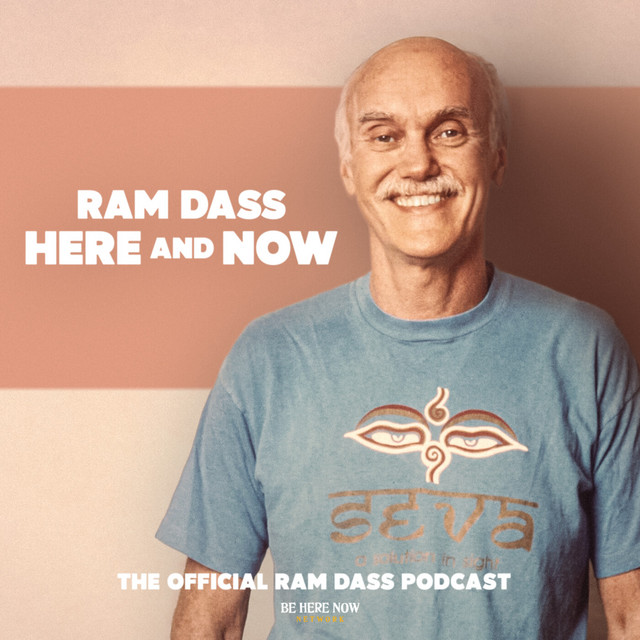
In this 1987 Eugene event, Ram Dass leads a guided meditation on compassion before addressing audience questions on parenting teenagers, reincarnation, relationships, and world peace. He frames the parent-teen dynamic as a collision of worlds—where spiritually conscious adults meet teenagers actively becoming themselves—and offers practical spiritual approaches to navigating that tension while maintaining equanimity and spaciousness.
Ram Dass opens the evening with a guided visualization centered on awareness and compassion. He guides participants through a practice where consciousness expands beyond individual identity to become "a being of infinite size and infinite compassion." This meditation sets the container for the Q&A to follow, anchoring the discussion in a state of expanded awareness rather than reactive thinking.
The heart of Ram Dass's parenting teaching emerges in his response to questions about teenagers. He uses the image of "worlds colliding"—drawing on Immanuel Velikovsky's cosmic collision theory—to describe what happens when spiritually conscious adults encounter teenagers who are "busy getting into stuff and getting through their stuff world." A parent on a spiritual path toward becoming nobody (ego dissolution, emptiness) meets a teen actively becoming somebody (individuation, ego formation). These are opposing trajectories playing out under the same roof.
"When somebody's on their way to becoming somebody and they meet somebody who's on their way to becoming nobody, it's when worlds collide, like Velikovsky said. And that's usually what happens between spiritually, relatively conscious adults and their teenage kids who are busy getting into stuff and getting through their stuff world."
Rather than seeing this collision as a problem to solve, Ram Dass reframes it as an exercise—a laboratory for one's own spiritual work. The parent's job is not to force the teenager into spiritual awareness or compliance, but to use the friction as feedback about their own development.
Ram Dass offers a two-part solution. First, the parent must work on themselves. The goal is to develop a mind—a quality of presence and awareness—such that you can take right action: protecting the teenager from serious harm while simultaneously maintaining spaciousness and not collapsing into reactivity or control.
"What you have to do is use that as an exercise to work on yourself to get to the point where your mind is such where you can do what needs to be done to keep that act together, to keep the kid from blowing themselves apart if you can, and at the same moment keep spacious."
This is a both/and teaching. You do not abandon parental responsibility in the name of non-attachment. Nor do you smother the teen in protective anxiety. Instead, you cultivate equanimity—the capacity to hold boundaries and necessity while staying emotionally open and non-reactive. The teenager becomes, in effect, your guru; their resistance and rebellion show you where you are still attached, contracted, or identified with outcomes.
In the Q&A, Ram Dass addresses questions about world peace. His teaching, consistent with his broader Dharma work, likely points to the understanding that external peace flows from internal peace. You cannot legislate or force planetary harmony without first transforming the consciousness of individuals. This aligns with his core teaching: that service (Seva) and social change must grow from a place of expanded awareness and compassion, not from fear or judgment.
When asked about reincarnation and relationships, Ram Dass draws on his Hindu and Buddhist background. The notion of multiple lifetimes reframes current relationships as part of a longer arc of karma and soul learning. If you are in relationship with someone—whether as a child, parent, partner, or rival—there may be karmic threads connecting you across lifetimes. This doesn't excuse harm or mean you must tolerate abuse; rather, it deepens compassion by suggesting that the people we encounter are here to teach us something.
This view also introduces humility. You don't know the full story of another person's spiritual journey or what they need. A parent may not fully understand why their teenager is the way they are, just as we rarely see our own past-life debts or lessons. This uncertainty itself becomes an invitation to compassion and patience.
Ram Dass demonstrates throughout this talk that humor and lightness are not opposed to spiritual seriousness—they are part of it. His lively Q&A format, his willingness to engage with audience energy, and ultimately his choice to end with a six-part round of "Jubilate Deo" (a jubilant song) all show that joy and laughter are spiritual practices too. Gravity and tenderness, yes; but also play and celebration.
The meditation-to-Q&A structure in this event mirrors a larger teaching: individual spiritual work (the meditation on infinite compassion) must flow outward into the messy, embodied world of relationships, parenting, politics, and peace. You don't meditate to escape the world; you meditate to return to it with a clearer mind and more spacious heart. The person asking about teenagers, world peace, or their marriage is not separate from the meditator. They are the same person learning to bring awareness into every corner of life.
If you are a parent navigating the intensity of teenagers, Ram Dass's core suggestion is clear: use the conflict as spiritual material. Rather than asking "How do I make my teen comply?" ask "What in me is reacting to their behavior? What am I afraid of? Where am I still identified with control?" This shift doesn't make parenting easier, but it makes it purposeful. Your work with your child becomes an extension of your practice.
For anyone interested in the intersection of karma, consciousness, and relationship, the 1987 Eugene event offers both philosophical depth and practical wisdom. Ram Dass's teaching on reincarnation and world peace suggests that individual and collective healing are one movement—that by showing up with compassion in your own family, you are already doing the work of peace.
Finally, the evening's closing—a group song in six parts—reminds us that spiritual practice is not only individual meditation in silence, but also the joy of singing together, meeting others, and letting the heart expand. This balance, between the infinite and the particular, between solitude and communion, is where Ram Dass's life and teaching have always pointed.