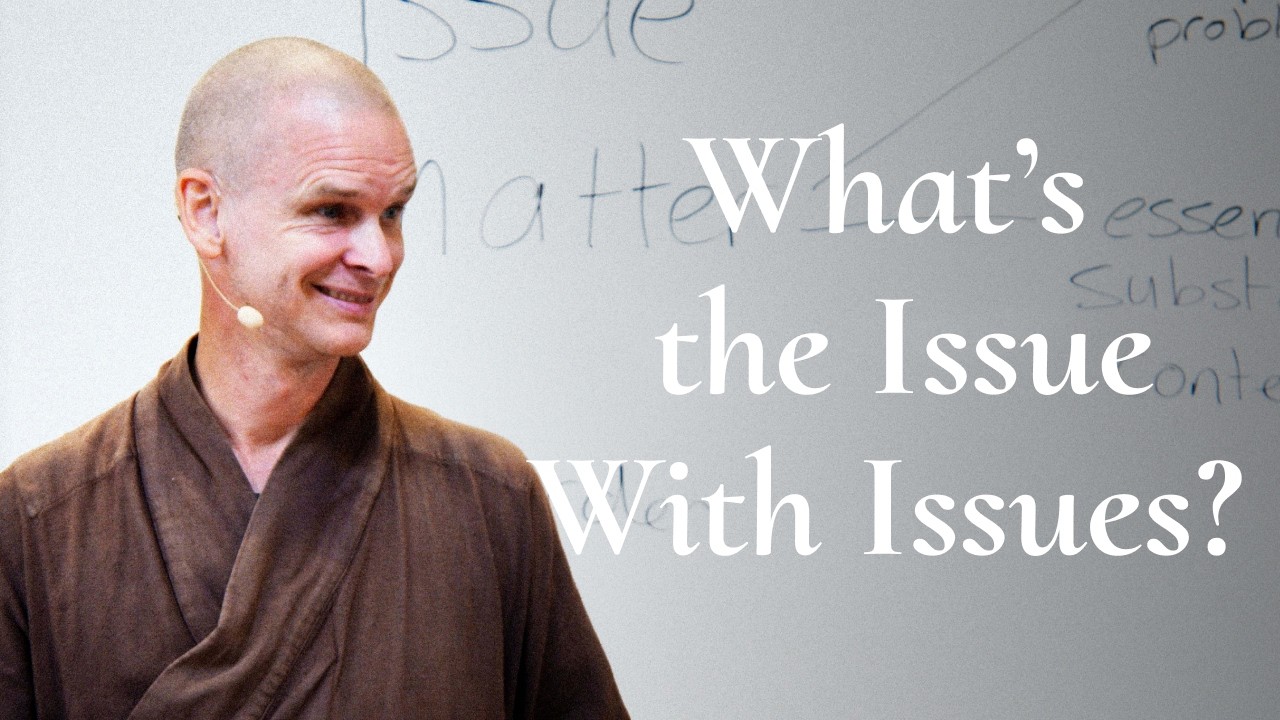
Three bells, then silence. That is how a music meditation recorded on 7 June 2026 in Upper Hamlet, Plum Village, in France opens, and for most of its 55 minutes it stays close to that stillness. The session was part of the June retreat celebrating 60 years of the Order of Interbeing, and it is built from readings, sung sutras, chants and gathas, with pauses long enough for the listener to actually breathe between them. Its central idea is simple and easy to miss: a song can be a form of mindfulness, and breath itself has a musical shape you can follow.
The session's own description asks listeners to treat it "as a meditation rather than a performance," to find a comfortable place, settle, and close the eyes when it feels natural. That instruction changes how the material works. The chants are not there to be admired. They are there to slow you down, and the readings are placed between them so that the words can land in a quiet body.
The structure is deliberate. Each reading is followed by a song or chant that picks up its theme, so the session moves like a practice, not a set list. A listener who treats it as background noise will find it long. A listener who sits with it will find that the silences do most of the work.
The Earth Touching poem by Thich Nhat Hanh is read three times in the recording, at roughly 1:18, 19:51 and 28:47 in the video's chapter list. Its opening is an instruction in posture and attention: "Sit so that you can really touch the earth and be one with her." The poem asks the practitioner to sit upright and solid, not to let thoughts lift the mind "up into the air," and to smile, because the earth "will transmit to you her solidity, her peace and her joy."
The image that carries the poem is a tree. The reading says that if you return to the earth, "the leaves, the branches and the flowers of your soul will be fresh and green" once you enter the mudra of earth touching. The idea is not that the earth is a metaphor for something distant. It is patient and always present, and the poem's line is that "Earth is still waiting for you." For anyone who has drifted away from practice, that is a useful thing to hear in the middle of a long listening session: the return is always available, and it begins with sitting down.
"Earth is still waiting for you. Because Earth has been waiting for you during the last trillion lives."
(Earth Touching poem by Thich Nhat Hanh, read in the session, 19:51 chapter)
The emotional center of the session is the reading introducing the Sutra on the Full Awareness of Breathing, also known as the Anapanasati Sutta. The speaker describes discovering it as a moment of real joy, and says that before that discovery they "didn't know how to enjoy the present moment." The sutra, the reading argues, is the path up the mountain: "There are a great many sutras, but approaching them without this sutra is like trying to reach the top of a mountain without a path to go on."
The most striking claim is about rhythm. "Our breathing is as beautiful as music," the reading says, and it asks you to imagine a violin bow drawn slowly across a single string, a note that sounds continuous. Then it offers a visual image that is almost a diagram: "If you were to draw an image of your breath, it would look like a figure eight, not a straight line. Because there is continuity as your breath flows in and out."
"Your breathing becomes the music itself."
(Anapanasati reading, approx. 8:50 in the session)
The breathing exercises that follow are the practical form of that idea. The practitioner breathes long and short, knowing each breath as it happens, then moves through a sequence that goes from the body, to feelings, to the mind, and finally to phenomena. The phrasing is repetitive on purpose. Each line gives the mind a fixed point: "Breathing in, I'm aware of my whole body." "Breathing in, I ease my mind." "Breathing in, I observe letting go." The repetition is what makes the breath feel like a melody you can hum yourself into.
The session's walking practice, "Walking Joyfully in the Ultimate Dimension," is among its most unusual passages. It places ordinary actions in two dimensions at once: the ultimate dimension, where things are seen as they truly are, and the historical dimension, where life is lived in time. The reading moves between them. Walking, we are told, should be done with the feet and not the head: "If you walk with your head, you'll get lost."
The same pairing shows up in everyday scenes. In the ultimate dimension, "discussing the dharma" means looking at each other and smiling, "you are me, don't you see?" In the historical dimension, enjoying lunch becomes a way of feeding "all generations of ancestors and all future generations." Getting angry in the historical dimension is met with a question rather than a verdict: "Where will we be in 300 years?" The shift between the two is the practice. Even the anger is held in the wider frame.
"Walk with your feet, not with your head. If you walk with your head, you'll get lost."
(Walking reading, approx. 34:48 in the session)
The song "Unborn and Indestructible" is the longest musical piece in the recording, and it works the way the Anapanasati does: by repetition that loosens the grip of the self. Its lines move toward the idea that the body and feelings came from parents, teachers and "all living" beings, and that the self is not a fixed possession. "I am one with all life. I have always been free." The song's refrain, "beyond time and space," is not an abstraction in this context. It is sung as an experience you can enter while sitting.
The readings that follow extend the theme into a kind of homecoming. A later reading describes a moon of freedom returning, "everything I thought I had lost," and concludes that nothing had actually gone. "Every flower, every stone, and every leaf recognizes me." Whether or not a listener takes the language literally, the effect is to lower the pressure of seeking. The practice is not a search for something missing. It is a return.
"The moon of freedom has returned to me. Everything I thought I had lost."
(Fragrant Palm Leaves reading, approx. 43:56 in the session)
The recording ends with the Great Bell Gatha and the Great Bell Chant, which return the listener to sound. A gatha is a short verse recited with breathing, and the bell is the thing that calls practitioners back to the present. The closing reading speaks of living beings hearing the bell clearly, and the session ends as it began: with a bell that asks you to stop, listen and be where you are. The return to the bell is the structure of the whole recording, which is why the opening three bells and the closing chant belong together.
The session was recorded as part of a June retreat celebrating 60 years of the Order of Interbeing. The material itself does not dwell on that anniversary, but its choice of readings and songs reflects a community that has built its practice around the same few images: the breath, the earth, the walk, the bell. For a listener new to the tradition, that continuity is the most useful thing to notice. The music is not a special event layered on top of the practice. It is the practice, sung slowly.
The video's own guidance is the best starting point. Turn off Stable Volume in the YouTube player so the quiet passages stay quiet. Find a seat, let the body settle, and allow the readings and pauses to guide the breath rather than trying to follow every word. If you want to go further, the Plum Village app offers free guided meditations, deep relaxations and other practices from Thich Nhat Hanh and his monastic community at plumvillage.app. Retreats are listed at plumvillage.org/retreats, and the community's own description of its work is at plumvillage.org.
The session asks for very little: a bell, a breath, and a willingness to sit still long enough to hear that the breath already has a shape. Start with the figure-eight. Let the next breath be the first note.