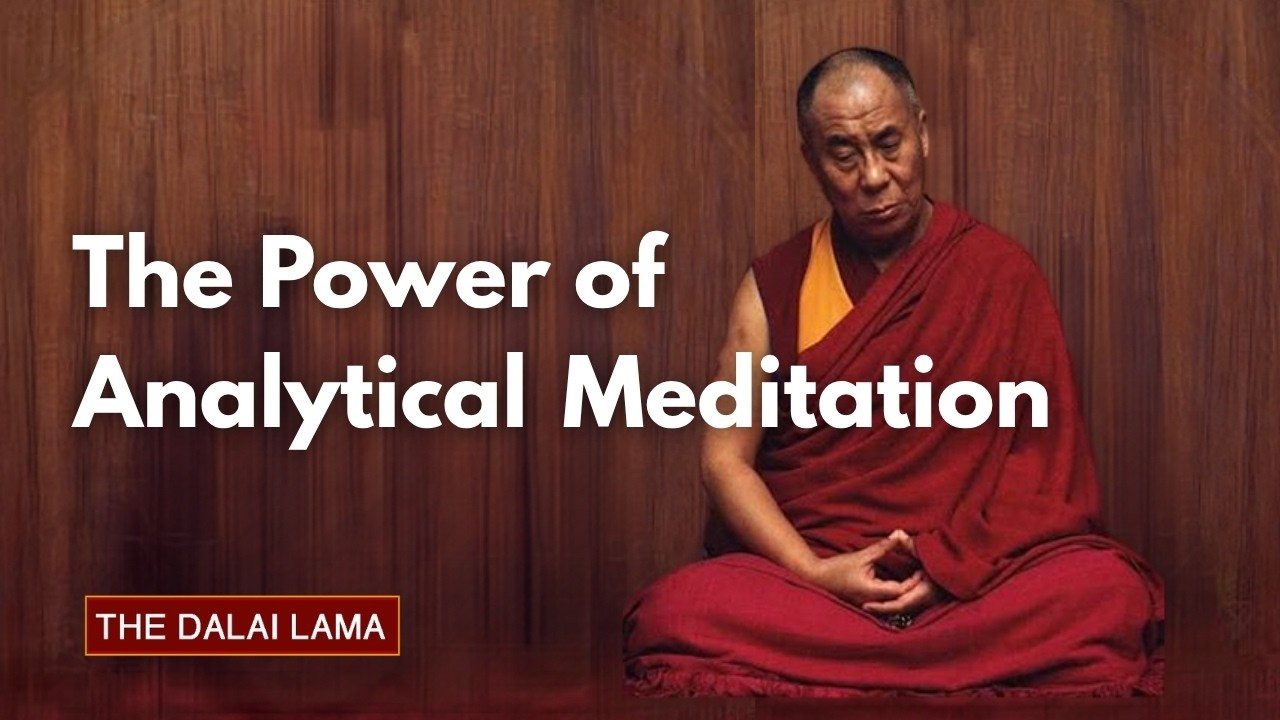
Bodhgaya, the town in Bihar where the Mahabodhi Temple stands, is the place Buddhist tradition holds as the site of the Buddha's awakening, and on December 17, 2018, the Dalai Lama visited the temple there. The video that came out of that visit runs under eight minutes, and most of it is not speech at all: the auto-generated transcript is dominated by music and fragments. But the readable portion holds a compact argument. The Buddha's central teaching, the Dalai Lama says, is karuna, compassion, grounded in the concept of ahimsa, or non-harming. The philosophical key to that compassion is interdependence: nothing exists independently, and the strong grip we place on people and things, the source of anger and attachment, loosens once we look closely enough to see that. He then makes a claim that gives the clip its edge, reporting a conversation with an American scientist who had spent decades treating patients whose minds were disturbed by anger, and who reached the same conclusion about the self.
Karuna is usually translated as compassion, though the word carries a sense of active care for the suffering of others rather than a soft feeling. In the video, the Dalai Lama places it at the center of the Buddha's message and ties it directly to ahimsa, the principle of not harming. He describes this as a tradition several thousand years old in India, and he frames the Buddha's teaching as something that developed in more elaborate form over time, with a great deal of philosophical discussion around it.
The sequence he lays out matters. Compassion comes first, then a deeper philosophical explanation of why compassion is reasonable rather than merely sentimental. That order is the spine of the teaching. Love and kindness are not presented as commands to be obeyed; they are presented as conclusions that follow from seeing how things actually are.
At about 3:26 in the video, the Dalai Lama names what he calls the most distinctive point of Buddhist philosophy: "we usually put it everything interdependence, nothing exists independently." His example is ordinary on purpose. A human being appears to stand there, a single individual, an Indian or anyone else, who looks entirely self-contained. But he asks what happens when you investigate that appearance. You find a body. You find a mind. Beyond the body and the mind, he asks, where is the person?
This is the reasoning behind the Buddhist teaching of no-self, sometimes called anatta. The claim is not that a person does not exist at all. It is that a person is designated in dependence on body and mind and on the many causes and conditions around them, and cannot be found as a separate, self-standing essence when you search for one. The Dalai Lama's phrase for the payoff is that this view works as an antidote. Destructive emotions such as anger and attachment, in his account, depend on a particular mistake: they grasp their object as if it were independent, fixed and solid, something that deserves the full weight of our reaction. Undo the mistake and the emotion loses its footing.
It is worth sitting with how practical this is. Anger, in the everyday sense, usually feels like a reaction to a clear and solid other person who has done something to us. The teaching asks us to look again at that solidity. It does not ask us to pretend the harm did not happen. It asks whether the person we are furious at is the fixed thing our anger assumes.
The most striking passage in the video comes at about 4:41. The Dalai Lama says that an American scientist, who had over several decades treated people whose minds were disturbed by anger, mentioned his findings to him. After a few decades working with such patients, the Dalai Lama reports, the scientist's conclusion was that nothing exists independently. He then reports the scientist's account of the anger itself: the moment someone feels angry, the object they are angry at appears very negative, but, in the Dalai Lama's words, "ninety percent of that negativeness is mental projection."
"very negative but ninety percent of that negativeness is mental projection" — the Dalai Lama, recounting an American scientist's findings, Bodhgaya, December 17, 2018
The number is the Dalai Lama's report of another person's conclusion, delivered in a short talk, not a figure from a published study that this video cites. It should be read that way. What the passage offers is the logic a contemplative teacher is pointing at: the intensity of anger is often generated by the mind's own projection onto the object, and clinical observation, as he describes it, seemed to confirm the same insight the Buddhist analysis reaches through reasoning about the self.
The Dalai Lama states plainly that Buddhist philosophy, unlike many traditions, can be placed next to modern science. He calls the Buddhist approach to investigation non-linear, and says that is why it can go alongside scientific method. By his own account, he has had serious discussions with modern scientists for nearly 40 years, and he says those conversations have been a visual benefit, a kind of visual learning. The phrase is slightly unusual, but the thrust is clear: seeing a theory tested against observation, rather than only hearing it argued, changes what one understands.
This is the part of the teaching that tends to get lost when Buddhism is summarized as a set of rituals or a religion of faith. In the Dalai Lama's framing, the Buddha's approach invites investigation, and it asks that a claim about the mind be checked against experience, including the experience of people who work with troubled minds every day.
At about 6:19, the Dalai Lama turns outward. He says that all the major world traditions carry the same potential, and that despite different philosophies, they all carry the same message: love, forgiveness and tolerance. He then restates his claim that in the philosophical field, the Buddha's dharma is distinctive for its investigative character. The two statements are not in tension for him. The shared message of love and forgiveness is the goal; the method of investigation is what he says sets the Buddhist path apart.
The argument works best if you take the two halves together. Love and forgiveness are easy to endorse and hard to sustain when the mind is gripped by anger. The teaching on interdependence is offered as a way of loosening that grip, so that the values every tradition names can actually be lived.
A reader who watches this video should know its limits. The clip is under eight minutes, and its transcript is fragmentary; long stretches register only as music, and some spoken lines are garbled. The visible pilgrimage, the temple and the crowd, do not come through in the text. The readable teaching is concentrated in a few minutes, and it is highly compressed. Terms like ahimsa, karuna and anatta are introduced without elaboration, and the claims about the scientist are reported secondhand. Reading the clip as a complete statement of Buddhist philosophy would be a mistake. Reading it as a brief, dense pointer toward a larger body of teaching is closer to what the speaker offers.
What stands out, even so, is how the Dalai Lama ties three things together that are often separated: a compassionate ethic, a specific account of the self, and a willingness to test that account against science. The chain runs from the way we see another person, to the anger we feel toward them, to the mind that can be trained to respond differently.
If this clip sparked curiosity, start with the terms it leaves open. Karuna and ahimsa are the ethical core; interdependence and no-self are the philosophical engine; the anger-and-projection argument is the bridge to psychology. Watch the video a second time with the transcript in mind and notice where the music interrupts the argument. Then look for longer teachings by the Dalai Lama on compassion and on emotion, where these ideas are developed at length. The Mahabodhi Temple itself, and the Bodhgaya setting in which the Buddha is traditionally said to have awakened, is the place where this teaching is meant to be practiced rather than only studied.