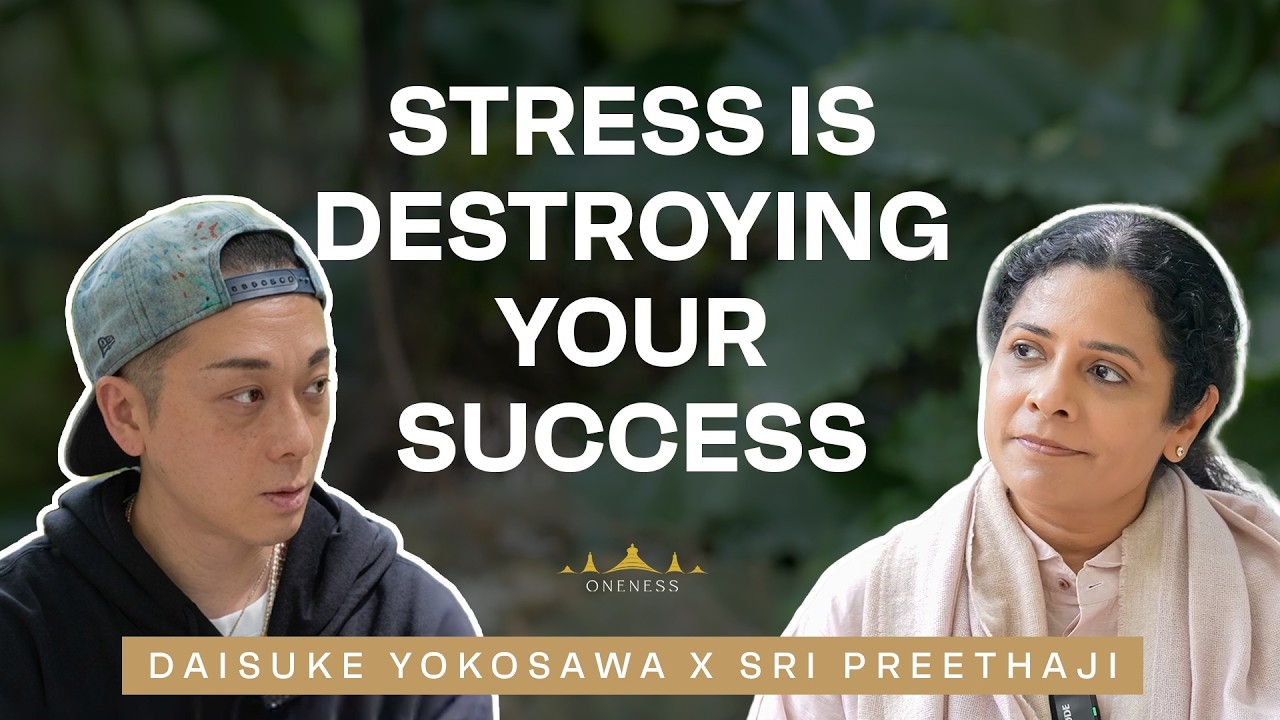
Sri Preethaji and Sri Krishnaji of the Oneness Movement teach that stress and struggle arise from disconnection within ourselves, and that dissolving these patterns—rather than fighting them—naturally opens access to calm, love, and genuine abundance. The work involves fundamental shifts in consciousness that move us from a state of overwhelm and resistance to one of flow and alignment with life's intelligence.
Most approaches to stress management focus on managing symptoms: meditation apps, breathing techniques, time management hacks. Yet people who practice these often still find stress returning. According to the Oneness Movement's teaching, this is because stress is not primarily a problem of external circumstances or even neural dysregulation—it is a signal of disconnection from our deeper self and from the intelligence that animates life itself.
Stress manifests as a sense of overwhelm, struggle, and the feeling that life is something we must fight against rather than flow with. This happens because we operate from a contracted state of consciousness in which we believe we alone are responsible for making things work. The weight of that belief creates the physiological and psychological stress response. As long as we remain identified with that limited sense of self, stress management techniques offer only temporary relief.
The Oneness Movement teaches that abundance is not primarily a material or external state. It is an inner condition that emerges when we align with the flow of life itself. Most people chase abundance through effort, struggle, and willpower—the very behaviors that create stress and contraction. This creates a paradox: the more we strain to achieve abundance, the further we move from the consciousness that actually attracts it.
True abundance arises when stress dissolves and we return to a state of natural ease. This is not passivity or giving up; rather, it is acting from alignment rather than from fear and desperation. When we are calm and centered, our decisions are clearer, our creativity flows, and we naturally attract opportunities and resources that match our peaceful, open state. Struggle-based effort repels these. Flow-based action attracts them.
Dissolving stress is not the same as managing it or suppressing it. The Oneness Movement distinguishes between fighting stress (which keeps us in resistance and contraction) and releasing it (which requires a fundamental shift in how we relate to ourselves and life). This shift happens in several interconnected ways.
First, there is the recognition that stress is not your enemy. Stress is feedback—it indicates where you are holding onto beliefs, resistance, or identities that no longer serve you. When you stop fighting stress and instead become curious about what it is trying to communicate, the grip it has on you weakens. This is not positive thinking or avoidance; it is a clear-eyed inquiry into what is actually happening inside you.
Second, dissolving stress requires reconnection to love. The Oneness Movement emphasizes that love is not sentiment or emotional warmth alone; it is the fundamental coherence of consciousness in which separation dissolves. When you operate from love rather than fear, stress cannot take the same form. Fear says, "I must protect myself and achieve security through control." Love says, "I am part of a whole that is intelligent and supportive." These are not compatible consciousness states. One generates stress; the other dissolves it.
The central teaching of the Oneness Movement is that the sense of separation—between self and other, between you and life, between your desires and the universe's capacity to fulfill them—is the root of suffering and stress. When you genuinely experience yourself as interconnected with all of life, the anxious sense of isolation and personal responsibility dissolves. You are no longer trying to control outcomes single-handedly; you are participating in an intelligence much larger than your individual mind.
This is not mystical bypassing or escapism. When you feel genuinely held by life, when you trust that there is an intelligence working through circumstances beyond your control, you naturally release the fight-or-flight nervous system activation that creates chronic stress. Your body-mind returns to its natural state of ease and receptivity. From this state, you are far more effective—not less—at navigating life and creating what matters to you.
There is a widespread belief that stress and struggle are necessary for achievement. Without pressure and anxiety, we assume nothing would get done. But neuroscience and the lived experience of high performers show the opposite. When you are calm, your prefrontal cortex (the part of the brain responsible for strategic thinking, creativity, and wise decision-making) is fully online. When you are stressed, this system is offline and you operate from fear-based reactivity, which is slow, repetitive, and often counterproductive.
The shift from struggle to flow means your actions arise from clarity and alignment rather than desperation. You move toward what you genuinely value rather than frantically away from what you fear. This quality of action attracts resources, collaborators, and opportunities that match its frequency. Desperate, fearful effort repels these; grounded, clear effort attracts them.
The Oneness Movement speaks of awakening love as central to dissolving stress and unlocking abundance. This is not sentimental love, but a fundamental quality of consciousness in which boundaries between self and other grow transparent. When love awakens, you stop experiencing others as obstacles or threats to your abundance. Instead, you recognize that genuine abundance includes others' wellbeing—that a rising tide lifts all boats.
This shift has profound practical effects. You stop operating from zero-sum thinking ("If they win, I lose"). You begin collaborating genuinely rather than competing from fear. You attract people who want to support your vision because they feel your care for them. You make decisions that honor both your needs and others' wellbeing, which creates sustainable success rather than the eventual collapse that comes from taking from others to feed yourself.
The teaching of the Oneness Movement is that stress, struggle, and scarcity are not fixed realities you must simply manage. They are symptoms of a particular consciousness—one based on separation, fear, and the belief that you alone are responsible for survival and success. Dissolving these symptoms requires a genuine shift in consciousness, not just better coping strategies.
If you find yourself caught in cycles of stress and struggle despite your best efforts to manage them, the invitation is to inquire more deeply: What would it feel like to trust life's intelligence? What would become possible if you moved from fear to love as your operating system? What abundance becomes accessible when you release the fight and return to flow? These questions cannot be answered intellectually; they require direct experience. For those drawn to this kind of inquiry, the Oneness Movement offers a path and a community of practice.