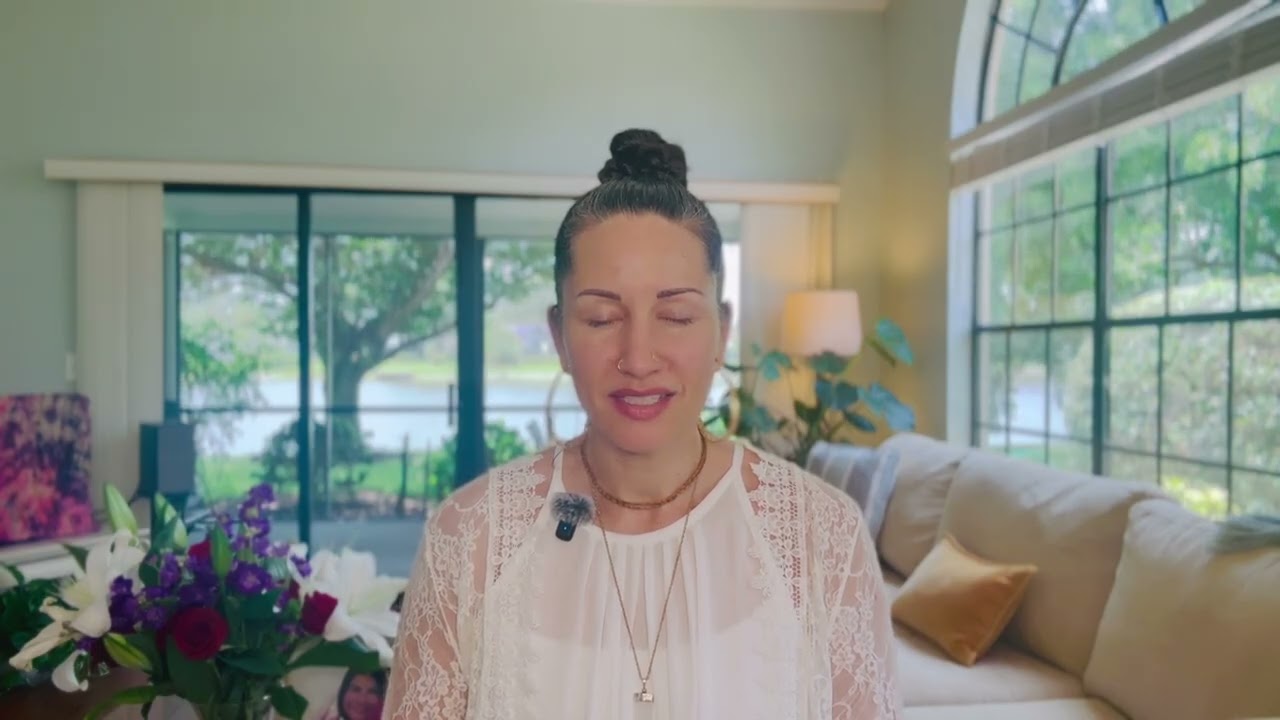
Start with the eyes. Close them gently, and let the lids go soft, the way a held note lets go of its tension once the breath behind it settles. That is where Carrie Suwal's short guided meditation on healthy eating begins, and it is a deliberate choice. Across roughly seven minutes, she asks the listener to release worry, soften each muscle, and breathe deeply into the belly before she ever mentions food. Then she makes a claim that quietly reorganizes the whole subject: what you put in your body is a statement about how much you believe you deserve care. Eating, in this reading, is less a matter of discipline than of self-regard.
Because the sequence is the argument. Suwal instructs the listener to let the softening of the eyes spread to "your whole body," then to release stress from the hands and arms, the shoulders and the neck. Only after that comes the line that frames everything else: "as you calm your mind, you calm your body first" (at 0:42). Most diet advice starts with a plan and asks you to hold yourself to it. This piece starts with a nervous system and asks it to settle. The implication is practical as much as spiritual. A tense, rushed person reaching for food is often reacting to tension, not to hunger, and a meditation that calms the body first is trying to interrupt that reflex before any eating decision gets made.
Notice too how the breath is handled. It is not a technique to be performed correctly. In the middle section she describes it as nourishment in its own right, "nourishing your body," "nourishing your mind," "nourishing your muscles and organs, also allowing them to relax" (around 4:00). The breath is set up as the first food of the session, one that needs no grocery list, which makes the later talk about eating feel like an extension of the same practice rather than a separate rulebook.
The meditation's central image arrives early, at 1:12: "Your body is your vessel. Inside of this vessel is who you are." She names that inner self as "your loving, kind, compassionate, beautiful soul," and then extends the metaphor: "this body is the house and the temple to that soul" (at 1:30). The language is religious in the broad sense, not in any doctrinal one. It treats the physical body not as a machine to be optimized or a figure to be corrected, but as the place where an inner nature becomes visible.
That framing does real work. If the body is a temple, then how you treat it becomes a form of devotion, and Suwal makes the link explicit: "To reflect your inner being, your inner nature outwardly" (at 1:53). She then ties this directly to food and movement: "how you treat your body by the foods that you eat, the exercises that you do, instantly impacts your inner state of wellness" (at 2:00). The word "instantly" is worth pausing on. She is describing a feedback loop in which the way you eat shapes your inner state, and your inner state shapes the way you eat, with no long delay between cause and effect.
This is the most concrete instruction in the meditation, and Suwal delivers it twice. The first version is a description of nourishment: "If you feed yourself healthy, nutrient rich foods only when you are hungry, giving your physical vessel what it needs" (at 2:18). The second is more pointed: "Feed yourself only when you are hungry and only what you need" (at 3:11). Hunger is treated as the signal, and the meditation's job is to ask the listener to respond to that signal rather than to boredom, anxiety, or habit.
There is a long tradition of this kind of attentiveness in contemplative eating practices, and what makes Suwal's version distinctive is its emotional vocabulary. She does not frame the rule as a penalty for breaking it. She frames it as care. "You are nurturing your soul. You are nurturing your mind. You are nurturing your emotions" (at 2:31). Eating only what the body needs becomes a way of saying yes to yourself, not a way of saying no to a craving.
"Feed yourself love. Feed yourself only when you are hungry and only what you need." (Carrie Suwal, guided meditation, April 2017, at about 3:06)
Here the meditation becomes sharper, and more morally loaded. Suwal says that eating unhealthy food to excess is "harming your inner being," and then goes further: it is "almost saying you are not worthy of loving compassion from yourself" (at 2:46). That is a strong claim. It locates the problem of overeating not in weakness or appetite but in a belief about one's own worth, and the fix is not stricter rules but a change in that belief.
The release that follows is one of the most physically specific moments in the recording. At 4:59 she asks the listener to "release any guilt or shame," telling them, "it is gone from your body," and then guides a series of exhales, "we'll do two more of those," to let it go. Whatever one makes of the metaphysics, the sequence has a logic. Guilt about eating tends to keep the cycle running: you overeat, feel shame, and the shame becomes a reason to restrict or to eat again. By inviting the listener to exhale that shame out before the eating question even comes up, the meditation tries to break the loop at its emotional root.
Suwal makes a claim here that will raise an eyebrow with some listeners: "What you ingest, there is an energy to that food" (at 3:23). She then draws a parallel that is either illuminating or overreaching depending on your starting point: "the more healthy, the more beautiful, the more nutritious your food is, the more healthy, the more beautiful, the more nutritious you are as a person" (at 3:32). Read literally, that is a direct equation between diet and character. Read as a meditation, it is an invitation to notice the quality of what you consume and to let that noticing become a form of self-respect.
It is worth separating those readings, because the meditation itself does not. The video offers no evidence for the energetic claim, and the leap from "nutritious food" to "more beautiful as a person" is a matter of belief rather than demonstration. A reader who wants to take the practice seriously can keep the part that holds up on its own terms, which is the attention: slowing down, eating when hungry, choosing food with some care, and not treating the plate as a verdict on who you are.
The meditation closes by returning to the eyes, the same organ it opened with, and asking the listener to look at themselves differently. "However you perceive yourself is the truth," Suwal says at 6:22. "So you view yourself with compassion and love. You see your beauty. Yes your physical beauty. But also the beauty of your heart" (at 6:29). She then widens the frame to the people and animals the listener cares for, and ends on the idea that the same care belongs to oneself: "You are worthy of nourishing that beautiful soul, by doing things that are healthy for you" (at 6:52).
That final move is the piece's real argument. The whole session has been building toward a single reversal. Healthy eating is not a set of restrictions imposed on an unworthy self. It is one of the ways a person who already deserves kindness shows that kindness. Whether or not you accept the energetic language, that reversal is the part most people struggling with food tend to find hardest and most necessary: the idea that the way you feed yourself is a measure of how you regard yourself, and that you can change the regard before you change the plate.
The video is short, and it rewards a second listen with the sequence in mind. Notice the order: the eyes, the shoulders, the breath, then food, then guilt, then self-regard. Try it once before a meal, not as a rule but as a pause. If the energetic claims about food are not persuasive to you, set them aside and keep the practical core: eat when hungry, eat what the body needs, and treat the guilt that often follows overeating as something to release rather than something to punish yourself with. Suwal's meditation is a seven-minute reminder that the body is where a person's inner life becomes visible, and that caring for it is one of the most direct ways to care for oneself.