In the shimmering heart of Africa, a musician found the rhythm his soul had been searching for. Jim Beckwith traveled to Ghana, West Africa, with his friend—a journey that would reshape not just his understanding of life, but the songs he would carry back home. What unfolded there was neither tourist spectacle nor casual adventure. It was a confrontation with mortality, nature, and the essential question of how to live.
Ghana held what Beckwith calls "the pulsating vibrancy" of existence itself. The coconut palms swayed in golden sunlight; the landscape breathed. But beneath the tropical serenity lay something more urgent. In Ghana, Beckwith witnessed what he describes as "the purest cycle of existence—birth followed by death." It was a simple truth that humans, he reflects, "often tried to adorn with layers of intellect."
The birds of Ghana taught him something the intellect could not. They moved through their lives unburdened by the recursive doubt that plagues human consciousness. "They never forget how to fly," Beckwith observes of these creatures. "Their flight, unaffected by the complexities of human life, was a poignant reminder of the natural order of things." Here was the seed of what would become "Fly Away"—not a song about escape, but about alignment with what is most natural, most true.
This wasn't a solitary meditation. Beckwith traveled with a friend whom he describes with evident affection as a brother, someone who brought him to this awakening. The intimacy of shared pilgrimage—two people witnessing the same landscape and arriving at different truths—is woven into the song's DNA. Companionship in seeking is part of the seeking itself.
Beckwith's teacher in spiritual matters was Sufi—rooted in the Islamic contemplative tradition that emphasizes ecstasy, dissolution of the self, and surrender as pathways to divine understanding. The Sufi concept of fana, the annihilation of ego, reverberates through "Fly Away." Surrender, in this lineage, is not resignation or defeat. It is the most radical act of freedom: releasing the grip of the mind's need to control, predict, and defend.
The song's subtitle—"surrender, follow your bliss"—echoes both Sufi teaching and Joseph Campbell's famous exhortation to follow one's bliss, the animating energy that pulls you toward your true path. For Beckwith, Ghana and Sufi practice converged on a single insight: the liberation that comes when you stop fighting the river and learn to float.
Yet Beckwith is not naive about this. The narrative he composed alongside the song acknowledges the tension: "Life, with its poetic symphony and inexplicable randomness, often left me tense. As if it was a mysterious song I was trying to decode, struggling to find the reason behind the rhyme." This is the honest part—the place where the spiritual seeker admits that understanding does not come easily, that the mind will tense against what it cannot grasp.
But tension itself becomes the teaching. The resolution is not intellectual. It arrives through a shift in orientation: "we are all but passengers on the grand ship of life, sailing a course charted by the cosmos. The key to enjoying this voyage was not in dissecting the details, but in enjoying our journey." This is the verse underneath the chorus. This is what "Fly Away" is singing.
When "Fly Away" found its way onto Beckwith's album Maybe Man, it carried all this weight—the dust of Ghana, the Sufi teacher's silence, the friend who became a mirror. But a song exists fully only when it is sung, when it moves from the private realm of composition into the shared space of performance.
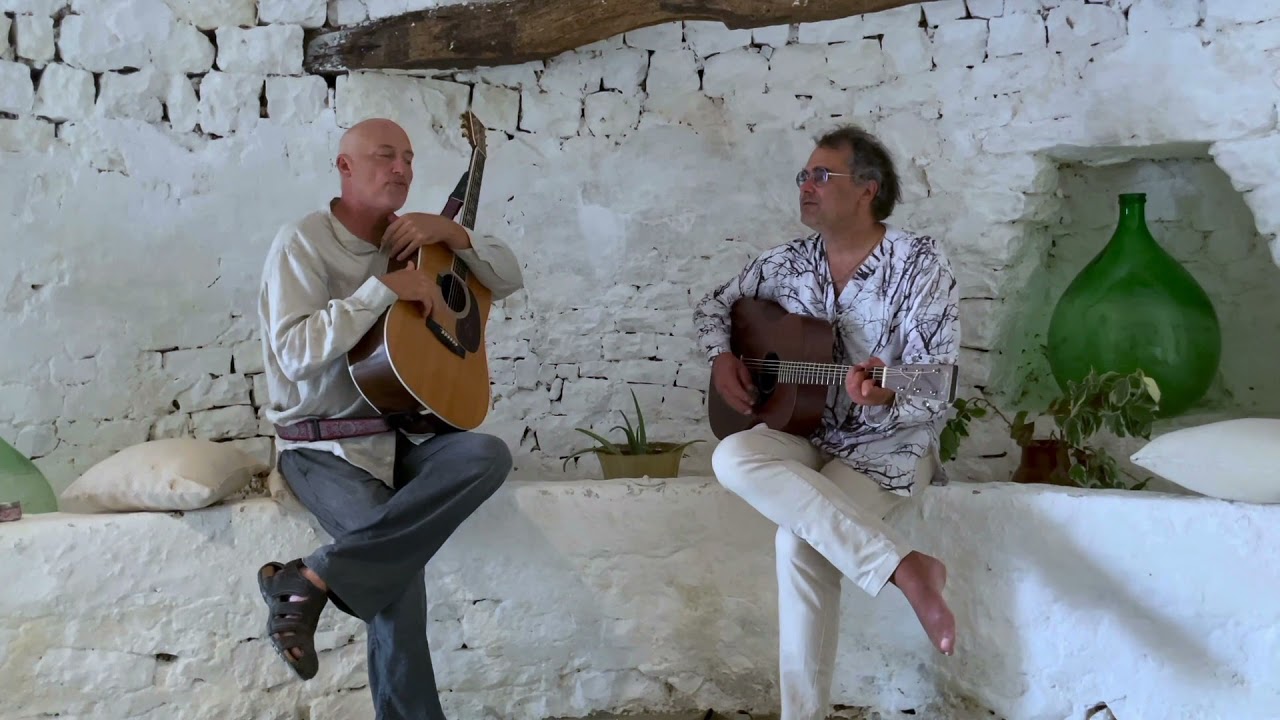
Around 2011, Beckwith performed "Fly Away" at a house concert in Boulder, Colorado. House concerts occupy a particular ecology in contemporary music—intimate, often low-stakes in appearance, but saturated with intention. They are the opposite of arena spectacle. In a living room, with an attentive group of listeners, the distance between artist and audience collapses. The cozy, laid-back atmosphere that Beckwith valued is not incidental to the music's power; it is essential. In such spaces, a song about surrender can be heard not as concept but as invitation, offered from one human to others in the room.
The Boulder performance was captured by Stephen Angus, who brought two cameras to navigate "a daunting low-light situation." The technical challenge—filming in dim ambient light, the way house concerts actually exist—became part of the document's authenticity. There is no spotlit stage here, no production gloss. What remains is Beckwith singing his song to people who came to listen.
To write a song about surrender requires a particular artistic discipline. It is tempting to make such a song sentimental, to soften it into something that feels safe. But Beckwith's "Fly Away" refuses that. It holds the reality that birds fly without thinking about it—without the existential weight that humans bring to every act. The song doesn't resolve that tension through false comfort. Instead, it invites the listener into the space where the tension exists and suggests that this very space is where freedom lives.
The title itself is economical. Not "Learn to Fly" or "Find Freedom" or any number of more prescriptive alternatives. Just "Fly Away"—a command and an invitation, simple as a bird leaving a branch at dawn.
For those drawn to "Fly Away," the invitation is to sit with the questions it raises rather than to seek quick answers. What does it mean to surrender? What are you holding onto through intellectual analysis that might dissolve if you simply let go? The song works not because it provides a map but because it names the territory—Ghana's golden light, the birds' natural wisdom, the friend beside you, the Sufi teacher's teaching of fana, the living room full of attentive faces. All of these are already part of your own journey. "Fly Away" simply reminds you that you are already flying.