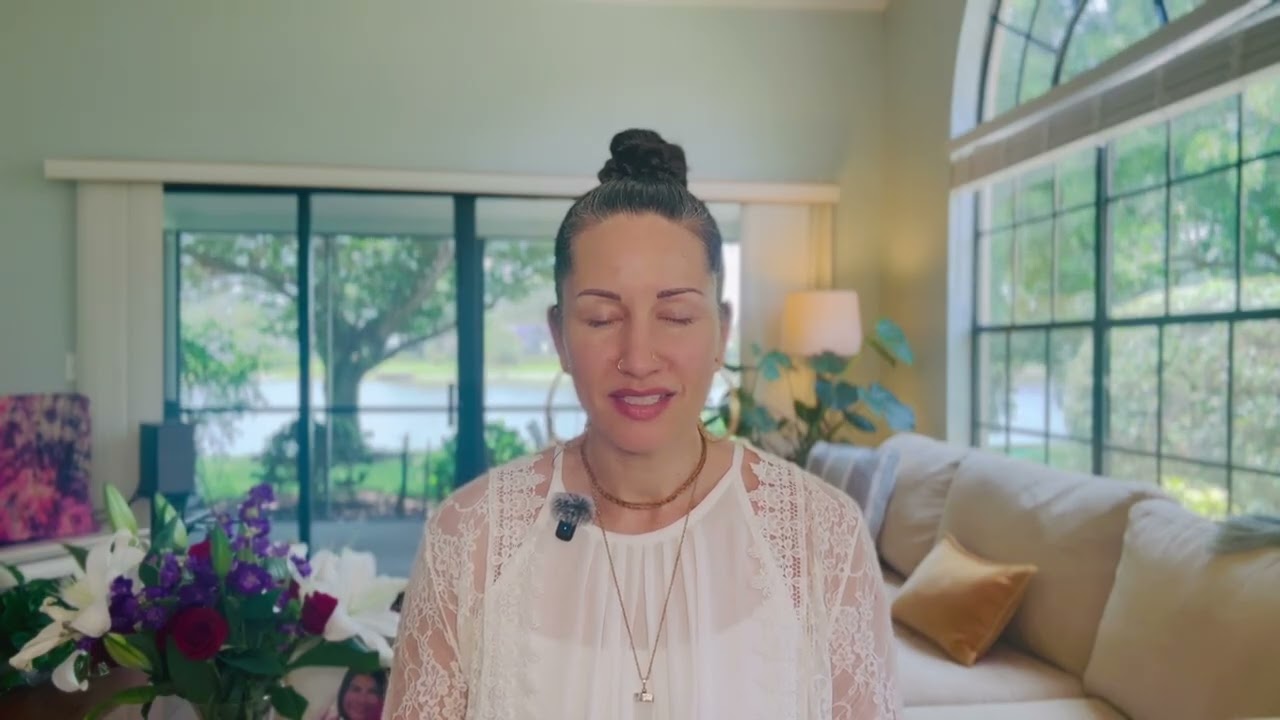
A thirteen-minute guided meditation asks you to do something most of us were never taught: stay with a hard feeling without trying to repair it. Justin Michael Williams builds the whole session around one permission, which he states in the video's YouTube description as "giving yourself permission just to FEEL your feelings, without needing to do anything about them, or push them down, or make them better." The practice moves through three layers, a physical settling, a counted breath, and a set of spoken phrases, and each one does a specific job. What follows walks through how the session is built, why its wording matters, and how you can borrow its structure when something heavy arrives.
The practice opens with a short framing and then asks you to find a comfortable seat, close your eyes if that feels right, and wrap your arms around yourself. There is no chant, no visualization of light, no instruction to become someone else. The first move is a hug. The meditation is clear that the point is not to achieve a state but to create what the speaker calls "a space just to feel it all the way in." That phrase, from the opening minute, is the thesis of the session: the feeling is allowed to be fully present, not managed.
At around the one-minute mark, Williams asks listeners to "reach your arms just around yourself and give yourself a hug, squeezing just gently on the sides of your arms or shoulders," and to "let this be relaxed and easy." It is an odd thing to start with if you expect meditation to be purely mental, but it makes sense for emotional work. Many people carry feelings in the body before they can name them: a tight chest, a jaw that will not release. A gentle squeeze gives the body something to hold while the mind catches up. Later in the session the speaker even invites a lighter touch, suggesting you "caress yourself a little bit with your fingers," which shifts the same idea from pressure toward tenderness.
The first breathing section, starting around 1:25, uses a steady four-count pattern: inhale for four, hold for four, exhale for four, hold for four, repeated several times with the speaker counting aloud. The counting does two things. It gives a restless mind a task, and it slows the breath to a regular rhythm that is easy to follow even if you have never meditated before, which the description says the practice is designed for. After several rounds the instruction becomes simply "just breathe normally," and the session turns from effort to observation.
A second breathing section, beginning around 8:33, changes the ratio. Here you inhale for four and exhale for six. The speaker introduces it directly: "let's do a breathing practice together to help regulate the nervous system." The video does not go into the physiology, so treat that as the teacher's framing rather than a clinical claim. Practically, though, a longer exhale than inhale is one of the most widely used ways people settle themselves, and the meditation places it at the moment just before the emotional phrases begin, when the reader is most likely to feel something rising.
The central metaphor arrives around the three-and-a-half-minute mark: "emotions are like your internal weather and so there's no point in standing outside and yelling at the rain when a storm comes. We let it pass through." This is the most useful idea in the session. Most of our suffering around a feeling is not the feeling itself but the resistance to it, the second layer of judgment that says this should not be happening. Weather does not need your permission to arrive, and it does not need your fixing to leave. Standing in the rain and objecting to it does not make it stop; it only adds a second kind of exhaustion.
Near the end, the meditation adds a distinction that deepens the metaphor: "you are not these emotions. They are passing through you just like the weather, and you can weather any storm." This moves the listener from being the feeling to being the one who notices it. It is not a request to detach coldly. It is a reminder that the self doing the feeling is larger than any single wave of it.
The longest stretch of the meditation is a sequence of short sentences, "it's okay to feel this way," repeated with pauses and music between them, sometimes for minutes at a time. Repetition is the mechanism. Repeated permission slowly stops feeling like a claim you have to earn. The speaker says "let the emotions arise" and then keeps returning to the same line, so that the phrase becomes a steady background rather than a demand.
Around the eight-minute mark, the instruction changes from listening to speaking: "now begin to tell yourself these words." Hearing a permission from a guide is one thing; saying it to yourself is a different act, and the meditation treats the shift as deliberate. The sequence then moves to hands over the heart, where the phrases become more personal: "I am safe in here. I am allowed to feel." The words are not affirmations you must believe on cue. They are a way of telling the body that the current feeling has a place to be.
- "It's okay to feel this way," repeated as the core permission.
- "Tell it to yourself," the move from hearing the words to speaking them.
- "I am safe in here. I am allowed to feel," spoken with a hand on the heart.
- "You are allowed to feel," a closing reminder in the second person.
Near the end the speaker says, "Feeling the hard stuff is a gift to yourself. It's like a cleansing." What makes this more than a platitude is the honest account that comes with it. The meditation acknowledges that "so much of the tension that we feel in our lives is from pushing our emotions down," and that "sometimes we have to push things down just to function or just to get through our day." The teacher does not condemn suppression. He describes it as a tool that has a cost when it becomes a default. The gift is not the feeling itself but the space to let it move through without immediately fixing it.
You do not need the full session to borrow its logic. When a hard emotion shows up, you can move through a shorter version of the same shape:
- Name the feeling, or simply notice that something is weather-like in your body.
- Settle physically, with a hand on your arm, your shoulder, or your heart.
- Breathe with a longer exhale than inhale for a few rounds.
- Say the permission silently or aloud: it's okay to feel this way.
- Remind yourself that you are not the feeling, only the one noticing it passing.
These steps are adapted from the meditation's structure rather than spoken verbatim in it. If a feeling keeps returning, grows heavier, or interferes with daily life, the video does not replace support from a qualified professional, and it does not claim to.
Start with the full recording once, in a quiet place, with headphones if you can, and let the self-hug and the first breathing round be your entry point. On a second listen, notice where your attention goes during the repeated phrases; the places it resists are often where the practice is working. You can pair the session with a few minutes of writing afterward, naming what came up in plain words. The meditation is short, free, and built for beginners, and its main lesson is easy to state and hard to practice: a feeling does not need to be solved before it is allowed to be felt.