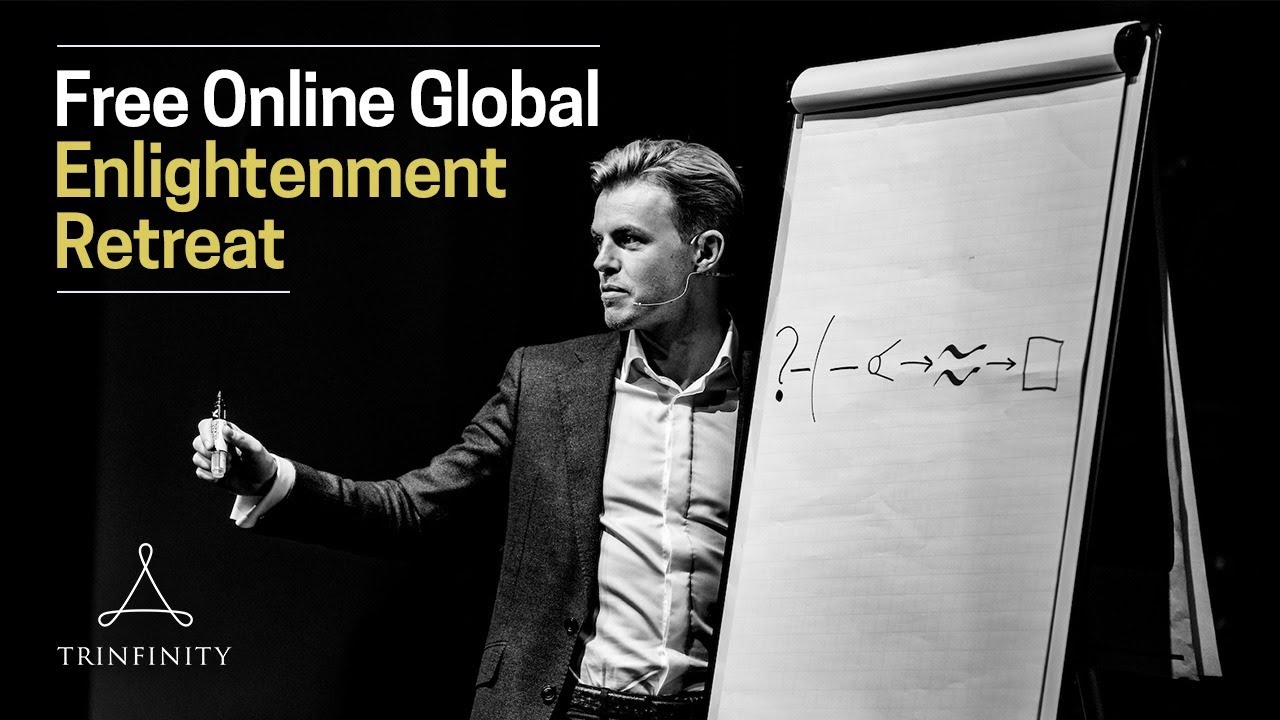
In this thirteen-minute teaching, Bentinho Massaro makes a claim that sounds almost reckless in a culture built on self-improvement: the constant urge to change and fix yourself is the very thing keeping you from your natural state of pure Awareness. His proposed remedy is not more discipline. It is a shift in perception, in which the body, the painful memory, and the anxious presentation next week are recognized as thoughts appearing inside Awareness rather than solid objects waiting out there to be managed. He describes this as the most irresponsible state a human can enter, and argues it is also the fastest route to real responsibility. What follows is an unpacking of that idea, the reasoning he gives for it, and the practice he offers for anyone willing to try it.
Whathappenswhenyoustubyourtoeonarock?
Massaro's favorite test case is the most ordinary injury imaginable. You walk into a rock. Your toe throbs, and within a second a whole chain of reactions begins. In his words, the mind goes straight to the verdict: "this rock is real, and that hurts, and I don't like it," followed by the plan, the vigilance, the resolution to move the rock or avoid it next time. Ask most people what that moment is, and they will describe a problem to be solved.
He asks a different question. What if, when you hit that rock, you stayed in unchanging Awareness, an uninvolved state? He is candid that this sounds strange. He calls it "the absolutely irresponsible state," and then immediately qualifies it: "don't worry, you'll be more responsible than you ever were before." The paradox is the point of the teaching, and it deserves to be taken seriously rather than softened into a platitude.
Whydoesreversingyourperceptionchangeeverything?
The core of the argument is a reversal of the usual picture. Most of us assume that the world is out there, solid and real, and that we are a body moving through it. Massaro says this assumption is "first of all, a mistake in perception." His alternative is spatial and specific: "Your body exists inside of your soul Awareness, your soul doesn't exist inside of your body." Awareness, in his description, is a sphere-like container, the space that witnesses the physical body, the mind, and everything that appears in them.
Once you see from that vantage, he says, you are already "looking from the outside in." The difficulty begins when people reverse this, treating the world as the container and themselves as a small object inside it. Then, as he puts it, "it becomes difficult to really rest with them," and the nervous system stays in a loop of acquiring, avoiding, rejecting, or fixing.
He also points to a practical consequence. Relief, in this framing, does not come from managing the object better. It comes from changing the perception, which he describes as "allowing it to be changed." He is explicit that you are not doing the work of liberation: "You're not doing anything. You're just allowing it to be changed in your perception. And voila!" He lists what tends to follow: the problem feels different, the energy flows, and you feel "present, grounded, skillful, wise, perfect timing," knowing what to do without strain.
Canyoubeirresponsibleandstillberesponsible?
This is the question the talk keeps circling, and Massaro's answer rests on a distinction between owning something and being identified with it. He says: "Yes, you gotta own it, but the best way to own it is to disown it; to de-identify from it, to see it's not what you are. Only then can you play with it. Only then can you let it go and flow and transform."
He illustrates this with a comparison to romantic love, and it is worth reading closely. "Only if you allow for that freedom, can there be love. But if you're attached to it, you're in it." Attachment, in his account, distorts every move. Each thing the other person does becomes a threat or a wound aimed at you. "You cannot love something you're attached to or identified with, ever." He calls this "natural metaphysics; it's a law."
The same logic applies, he says, to the components of your life. You cannot take true ownership, in integrity, of your circumstances while you are tangled up in them and believing you are tied to them. Ownership requires enough distance to see clearly what you are dealing with.
Whycan'tyouchangeathingyou'reinsideof?
Massaro's most vivid image for this is a balloon. The sense of self, with its worries and responsibilities, is like air compressed into a tight little bubble. When you are inside that bubble, every problem feels enormous and every fix feels urgent. Then, in his telling, you pop it: "The air in the balloon was here, compressed, tight, dense, little bubble. You pop the balloon, that sense of responsibility disappeared, and now you had the whole overview."
"You can't change a thing that you're in. Yes, you gotta own it, but the best way to own it is to disown it." (about 5:24)
— Bentinho Massaro, in the video
From that wider space, he says, you can handle even the prickly parts of life. "From that well-being, you had no problem caressing the cactus." The bubble version of you asks how it will own a painful part of life and how it will change that part. The version that has popped the balloon simply becomes the whole and rests in a natural state. Later in the talk he pushes the metaphor further, urging the listener to "be your own cactus" and to "become part of the air," blowing freely with the wind rather than steering the balloon.
Howdoyouusethe"it'sjustathought"practice?
The talk's most usable material is the exercise. Take something you haven't forgiven, something you are struggling with, or something you are preparing for. Massaro's example is "some important presentation next week that will determine a lot of things in your life, or so you believe." The mind labels it as real, something to plan for at all costs. The mind's internal reasoning typically sounds like this: I can rest in pure Awareness while reading my book, but this presentation is real, it matters, and it will feed my family.
His instruction is to reframe it deliberately: "simply call the whole thing, 'This is nothing but another thought appearing on the screen of my Awareness.'" He anticipates the objection, and his answer is gentle. "You don't have to believe it. Don't try to believe it. If you don't believe it, that's fine. But still define it in that way, pretend for a moment, as an imaginal exercise."
The logic is that it is easier to rest with a thought than with a reality. He sets up a pair of labels, calling the presentation "reality B" and calling it a thought like any other, "thought B." Thoughts are easier to witness because we have less investment in them. The practice is to settle at the root of the thought, not engage it, not add a new story to it, and witness it in the present. He is explicit that you should not try to resolve it: "Don't engage. Just witness. Settle down in the present. Don't change anything about it."
He also warns against turning anything into a meaningful project. The mind is very good at spinning a neutral event into a narrative of significance. The practice invites you to rest in what he calls "the absolute, utter absence of meaning-giving," which he presents as the ground where stability is found.
Whatdoesitfeellikewhentheswitchflips?
Massaro describes the moment as a "little flip in your mind," a switch you can find and turn. He says that when it happens you will notice "an immediate non-story, non-dual feel of perfection." For some people, he suggests, this can feel like "an uncontainable desire to shout off the rooftops that everything's been perfect all along." For others, it is quieter: "a subtle sense of ease, like a soothing background stream." Near the end, he describes the result as a feeling of trust and confidence, with a sense of "the stability of the Earth in your back."
These are descriptions, not guarantees, and the speaker himself frames them as things that deepen over time. It is worth holding them lightly. The honest test is simpler: do you find yourself, even briefly, unhooked from the urge to fix?
Wheretogofromhere
If the talk has caught your attention, the most useful next step is to try the exercise on something small before attempting anything heavy. Notice the next time you stub a toe, get irritated in traffic, or dread a conversation. Name the experience as a thought appearing in Awareness, without believing the label, and see whether the urgency to fix it softens even slightly. Then watch the video again, paying attention to the moments where Massaro repeats the central idea, since those are the places where his emphasis is clearest. Treat the teaching as a set of hypotheses to test in your own life rather than conclusions to accept on authority. That, perhaps, is the most faithful response to a talk that asks you to stop changing things and see what happens.
Comments
Loading the conversation…
Transcript
[0:00] Remember yourself. By letting it all be equal
and even; by not engaging any further in the
[0:09] energy of changing and altering and fixing;
by letting go that whole responsibility that
[0:14] you have to fix and change yourself all the
time, you will most rapidly change yourself.
[0:28] The moment that we think that something is real,
[0:32] the moment we think it is real, we can't
detach from it. We can't look at it
[0:38] objectively anymore. We can't relax with it, we
can't accept it. We have to either acquire it,
[0:43] or we have to avoid it or reject it, or we have to
fix it. So anything in your life that you assume
[0:48] is solid and real and really, really out there,
as if it exists outside of your perception...
[0:56] First of all, it's a mistake in perception,
because that's not what's actually going on.
[1:00] All things are happening inside of your
soul, inside of your Awareness. Your body
[1:05] exists inside of your soul Awareness, your soul
doesn't exist inside of your body. Your Awareness
[1:11] doesn't exist inside of your body. Your soul
Awareness is the sphere-like container—it's
[1:18] the space—which right now witnesses your physical
body. You are that soul consciousness observing
[1:25] your mind and your body. You're looking
from the outside in already, you see?
[1:33] And the moment that you reverse that, which
most people have, where you think things are
[1:38] outside of yourself and they're real, now it
becomes difficult to really rest with them,
[1:43] to really just settle into instant purity, instant
freedom, instant not changing anything about it;
[1:50] just letting it liberate itself through
your change in perception. That's all.
[1:54] You're not doing anything. You're just allowing
it to be changed in your perception. And voila!
[1:59] The whole thing feels different. The
problem is gone. The light is there.
[2:04] The energy flows. You feel happy, you feel
good, you feel wise; not just happy-go-lucky,
[2:09] like hippie... No. Present, grounded, skillful,
wise, perfect timing. Knowing exactly what to do,
[2:16] how to do, when to do it, even though you
feel like you're not doing a single thing.
[2:20] You're just enjoying the life-stream of
God itself, by not changing anything.
[2:25] The moment you try to change it—again, remember,
the moment you try to enter your perception,
[2:29] enter your world, enter this canvas, enter your
painting, and try to change something about it—you
[2:34] are exiting your enlightened state every time
you do that. YOU do that. You are enlightened,
[2:38] by nature. You're not ever going
to get there with your non-nature.
[2:45] You have to eliminate your assumptions.
Settle down. Allow God to enlighten
[2:53] you. Don't try it yourself. It's a
painful, long-ass journey. Don't do it.
[3:01] Another tool that can kind of help you
with this—to just settle into this natural,
[3:05] liberated state... If you
see everything as a thought,
[3:09] it's easier. Even if you don't believe
it yet, that's okay. I'm telling you,
[3:13] it is a thought. Everything is a thought. There
is no actual matter at the end of the day.
[3:18] In the final analysis, seeing through the whole
illusion, it is truly realizing—and you can come
[3:25] to this, naturally, over time, and it will deepen,
and it will deepen, and it will deepen—that
[3:32] what appear to be things, material things,
the laws of physics, the objects in the room,
[3:37] your body, the chemical reactions. These
are a type of thought, in the sense that
[3:45] they exist as thought forms, as intentions,
as ideas, within the supreme intelligence of
[3:54] Intelligence itself, Consciousness; the
one Infinite Creator, awake to itself.
[4:00] You don't have to believe this. I know it doesn't
feel like that when you bump your toe into a rock.
[4:05] It feels like, "Fuck, this rock is real, and
that hurts, and I don't like it. And I gotta be
[4:11] more careful about this physical rock next time. I
gotta devise a plan about this rock. I'm going to
[4:17] have to move this rock soon, make sure it doesn't
happen again." And you get into that focal mind.
[4:23] What if, when you hit that rock, you
maintained the unchanging Awareness;
[4:30] the uninvolved state; the absolutely
irresponsible state? And don't worry,
[4:38] you'll be more responsible than you ever
were before. Your integrity is going to be
[4:44] optimized. But it is like the most irresponsible
state ever, at least in human definitions,
[4:51] because you give up all of it. You give up
ownership, fixing, changing... all of it.
[5:01] And you almost feel bad about how good it feels
to be absolutely irresponsible. But it feels so
[5:09] good and true, that you can't question it;
that you're like, "Holy crap! This is it. I
[5:19] just gotta stop changing things." And then
you will change things. That will happen,
[5:24] you see? Faster than before, because you're not
in it. You can't change a thing that you're in.
[5:29] Yes, you gotta own it, but the best way to own
it is to disown it; to de-identify from it,
[5:34] to see it's not what you are. Only then
can you play with it. Only then can you
[5:38] let it go and flow and transform. Just like a
relationship: Only if you allow for that freedom,
[5:45] can there be love. But if you're attached to
it, you're in it. How can you love something
[5:50] that you're in, that you're dependent on, that
you're tied to? That if they do this, oh my god,
[5:54] they're doing it to you too. And if they do
that, oh my god, they're doing it to you too.
[6:00] In the freedom, there can be love. You
cannot love something you're attached
[6:03] to or identified with, ever.
It's just natural metaphysics;
[6:08] it's a law. Similarly, you cannot change
or take true ownership, in integrity,
[6:16] about the components of your life by trying to
fix them, and believing that you're tied to them.
[6:22] Your well-being needs to be taken away from
that whole thing, like air out of a balloon:
[6:28] pop! Back in the whole space. It was in here. The
air in the balloon was here, compressed, tight,
[6:34] dense, little bubble. You pop the balloon, that
sense of responsibility disappeared, and now you
[6:41] had the whole overview. And from that well-being,
you had no problem caressing the cactus.
[6:47] But as the balloon, "Oh, my god. How am I gonna
own this part of my life? How am I gonna change
[6:52] that?" So you become the whole, by simply
resting in a natural state, without opinion,
[7:01] without anticipation, and by seeing everything as
a thought, even if you don't believe in it yet.
[7:09] That means, take the thing that you have
trouble with, like something that you haven't
[7:14] forgiven yet, or gotten past, or that you're
struggling with, or you're preparing for it:
[7:18] some important presentation next week that
will determine a lot of things in your life,
[7:22] or so you believe. Something with a lot of charge
or tension, that you know you've identified that,
[7:29] you've defined that, as a real thing: that real
rock that's over there, that you, as a real body,
[7:35] need to be really aware of, careful for, plan
for, avoid, reject or acquire, at all costs.
[7:42] Might not be that extreme, but take something
in your life, some component, some idea,
[7:46] some relationship, some opportunity that resembles
that state of charge, that state of "Okay, this is
[7:53] real. Sure, when I'm reading my book, I can stop
for a minute and not want anything from anything,
[7:59] and not fix even a single thought, and therefore
awaken to the natural state of pure Awareness,
[8:05] naturally. I can do that, but I have this
presentation coming up, and I'm getting nervous
[8:12] for it, and it's important for me, and it's going
to feed me and my family. And it's a real thing."
[8:17] Try, in that situation, to redefine that,
reframe that for yourself, and simply call
[8:24] the whole thing, "This is nothing but another
thought appearing on the screen of my Awareness."
[8:33] You don't have to believe it. Don't try
to believe it. If you don't believe it,
[8:37] that's fine. But still define it in that way,
pretend for a moment, as an imaginal exercise,
[8:45] that this serious event in your life is nothing
but another thought appearing in your Awareness.
[8:55] Because if you can rest with a thought of this
nature, that means you can rest with a thought.
[9:02] You can settle down at the root of the thought and
not care about it. Just let that natural presence
[9:07] shine forth. If you've demonstrated to yourself
that you can do that with thought A, then there
[9:13] is no reason you can't do it with thought B.
But it's more difficult to do it with reality B.
[9:20] Okay, so don't project reality B. Say,
[9:23] "This reality B is actually nothing but... it's
just like thought A. So let's call it thought B.
[9:30] And hey, look, there's thought C, trying to worry
about whether it believes this exercise or not."
[9:36] Don't engage. Just witness. Settle down in
the present. Don't change anything about
[9:46] anything—including the activity of changing,
the habit of changing—and that wheel will
[9:52] unwind. But it doesn't have to. That's the
beauty of this. It's instant liberation.
[9:56] When you get this paradox, when you
get this little shift, and it's like a
[10:00] little flip in your mind. When you find
this flip...this switch...and you flip it.
[10:07] When you find this flip. When you
find this switch and you flip it,
[10:12] you will notice an immediate non-story,
non-dual, feel of perfection.
[10:23] It might be subtle, and for some it might
be radical, like an explosion of bliss,
[10:29] like an uncontainable desire to shout off the
rooftops that everything's been perfect all along,
[10:33] and you never knew, and nobody ever
knows, and they should pay attention.
[10:37] Or it can just be a subtle sense of ease,
like a soothing background stream starts to
[10:42] trickle into your spine, and it's like, "Wait
a second... This feels nice. You mean, I'm not
[10:48] responsible for that thought form?" Absolutely
you're not. "But what about...?" What about?
[11:01] I dare you to just rest with all these
thoughts, and to not turn them into new
[11:06] meaningful projects. Don't turn anything you see
into a meaningful project, and you're going to
[11:13] find the deepest meaning you've ever found
in not attributing any meaning to anything,
[11:17] which you've only done out of personalized fear,
because you thought you were air caught up in a
[11:21] balloon, and you feared the cactus that was
approaching. So you tried with all your might
[11:25] to steer the air inside of this balloon in such
a direction that it would play with the wind
[11:29] of the external forces, so that ultimately,
when your time comes, it avoids this cactus.
[11:35] Be your own cactus. Pop the balloon, now. Become
part of the air, and as the wind, just blow right
[11:44] through the cactus. It doesn't matter. You will
find the deepest sense of well-being, which I
[11:50] would say is meaningful, that you've ever found
in the absolute, utter absence of meaning-giving.
[11:57] If you can do that for two to five seconds,
then you can do it for 20 to 50. When you
[12:00] can do it for 20 to 50, you don't need to
do it for longer because you are awake.
[12:07] That's how simple, how direct it is.
This realization will deepen in you.
[12:16] So it can be a soothing sense of
ease and trust and confidence,
[12:19] almost like you're laying down on this
mountainous terrain that's just super stable,
[12:24] and you can feel that stability of the Earth
in your back. It can be a simple relaxation,
[12:33] or it can be a radical explosion of bliss,
where you want to shout it off to rooftops
[12:38] and let everyone know that this is the thing
that everyone's been looking for. And it's
[12:43] right here staring you in the eyes, plain
sight. It's your own undiluted Awareness.
Amsterdam-born spiritual teacher who blends Advaita-Vedanta, Dzogchen Buddhism, and modern spirituality into a non-dogmatic path that helps people realize they are the One Infinite…
He means that the constant urge to change and fix yourself keeps you from your natural state of pure Awareness. In his view, the moment you try to alter your experience, you step out of that state, so the shift comes from a change in perception rather than from effort. He says you will 'change yourself most rapidly' once you let go of the responsibility to fix yourself all the time.
Take a charged situation, such as an important presentation or something you have not forgiven, and mentally label it as 'nothing but another thought appearing on the screen of my Awareness.' Massaro says you don't have to believe the label; you can simply pretend for a moment as an imaginal exercise. The aim is to rest with the thought without engaging it, adding a story, or trying to resolve it.
Massaro does describe the perceived world as illusory and says that material things exist as thought forms within Consciousness. He acknowledges this is hard to accept when you stub your toe on a rock. He frames it as something to deepen over time and explicitly says you do not have to believe it yet.
Massaro argues that the best way to own something is to disown it, meaning to de-identify from it and see that it is not what you are. From that distance you can play with the situation, let it go, and transform it. Ownership driven by attachment, by contrast, keeps you tangled up and reactive.
He argues that love requires freedom: you cannot love something you are attached to or dependent on, because every action by the other person feels like it is aimed at you. He says you cannot love what you are identified with, and he calls this a law of natural metaphysics. He applies the same reasoning to how you relate to the circumstances of your life.
The balloon represents the sense of self, with its worries and responsibilities, compressed into a tight bubble. Popping it releases the air into the whole space, which gives you an overview and removes the sense that you must fix everything. From that wider space, he says, you can handle even painful parts of life, like caressing a cactus.
According to Massaro, it looks like witnessing a moment, such as bumping into a rock, without launching into a plan to fix or avoid it. It also looks like not turning neutral events into meaningful projects. The result he describes is a subtle sense of ease and trust, though he frames these as experiences that deepen over time.