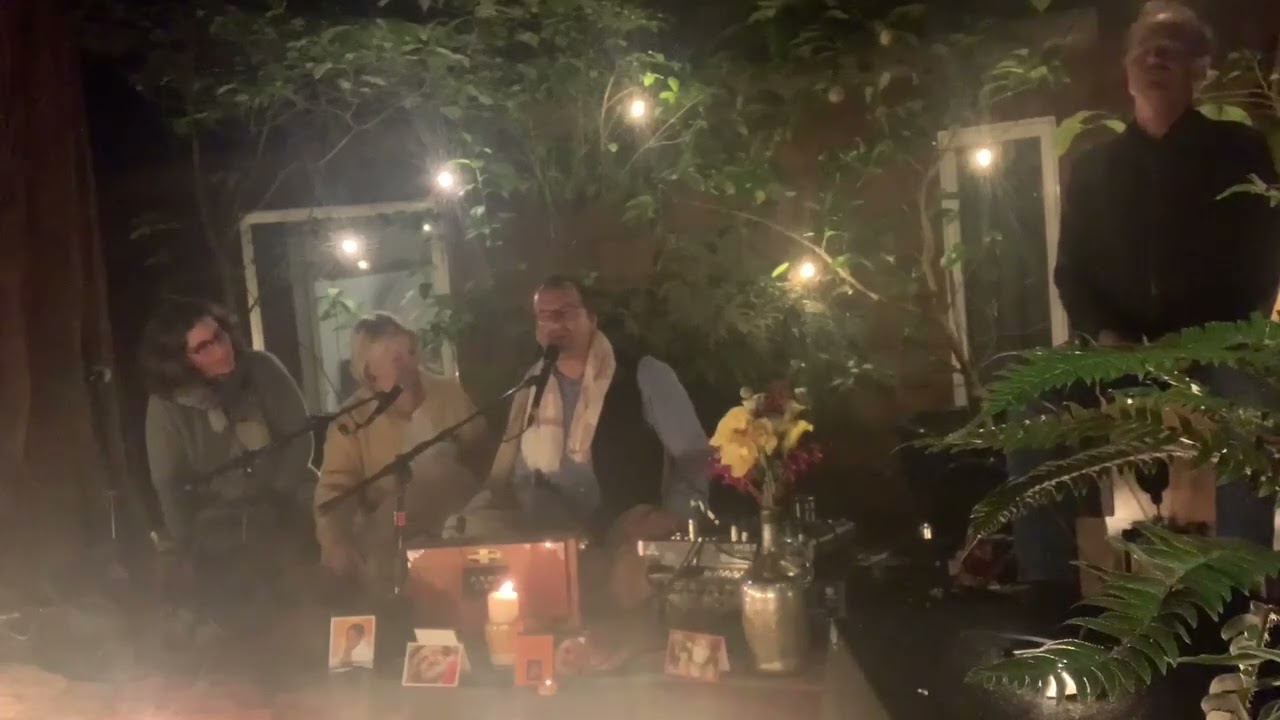
Asato Ma, often called the Peace Mantra, is an ancient Sanskrit prayer to be led out of untruth, darkness, and death and into Truth, Light, and immortality, closing with a threefold invocation of peace. The kirtan duo Rob and Melissa recorded their version on the riverbank where, as they tell it, the melody first arrived: a sunrise sadhana of meditation and chant on the banks of the Ganga near Rishikesh in northern India. What began as a small, unplanned morning practice became the opening chant of a new series of singles, and the story of how it got there says as much about the mantra as the words do.
The camera was not supposed to be running. The light comes up slowly over the water, the group sits together on the sand, and the first phrases rise in the open air with no studio around them. The duo has been clear that this was never meant as a production. A visitor who had joined them that morning took some video and a few photos, and the footage that resulted is a glimpse of an ordinary practice rather than a staged performance. That unguarded quality is part of why the recording works, and it is a useful lens for understanding the chant itself: Asato Ma was built to be sung by people sitting together at dawn, not performed for someone watching from a distance.
According to the description accompanying the video, the melody of the chant first came through on the morning of the filming. The duo describes the moment in the language of reception rather than composition, saying the mantra may have been "downloaded" by the ancient yogis and rishis in the same region. That phrasing matters. In much of the devotional music tradition, a melody is not something a singer invents from scratch; it arrives, often during practice, and the musician's job is to receive it cleanly and pass it on without distorting it.
Whether you take that literally or as a poetic description of creative openness, the practical lesson holds. Kirtan, the call-and-response chanting tradition that Rob and Melissa work in, rests on repetition. A melody that comes through during meditation is usually simple enough for a room of people to learn by ear within a few cycles, and simple enough to hold steady for many minutes. The melody for Asato Ma reflects that logic. It is meant to be carried by voices, not just admired on a recording.
The setting also explains why the melody felt like a gift. The duo ties the moment to a morning when they had met a new friend who asked to join their sunrise practice. "Little did we know how special this moment, this connection, and the incredible sunrise would be," the description reads. The melody did not require a plan, a rehearsal, or a microphone. It required a group willing to sit still while the sun came up.
The mantra is short, but its structure is precise. It has three movements, each one a pair of opposites, and each one asks to be moved from the first state to the second. The translation given in the video's description reads:
Lead us from untruth to Truth
From darkness to Light
From death to Immortality
Om Peace Peace Om— as rendered in the video description by Rob and Melissa
The original Sanskrit follows the same shape. Asato ma sadgamaya asks to be led from the unreal to the real. Tamaso ma jyotir gamaya asks to be led from darkness to light. Mrityor ma amritam gamaya asks to be led from death to the deathless. Each line begins with the same request, a plea for guidance, and each one names the place the singer is starting from and the place they hope to arrive.
That repeated "lead us" is the emotional engine of the chant. It does not say "we are enlightened" or "we have arrived." It admits a gap between where we are and where we want to be, and it asks for help crossing it. For a practitioner, this is an honest starting point. It places the singer in the position of someone who needs guidance, which is the posture most meditation traditions encourage before any real inward change can begin.
The three pairs also move from the abstract toward the existential. Untruth and truth concern how we perceive. Darkness and light concern what we can see. Death and immortality concern what we fear most. Sung in sequence, the mantra travels from the mind, to the senses, to the deepest question of existence, and that arc is part of why it feels complete in the space of a single breath cycle.
The closing line of the Sanskrit is "Om Shanti Shanti Om," and the repetition is not decorative. Shanti means peace, and here the word is invoked three times before the mantra closes with Om at both ends. The English rendering in the video, "Om Peace Peace Om," keeps that structure. The chant does not stop at its request for guidance. It finishes by asking for peace, and then it asks for it again, and again, before it lets the sound return to Om.
Singing a closing phrase three times is a common device in group chant, and the logic is practical. The first repetition lets the room settle into the pitch. The second deepens the sound as more voices find it. The third is where a group usually stops thinking about the words and simply hears them. By the end of a well-sung Asato Ma, the lyrics are no longer being translated in the mind; they are being felt in the chest and in the room.
For someone listening to the recording rather than singing it, the threefold Shanti works differently. It gives a clear shape to the close of each cycle, a point where the listener can exhale and let the sound resolve. That is one reason the mantra suits repeated listening as well as group practice.
The duo describes the morning as a sadhana, a word for a regular spiritual practice, combining meditation and kirtan on the beach. The practice itself was not new to them. What was new was the arrival of a stranger who wanted to join, and the fact that she filmed part of it without anyone having prepared for a shoot. The result, the description says, "is a real and honest moment - a glimpse into our practice."
There is something instructive in that choice to leave the imperfect footage in place. Much devotional music online is polished until it no longer resembles the room where it was sung. Here the wind, the water, the ordinary handling of an unplanned moment are part of the record. For a listener drawn to the chant, that honesty makes the mantra's promise feel closer. The text asks to be led out of darkness; the setting is literally the hour when darkness gives way to light.
The description also notes that the participants of the duo's 2019 India retreat arrived that afternoon, and that Asato Ma became the theme of their time together. A chant that surfaced on one morning, in one place, became a shared focus for a group of people who had come a long way to practice. Mantras often work this way. They begin as a private discovery and become a common thread once others hear them and begin to sing them back.
The video introduces "Asato Ma" as the first chant in a series of new singles the duo is calling "The Stay hOMe Sessions," made in collaboration with Ben Leinbach. The series title plays on the word home, and the chant itself is about being led from a restless, divided state toward something steadier. Opening the series with a mantra about guidance and peace, recorded in a moment that began with a gift, gives the sessions a clear emotional thread.
The release also makes a larger point about how sacred music moves between place and listener. A melody that arrived on a riverbank in northern India is now a recording that a person might play in a kitchen, on a commute, or during their own morning sit. The description asks viewers to subscribe and stay tuned for the next release, which suggests the sessions are meant to unfold over time rather than arrive as a single record.
You do not need to speak Sanskrit to begin. Start by reading the translation aloud so the meaning is fresh in your mind, then sit with the three pairs of opposites and notice which one lands most strongly for you right now. Some people find themselves in the darkness-to-light line; others are most moved by death and immortality. Let that line shape the way you sing it.
When you chant the Sanskrit, keep the pace slow and the breath long. Let each phrase end before starting the next, and give the threefold Shanti room to deepen. If you are singing with others, listen more than you project. Kirtan depends on the group sound, and the mantra is designed to be carried by many voices at once. If you are alone, the same principle applies to your own attention: the words are a request, so sing them as a request, not a performance.
A final practical note comes from the duo's own example. The morning that produced this recording was not planned as a production. It came from showing up at sunrise, sitting with a group, and letting the practice do what it was meant to do. That is a model worth borrowing, whether you are a kirtan singer or someone who has only just discovered the chant.
If Asato Ma has stayed with you, listen to the recording the way the duo recorded it: early in the day, at a low volume, with nothing else asking for your attention. Then try singing the three movements yourself, one pair of opposites at a time, and let the Shanti close the cycle. The rest of the duo's music is available through their own pages on Spotify, Apple Music, and their official site, and the series they have begun promises more chants to come. The mantra's central request, to be led from what is false, dark, and fearful toward what is true, luminous, and lasting, is one you can return to long after the sunrise has passed.