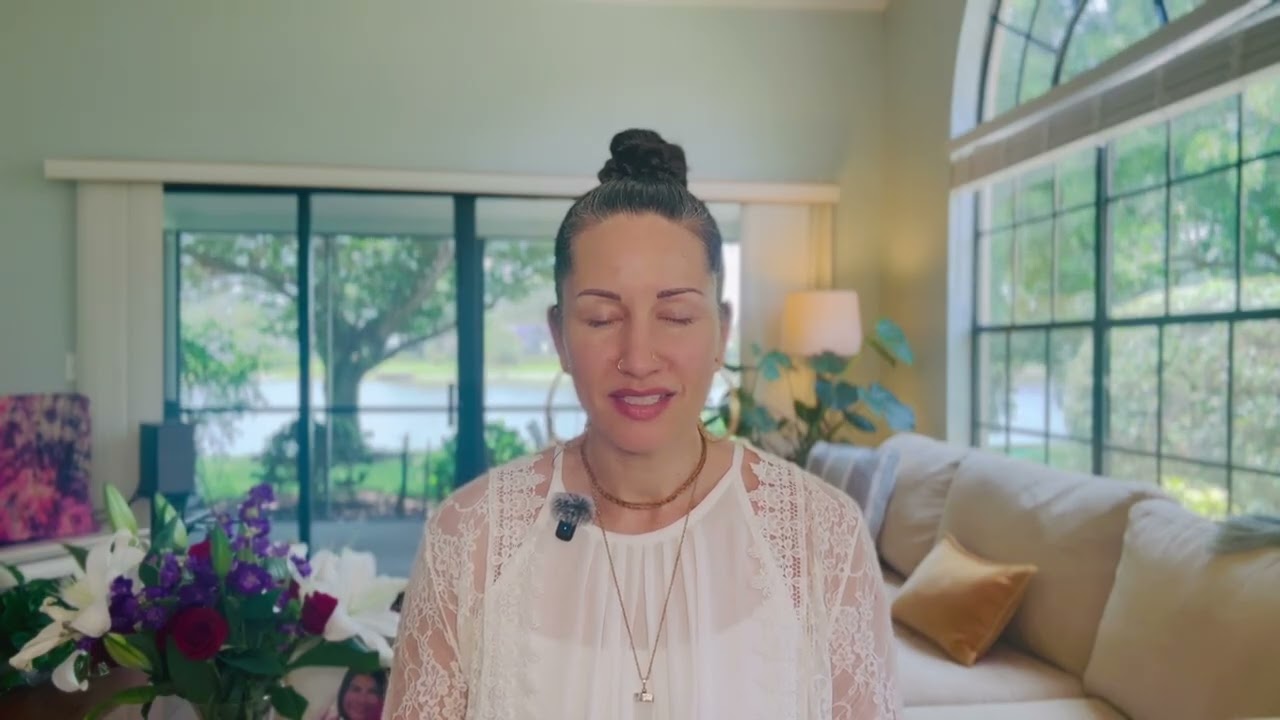
Sit cross-legged on the floor, palms turned up on your lap, and close your eyes. Amanda Sellers' voice, unhurried and close to the microphone, opens with a line that works like a permission slip: "be proud of yourself for taking this window of time to focus on you first." That is how Start Your Day begins, a seven-minute guided meditation posted to her YouTube channel, Amanda Sellers Meditation, in June 2011, which has since logged 324,460 views. Over those seven minutes it moves in a deliberate order: first the body, then the breath, then the mind's chatter, then gratitude for what you already have, then a visualization in a garden where you meet an idealized version of yourself and ask it for direction, and finally a rehearsal of a day that goes better than you could imagine. It closes with a hand on the heart and a suggestion to pick up a pen. The sequence is the real subject here. It treats a morning sit as a chain of small, ordered acts, each one setting up the next, and what follows is a close reading of how that chain is built.
Most morning routines put intention first: a list, a plan, a mantra. Sellers reverses that. Before anything else she asks you to get comfortable, and she specifies how: "I like to sit cross-legged on the floor with my palms facing up on my lap" (Sellers, Start Your Day, 0:20). The instruction is modest, but it sets the terms. Posture is treated as the first thing you can actually control before the day starts, and open palms suggest receptivity without asking you to do anything with your hands.
Then comes the breath. Close your eyes, take a deep breath, and exhale while feeling "supported by the Earth" (Sellers, Start Your Day, 0:29 to 0:40). The cycle repeats: inhale, then release "any tension you may be holding on to" (0:48 to 0:56). The repetition is the point. Each pass gives the body another chance to let go of what it was carrying when you sat down, and the video returns to this pattern several times in the first minute and a half, so you are never asked to relax all at once.
The transcript marks music at several of these breath cues, though it doesn't identify the track or say whether it is meant as a pacing device. What is clear from the words is that the breath carries structural weight. It is the thread the rest of the meditation hangs on.
The instruction to quiet the mind is the most common and most misunderstood part of any guided meditation. Sellers' version is concrete:
"clear your mind of any thoughts that are trying to come in just let them go let every thought that comes into your head leave with every breath you exhale"
— Amanda Sellers, Start Your Day (2011), 1:12
Notice what the line does not ask for. It doesn't tell you to stop thinking or to banish thoughts. The verb is "let them go," and the release is tied to the exhale. Thoughts are allowed to arrive, and the breath is the vehicle that carries them out. From there the video asks you to "bring awareness to each breath" and to "feel peace in your heart" (Sellers, Start Your Day, 1:30 to 1:38), which turns a mental task into a physical one. If you have ever felt you were failing at meditation because a thought showed up, this is a useful reframe: the practice assumes thoughts will come and gives them a place to exit.
The gratitude section is the emotional center of the piece, and its structure is worth noticing. Sellers begins with the most intimate subject available: "give gratitude to your heart for beating non-stop every day" (Sellers, Start Your Day, 1:45). Next comes the body, "your amazing body," then the outward circle of "your home, family, friends, your job." Then an open question, "what else are you thankful for," which keeps you generating rather than reciting. The instruction to "feel your gratitude with every ounce of your soul" arrives around 2:14, followed by the line "you are truly blessed" (Sellers, Start Your Day, 2:20).
Gratitude placed before goal-setting does a specific job. The meditation tells you to carry the feeling forward: "now carry this feeling of gratitude and love with you" (Sellers, Start Your Day, 2:25). Whatever you go on to imagine, the sequence implies it should be imagined from a place of already having been given something, not from a list of what is missing. That is a choice with consequences for the tone of everything that follows.
This is the most distinctive stage. Sellers asks you to imagine "yourself standing in a beautiful garden surrounded by lush flowers and trees," with the ocean visible beyond waves lapping at white sand (Sellers, Start Your Day, 2:32 to 2:53). Somewhere in the garden you notice an image of yourself sitting on a bench, and she defines that figure precisely: "this image of you is the exact version of yourself you strive to be" (3:03). You smile and walk toward them.
Then the questions begin. What does this ideal self look like? What are they wearing? What successes do they enjoy, and what is their quality of life (3:17 to 3:47)? The details matter, because each one asks you to build a specific picture rather than hold a general wish. Then comes the move that makes the practice work: "this version of you has already accomplished all of the goals you have set out for yourself" (Sellers, Start Your Day, 3:51). The ideal self is not a distant aspiration. It is a figure who has arrived, and that changes your relationship to them. You are no longer chasing this person; you are consulting them.
The consultation is practical. You ask them what choices and decisions you need to make today to accomplish your goals, and who you have to become to be the best you can be (3:56 to 4:20). Then you thank them for their wise words, and the voice says: "now you have the wisdom and the power from within to be the best you you can be" (Sellers, Start Your Day, 4:32). The wisdom is placed inside you, and the figure in the garden is simply a way of reaching it. The garden also works as a threshold. "Tell yourself you will be back soon," the voice says, and you return your attention to the body, the heart, the breath, and the light around you (4:40 to 4:49).
Back in the body, the practice turns to the calendar. "Think of all the things you plan on doing today," the voice says, "and picture yourself moving through the day" (Sellers, Start Your Day, 5:04). Then the instruction that stands out: "envision every detail of the day going better than you could ever imagine" (5:06 to 5:20).
Pay attention to the word "imagine." The request is not for a realistic forecast. It is a rehearsal in which every detail goes better than expected, and the voice reinforces the stance: "no matter what you are faced with you handle it with the utmost confidence and dignity," because "the universe is out to do you good" (Sellers, Start Your Day, 5:21 to 5:34). Then: "there are no problems just opportunities" (5:43).
That last phrase is the one most listeners will test. Read as a lens on how you show up, rather than a claim that nothing is difficult, it is a usable idea. The meditation does not say what to do when a problem is a problem, whether it's a late bill or a hard conversation. It is a stance for approaching the day, and it is worth treating that way rather than as a description of the world.
The close is brisk. Place your hands over your heart, thank yourself, thank the universe, and open your eyes (Sellers, Start Your Day, 6:06 to 6:13). Then comes the final instruction, the one that turns the session into something you can keep: "maybe get a pen and paper and jot down some advice you received from your higher self" (Sellers, Start Your Day, 6:16). The word "maybe" makes it optional, but it is the only step that asks you to put the garden's answers in writing. A sentence said in a visualization can dissolve by mid-morning. A line on paper is still there at lunch, and you can check it against how the day actually went.
- Settle (0:05 to 0:40): Sit comfortably, palms up, close your eyes, breathe, and feel supported.
- Release (1:00 to 1:38): Let each thought leave on an exhale, and bring awareness to the breath.
- Give thanks (1:45 to 2:30): Move from heart and body to home, family, friends, and work, then ask what else you are grateful for.
- Visit the garden (2:32 to 4:40): Meet the ideal version of yourself on the bench, ask about their choices, thank them, and say you will return.
- Rehearse the day (5:04 to 5:43): Picture your planned tasks going better than you imagined, and hold the stance that problems are opportunities.
- Anchor and record (6:06 to 7:05): Hands on the heart, open your eyes, and write down what you heard.
The source material is the video itself and its short description. It doesn't say where the practice came from, what research if any informs it, or how it fits into Sellers' other work. The description promises "more NEW Meditations coming soon" and points to her Instagram. Anything beyond that would be guesswork. What the video offers is a complete, short structure you can test on your own mornings, and that is enough to evaluate it on its own terms.
Try the sequence for seven mornings without changing anything. Keep one line from the garden each day, then check at night whether it held up. Pay attention to the two places most likely to snag. The first is the ideal self, if the picture feels too polished to trust. The second is "no problems, just opportunities," which will sound different on a day when something goes wrong. Those friction points are often where a practice like this gets interesting, and the video gives you enough structure to notice them.