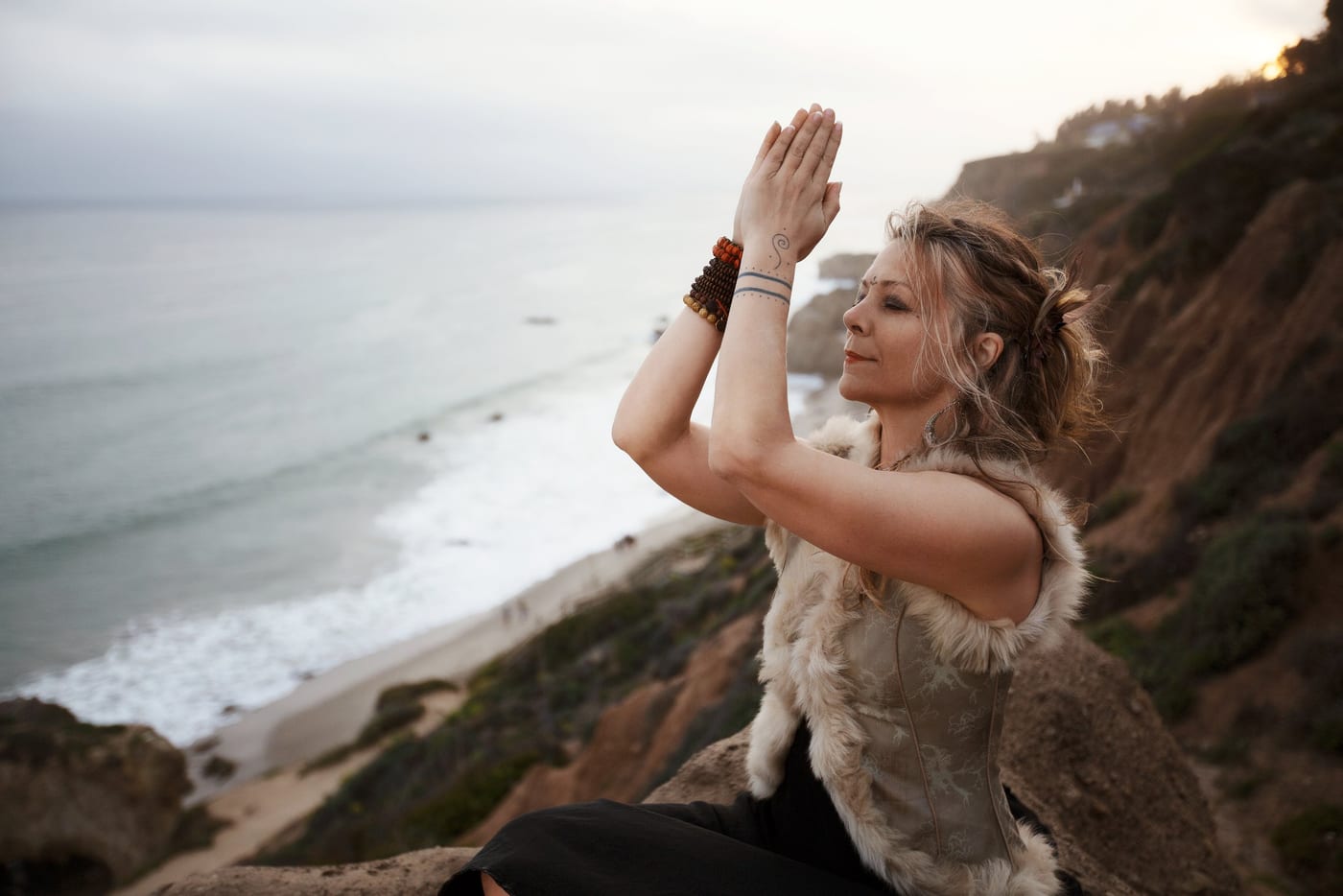

Deep Repose: Meditation Music from Reclaiming and Friends is a fourteen-track compilation released on 8 December 2024. It is built for rest and stillness. That purpose makes it a useful companion to the rest of Suzanne Sterling's catalogue, which ranges from participatory kirtan to dub-inflected mantra to earth-based ritual song.
Suzanne Sterling is a singer, musician, ritual leader and activist who has taught transformational workshops for more than 25 years. She has released five solo albums and appeared as a guest on many others. Deep Repose is not one of the solo records. It is a gathering of contributors, which places it alongside Sacred Well: Ritual Music from Reclaiming and Wyrd Vibrations: Future Sounds of Paganism from Reclaiming Tradition. These releases draw on her more than two decades with the International Reclaiming Community, where she has co-created public ritual and trained teachers in earth-based spirituality.
Read that way, the album is less a statement of personal style than a portrait of a community she has long worked within. Her presence is felt as a curator and participant in a wider circle, which is consistent with how she describes her own aim: helping people find their voice and using ritual as a tool for healing and community building.
The track-by-track instrumentation and personnel are not documented in the material available for this guide, so it would be dishonest to catalogue who plays what. What can be said is shaped by the album's stated purpose and by Sterling's wider approach. Her music is built around the human voice, mantra and rhythm rather than dense orchestration, and it favors repetition: a phrase returns, a melody settles, and the listener is invited to stay rather than wait for a climax.
Expect that sensibility here, applied to meditation. The album is built for rest, so the pacing should be slow and the mood inward. This is not a record of peaks and arcs. If you want fast tempos or layered electronic arrangements, look elsewhere.
I can't responsibly name individual tracks. The record I have for this album does not include a track listing or track-by-track descriptions, and I won't invent titles. The better move is to treat the fourteen tracks as a sequence and let the Spotify listing (linked from the album page) supply the titles and credits.
Here is what to listen for as you work through them:
- The opening track. On a rest-oriented compilation, the first piece sets your breathing and attention. Notice how quickly it asks you to slow down.
- Any track where a voice carries the center. Sterling's tradition treats the voice as the primary instrument, so voices that lead rather than decorate are where the album's logic is clearest.
- The closing track. Meditation sequences often end by returning you gently to the room. Notice whether the album lets you out softly or leaves you in silence.
Sterling's work sits primarily within bhakti, the Indian devotional path in which song and repeated sacred names become a direct route to the divine. Alongside it runs the earth-based strand from her long work with the International Reclaiming Community. Deep Repose belongs to that second strand by name, as its title credits Reclaiming. It shares ground with ambient and meditation music, but its frame is ritual and community rather than purely atmospheric.
Her lineage is better read as a set of practices than a single guru line, and no specific teachers are named in her bio. Listeners expecting a strictly orthodox South Asian devotional record should adjust expectations: this is an eclectic, community-built collection.
This album suits listeners who want stillness more than call-and-response singing. It is for people already comfortable with ritual or devotional frames, including pagan and Reclaiming-influenced ones, since the spiritual language is central rather than decorative. It will land hardest in a life moment that calls for rest: the end of a demanding week, a period of grief or transition, or the close of a yoga or movement practice, where it suits savasana.
It is a poor fit for anyone seeking a purely secular ambient sound. The Chill Yoga Music and Trip Tracks compilations are closer matches for that.
Because the fourteen tracks are meant as a continuous experience, play the album in order rather than shuffling. Evening is the natural time. Dim the lights, use headphones if you want the voices close, and lie down or sit with a steady posture. Give the first few tracks time to work on your breathing before judging them. If you use it in a class or ceremony, preview the album first on Spotify, since track-level descriptions are not available here. Treat it as a ritual container for an hour of quiet rather than as background music.
If this album draws you in, Japa 2024 Remaster and Mala 2024 Remaster offer a more mantra-centered path to the same stillness, and Sterling's live kirtans and workshops are the logical next step.