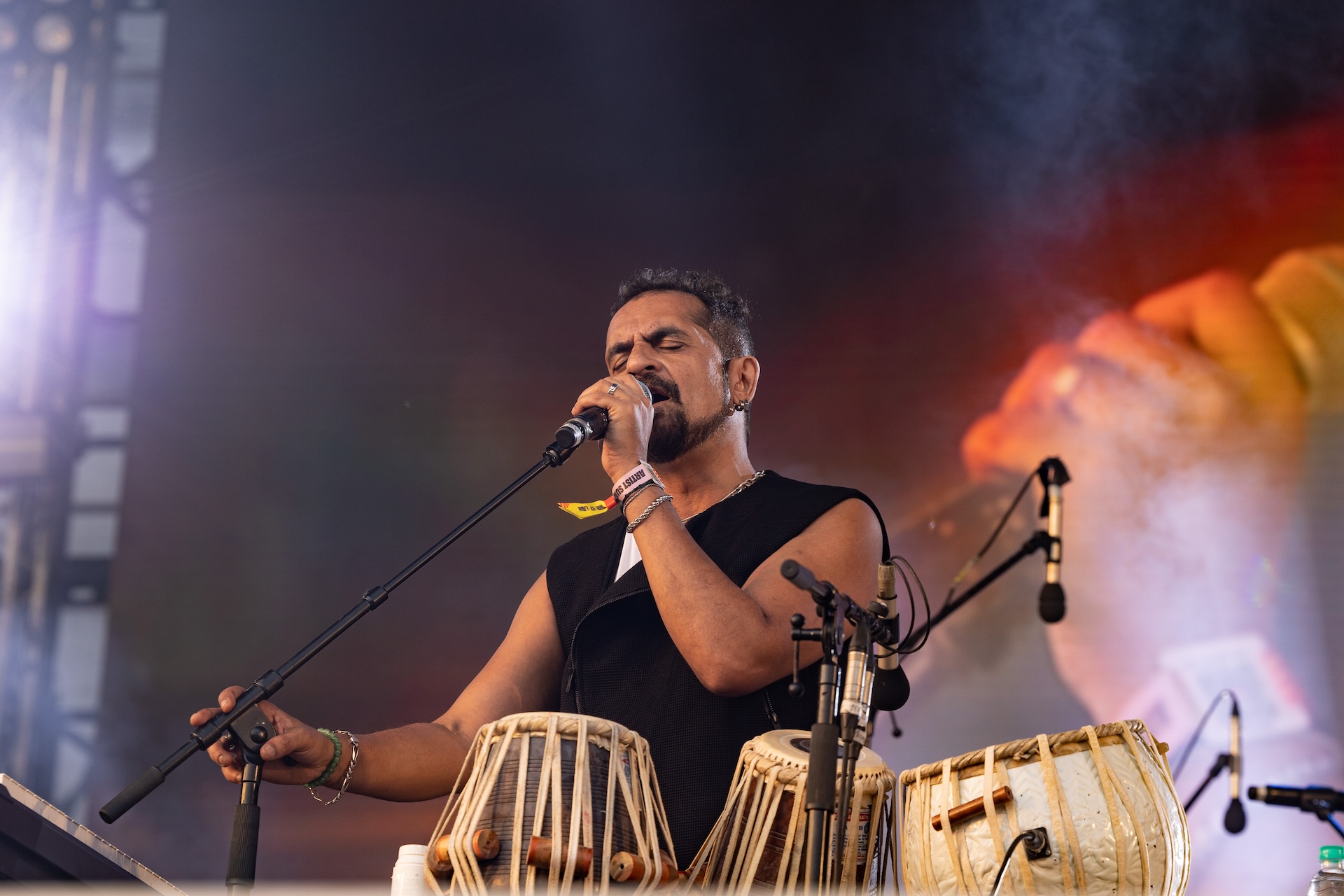

Karsh Kale's music sounds like a tabla player rewiring a drum and bass rig in real time. It's restless, syncopated, and layered—bansuri flutes float over breakbeats that crack at 160 BPM, sitars bend notes through delay pedals, and vocalists trained in Hindustani classical forms weave around programmed basslines thick enough to rattle car windows. His productions don't soften edges or smooth over differences. They collide deliberately, creating friction that generates heat rather than resolution.
The instrumentation itself moves between worlds without asking permission. On tracks like "Milan," tabla patterns cascade with the precision of classical training, but they're flanked by drum machines that punch through the mix with electronic clarity. The sarangi—a bowed string instrument with a reedy, vocal-like timbre—appears not as ethnic flavoring but as a lead voice, processed and looped into the harmonic fabric. Kale's production aesthetic favors density: vocal samples pile up, strings overlap, and rhythm sections multiply. The tempo shifts track to track, but there's a consistent preference for rhythmic complexity—polyrhythms that lock tabla cycles against electronic grids, creating pockets of space that feel both ancient and digital.
Kale doesn't work within a devotional lineage in the way kirtan or bhakti artists do, but his music carries the weight of classical training. Studying tabla under maestros means absorbing not just technique but an entire rhythmic philosophy—the cyclical time structures of ragas, the improvisational dialogue between percussionist and melodic player. What he does is extract that rhythmic DNA and transplant it into contexts where it was never meant to survive: the amen break, jungle basslines, downtempo grooves borrowed from trip hop.
This positions him outside the sacred music revival that defines much of the conscious-music landscape. He's not leading chants or setting mantras to ambient pads. His use of Hindi and Urdu vocals—often drawn from folk traditions, Sufi poetry, or Bollywood—functions more as timbral material than spiritual practice. The voices are evocative, emotionally charged, but they're arranged like instrumental parts, chopped and looped with the same attention to texture as a synth pad.
Where earlier fusion attempts often placed Indian instruments politely atop Western arrangements, Kale treats tabla as a co-equal with the beat machine. His breakthrough was understanding that tabla and breakbeats share structural DNA—both are percussive, both work in cycles, both thrive on subdivision and syncopation. By programming live tabla recordings into samplers and layering them with electronic drums, he created a hybrid percussion language that sounds neither purely traditional nor fully electronic.
This approach helped define the Asian Underground movement of the late 1990s and early 2000s, alongside artists like Talvin Singh and Asian Dub Foundation. But Kale's sound skews more aggressive, more hip hop-informed. His 2006 album Broken English featured collaborations with MC artists and pushed the desi hip hop aesthetic into sharper focus—beats hard enough for a cypher, melodies pulled from subcontinental folk forms, production polish that could sit comfortably on college radio or a South Asian wedding playlist.
Kale's work is deeply collaborative. He's partnered with vocalist Shilpa Ray, whose raw, blues-inflected voice cuts through his denser productions with visceral intensity. His projects with guitarist and producer Midival Punditz further explore the intersection of Indian classical motifs and club culture. He's worked with Anoushka Shankar, daughter of sitar legend Ravi Shankar, blending her classical sitar training with his electronic frameworks. These aren't guest spots—they're sustained dialogues that reshape the sound.
His connection to the downtown New York experimental scene also matters. This was a space where genre boundaries dissolved, where jazz musicians jammed with electronic producers and South Asian artists weren't expected to stay in their lane. That ethos saturates Kale's work—it's cosmopolitan without being rootless, urban without severing ties to tradition.
Expect density and velocity. If you're coming from ambient kirtan or mantra electronica, Kale's productions will feel busier, more percussive, more insistent. The beats don't sit back. They drive. What may surprise is how deeply melodic the music remains despite the rhythmic intensity—flutes sing, strings bend, voices carry weight even when processed beyond recognition.
Start with Liberation or Realize to hear the blueprint: tabla and electronics in full conversation, vocals that ache and soar, tempos that shift from downtempo reverie to jungle sprint. If you want the harder-edged hip hop fusion, go to Broken English. If you're curious about his role in the broader Asian Underground movement, seek out his collaborative work with Tabla Beat Science.
Kale occupies a liminal zone. He's too rhythmically aggressive for yoga studios, too electronic for classical purists, too rooted in Indian musical forms to be dismissed as mere fusion novelty. His music fits best in the lineage of diaspora artists renegotiating cultural inheritance—not preserving it in amber, but rewiring it for the present. He's part of the conversation that includes Nitin Sawhney, Nusrat Fateh Ali Khan's collaborations with Massive Attack, and the global bass movements that treat tradition as raw material rather than museum piece. Sacred texture without the sermon.


