
Letting Go is a single, one track released on November 28, 2024. It asks for a different kind of attention than an album does. There is no sequence to follow and no arc across sides, just one piece of music and the time you give it.
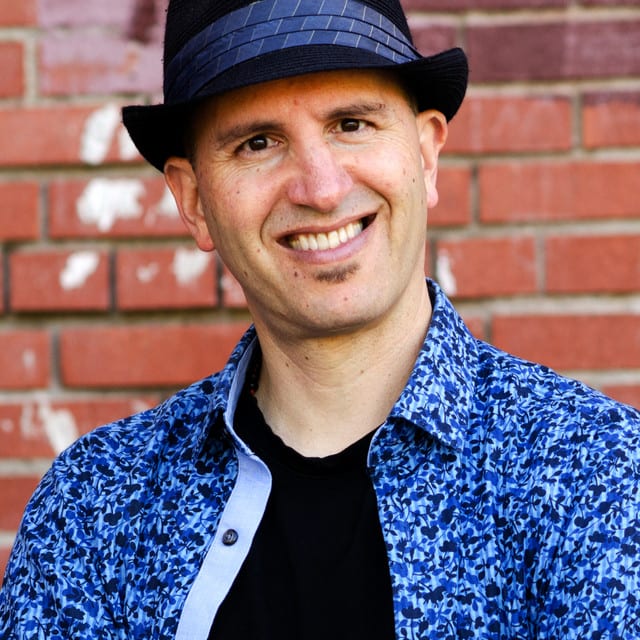
Jim Gelcer came to kirtan from a long career as a professional musician. Born in Cape Town and raised in Toronto from 1968, he studied drums, vibraphone, arranging and improvisation at the Eastman School of Music, then jazz at York University. He played with Lee Aaron and the Flying Bulgar Klezmer Band and composed for film and television. Kirtan arrived after he studied Sivananda Yoga and was invited to chant in the temple at the Sivananda Ashram in the Laurentian Mountains.
His discography runs from the 2010 debut Bhagavan through Bhakti Groove Machine (2013) and Cape Town to Kolkata (2019) to the 2025 album Quiet Expanse. Letting Go belongs to the run of thematic singles he put out in 2024 and 2025, alongside "Healing," "Hope" and "Compassion." Read together, those titles sketch an arc of inner work: grief, repair, release. This single sits at the point where the work turns from holding on to setting down.
Gelcer's voice is a warm, precise alto that sits in the mid-register. It is not showy. The priority is the clarity of the text and the sincerity behind it. His kirtan typically leans on harmonium, with jazz-informed chord voicings underneath and room for restrained drums or keyboards. The feel is closer to chamber music than to a festival singalong.
The pacing is the main thing to know. His recent singles move at a meditation pace and may hold a single mantra or phrase for minutes at a time. Expect repetition meant to be sunk into rather than climbed over. There are no synth swells, no stadium drums and no call-and-response built to raise the room. The mood is steady, intimate and unhurried.
With a one-track release, the signature track is the title track, "Letting Go."
"Letting Go." What makes it land is the match between subject and method. A piece about release works by subtraction. Gelcer's jazz training shows less in flourish than in his comfort with space and silence, and in his willingness to leave a phrase alone instead of decorating it. The repetition does what the title promises. Each pass through the phrase asks you to loosen your grip a little more, and the music doesn't push you toward a climax. Listen for how the arrangement stays patient while the voice stays plain.
If you want context for it, "Healing," "Hope" and "Compassion" are the natural neighbors. They are short, thematic and made for meditation or a morning routine.
This is bhakti music, devotional chanting in the kirtan tradition, shaped by the Sivananda lineage in which Gelcer trained. That lineage treats asana, pranayama, meditation and devotion as integrated paths. It is classical and nonsectarian, so the chant here sits inside a framework of meditation and self-inquiry rather than performance.
What sets Gelcer apart is the honest blend. He doesn't present kirtan as an untouched relic. He openly folds in jazz, R&B and rock sensibilities, and he doesn't water the tradition down. Within the wider field of kirtan and yoga music, this is the restrained, spacious end of the spectrum. It is nearer to ambient in its stillness than to ecstatic group chanting, though the Sanskrit and the devotional intent keep it from being background music.
This single is for the listener in a transitional season: someone carrying a loss, a resentment or an old habit of control, who wants company in setting it down rather than a pep talk. It suits people who already have a meditation or yoga practice and want a sonic anchor for it. It also suits listeners who like their devotional music musically literate and unshowy.
It will frustrate anyone who wants high-energy, propulsive kirtan with a charismatic leader driving the room. Listeners who want a fully secular wellness soundtrack may also struggle, because the Sanskrit and the devotional frame are the point, not decoration. And if you want purely instrumental music, the vocal presence here asks you to engage with language as practice.
Give it your full attention at least once, with no screen and no task. Some suggestions:
- Evening, alone. Let the day wind down first. The piece rewards a settled body.
- Headphones. The restraint is the draw. Small details of voice, harmonic movement and silence are easier to hear up close.
- Sit with it as a practice. Pick one thing you are ready to release, then let the repeating phrase carry it. If your attention wanders, return to the voice, as you would to the breath.
- Replay without agenda. Because the track is short, a second and third listen costs little. Repetition is the form here, and the piece often opens on later passes.
Afterward, sit for a minute before reaching for your phone. The silence that follows is part of the listening.