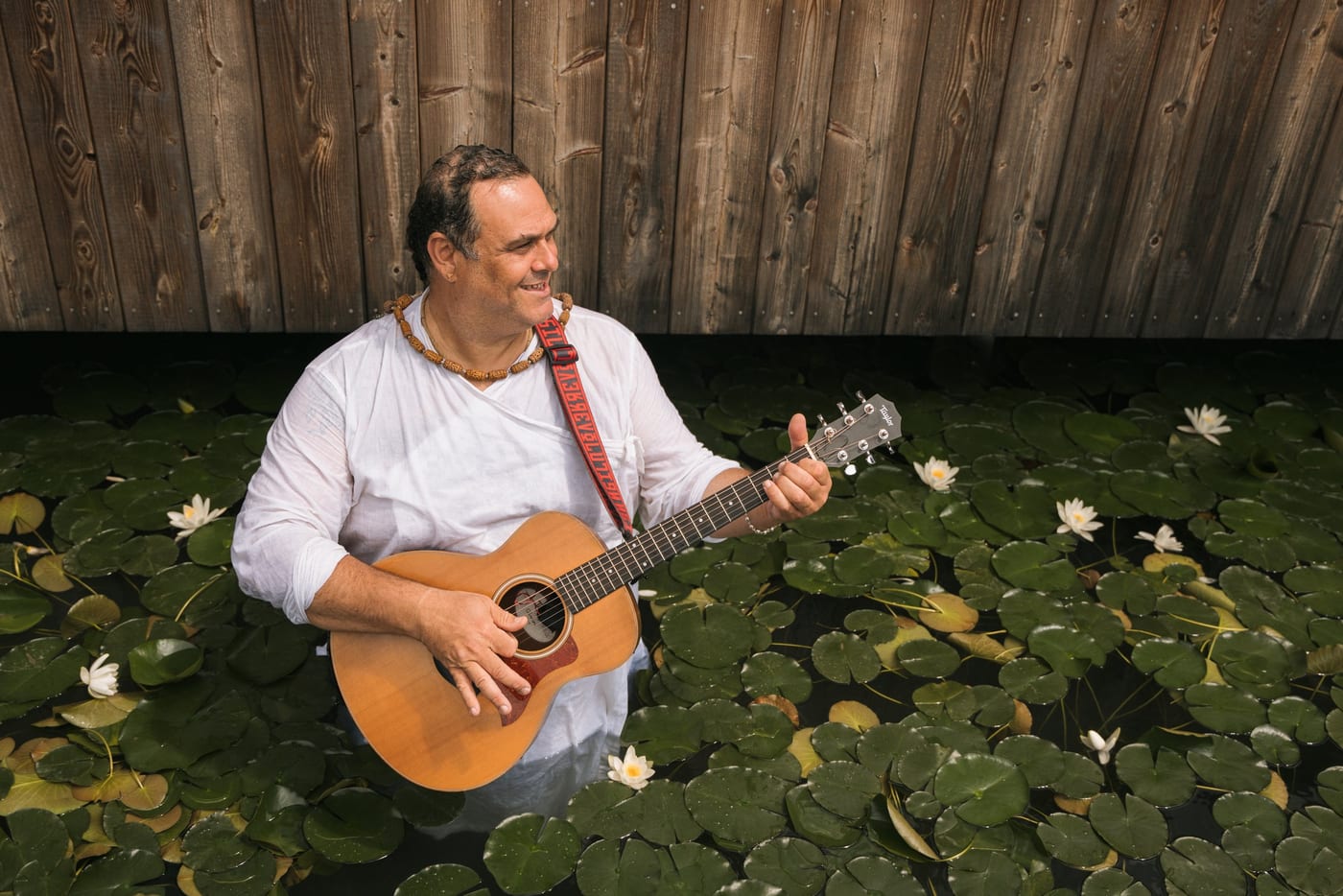

"Wade in the Water - Royal Opera House, Mumbai (Live)" arrived on January 23, 2026, as a one-track single, the first entry in a 2026 run of singles that continued with a live "Bhaja Govindam" in April and "Unlimited" in July. It is not an album in the full-length sense, so this guide treats it as what it is: a single performance, captured in a room, worth sitting with closely.
The placement matters. Gaura Vani is a storyteller and kirtan leader with roughly two decades of touring and recording behind him. He was raised by monks in temples from the age of four, rebelled as a teenager, acted in Hollywood films alongside Michelle Pfeiffer, Denzel Washington and Ethan Hawke, and then built a career on stages ranging from Lollapalooza and Bhakti Fest to temples and yoga studios. A live recording from a formal opera house in Mumbai fits that non-linear path. It shows the chant-and-song vocabulary he carries into a concert hall without, according to the verified record, losing its devotional center.
The catalog data does not itemize instrumentation for this release, so specifics should be confirmed through the Spotify credits or gauravani.com rather than assumed. What can be said is grounded in how his work generally operates: the human voice sits at the center, repetition is part of the design, and the live setting brings the room into the sound.
The title points somewhere useful. "Wade in the Water" is a song name that suggests an English-language piece, and Gaura Vani is documented as mixing mantras with English-language songs, notably in his hospital performances with nurses in Mumbai. This single is a chance to hear that side of his range, set in a venue far more formal than a kirtan hall. Expect the pacing of a performance rather than a studio meditation: room acoustics, audience presence, and a shape that unfolds in real time. Listeners who want constant variation may find a single sustained live piece demanding; those who settle into repetition will find it rewarding.
There is only one track, and it is the whole case.
"Wade in the Water - Royal Opera House, Mumbai (Live)." What makes it land is context. This is a live document of how a bhakti-rooted musician carries devotional feeling into a concert hall. The verified biography notes that the 2026 Royal Opera House recordings show the material can sit in a formal setting without losing its devotional center, and this single is a direct way to test that claim yourself. Because it is one track, it also works as a low-commitment entry: a single sitting, a single room, a single performance.
For a second live data point from the same venue, the April single "Bhaja Govindam (We All Bleed Blood)" was also recorded at the Royal Opera House Mumbai, and the two pair naturally.
Gaura Vani's work sits in the bhakti tradition, the devotional path within Hinduism centered on love for the divine expressed through song. Kirtan (call-and-response chanting) and bhajan (devotional song) are his working vocabularies. His formation came from inside temple life, so mantra and ritual predate any career decision. The public record does not name a specific guru lineage or sampradaya, and this guide does not assign one.
"Wade in the Water" is interesting because it steps slightly outside the Sanskrit-first default. It reflects the East-West sensibility that also runs through his collaboration As Kindred Spirits, whose members include Shyam Kishore on tabla and sarod, Acyuta Gopi on vocals, and Ananta Govinda on mrdanga. Whether any of them appear on this recording is not stated in the data, so no personnel claim is made here.
This single suits a listener curious about bhakti who is open to hearing devotional music as a performed, communal practice rather than background sound. It will land especially well for someone coming to Gaura Vani through the live material, or for a listener who knows chant but wants to hear it translated into a concert setting. It is also a good fit for someone in a reflective stretch of life who wants something sung and human rather than programmed.
It is a poor fit for those wanting high-BPM or remix-driven kirtan, or strictly orthodox temple liturgy. Anyone seeking quiet, sparse meditation tools should begin with the studio record Meditation & Mantra instead, since live recordings change the mood of a room.
Give it your full attention. Use headphones, in the evening, alone, with nothing else competing. Listen once without trying to analyze anything, then again, paying attention to how the voice shapes the room: where it pulls back, where it opens, and how repetition builds. The live recordings reward active attention rather than passive playback.
Treat it as a single sitting of about one song's length, and let it be an introduction rather than a verdict. If it draws you in, the natural next steps are the live "Bhaja Govindam (We All Bleed Blood)" and then the studio and compilation work for the broader picture.