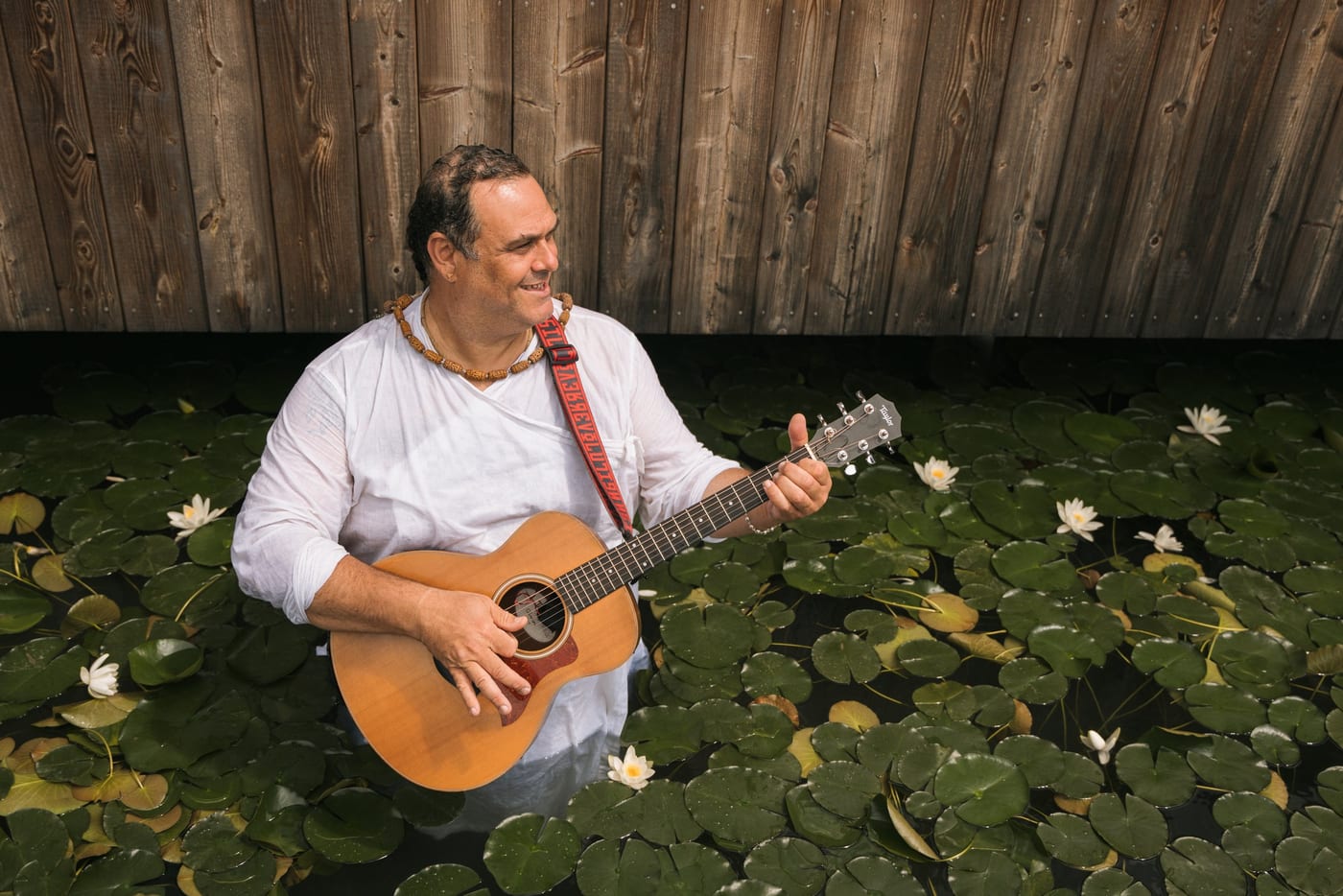

Start with the voice. Gaura Vani's music is built on a human voice carrying Sanskrit mantra and bhajan lines, with the emphasis on repetition and on the names of the divine rather than on melodic showmanship. The catalog data does not itemize instrumentation track by track, so this piece describes the instruments documented in his ensembles and does not guess at a harmonium or drum setup for any given recording.
Tempo and texture shift with the format. The studio records lean toward sustained, meditative chant. The kirtan sessions work as call-and-response, where a phrase is offered and returned and the energy builds through the exchange. The festival material is louder and more driving, with a percussive pulse and a crowd doing much of the singing. The most useful contrast to hear early is between restrained studio work and crowd-driven live recordings. Even the energetic material rests on chant rather than programmed beats.
The work sits in the bhakti tradition, the devotional path within Hinduism centered on love for the divine expressed through song. Kirtan, the call-and-response chanting of names and mantras, and bhajan, the devotional song form, are the working vocabularies. Sanskrit is the default language rather than decoration. Titles such as Armor of Narasimha (Narasimha Kavacha), named for a devotional text, and Krishna Kripa Ho Tabhi show the instinct to anchor songs in named deities and sacred words.
The bio's account of his formation is specific: he was raised by monks in temples from the age of four, immersed in mantra and ritual as part of daily life. That came before any career decision. The public record names no particular guru lineage or sampradaya, so none is assigned here. What can be said is that the practice was lived before it was performed.
What sets Gaura Vani apart is range inside one devotional center. Many kirtan leaders work in a single format. He moves among solo devotional recording, the East-West fusion of As Kindred Spirits, and high-energy festival kirtan with The Juggernauts. The Hanumen adds a quartet built on world percussion, chant, and harmony, which is less common in a scene often organized around voice and one melodic instrument.
The biography feeds the sound. A temple childhood, a teenage rebellion, a Hollywood acting stretch (films alongside Michelle Pfeiffer, Denzel Washington, and Ethan Hawke), and a first rock and roll band in high school all sit behind a catalog that includes ten albums and thousands of songs. He is also a storyteller, and that shows in the songwriting side of the catalog, particularly the more composed studio albums Like a River to the Sea and Nine Islands.
He has shared the stage with Jai Uttal and Krishna Das, which places him in a recognizable circle of modern chant artists. Within his own projects, As Kindred Spirits is the best documented. Its members include:
- Acyuta Gopi, vocalist, alongside Gaura Vani
- Shyam Kishore, on tabla and sarod
- Ananta Govinda, on mrdanga (khol)
That lineup gives the ensemble an Indian percussive and string foundation, with the sarod's sustained tone and the mrdanga's resonant clay-drum attack, in conversation with the Western side of the fusion. The Hanumen contributes world percussion and harmony singing, while The Juggernauts push toward festival intensity.
On the studio side, Ben Leinbach, known for his work with Jai Uttal, co-produced Ten Million Moons.
Begin with Kirtan: The Bhakti Yoga of Chanting Mantras, the 2018 twenty-track compilation. It surveys the chant and call-and-response approach rather than telling one story. For mantra as a practice tool, move to Meditation & Mantra (2023), the most direct entry for listeners who want to sit with repetition. Like a River to the Sea (2015) and Nine Islands (2019) show the composed songwriting side, and Love (2022) is a good middle step before live material. The live single Bhaja Govindam (We All Bleed Blood), recorded at the Royal Opera House Mumbai in 2026, shows the energy of a concert room. For a single track, try Armor of Narasimha.
Expect the first listen to feel slower than you anticipated. The repetition is part of the design. Expect, too, that the live recordings reward active attention and do not work well as background music.
A few things tend to surprise newcomers. One is how well the chant holds in a formal hall like the Royal Opera House Mumbai. Another is that he has sung with nurses at hospitals in Mumbai, mixing mantras with English-language songs. The Juggernauts material is loud and crowd-driven, so if you want quiet, start with the studio albums.
This is not music for listeners who want club-style drops or remix-driven kirtan. It also asks for some patience with Sanskrit and Hindu names. Those wanting strictly orthodox temple liturgy may find the fusion projects less pure.
Within the wider conscious-music world, Gaura Vani occupies the territory between traditional kirtan and festival-scale world fusion. His stage map is unusually broad: Lollapalooza, Floyd Fest, Bhakti Fest, Omega Ecstatic Chant, and Wanderlust, plus temples, opera houses, and yoga studios. Few devotional artists hold that range of rooms.
The Spotify numbers, about 17,900 followers, describe a devoted niche audience and not a mainstream one. What the catalog offers in return is a long, non-linear path documented in song: a temple-raised voice that went out into the world and came back to chant, now testing how far a sung, communal, devotional practice can travel from the room where it began.