
Allyson Grey occupies a distinctive position in contemporary American art: a painter whose minimalist abstractions serve explicitly spiritual purposes, and a cultural architect who has spent decades building institutions where art and consciousness converge. While her husband Alex Grey's visionary anatomical paintings often draw the spotlight, Allyson's contribution operates on a different register—quieter in its visual language, yet foundational to the physical and philosophical infrastructure that has made their shared vision possible.
Her paintings speak in the language of grids, gradations, and geometric repetition. These are not the ecstatic, psychedelic anatomies of visionary art's most recognizable imagery, but rigorous studies in pattern and seriality that she organizes into what she calls "Order" and "Chaos" systems. Through meticulous attention to line and color transition, Grey creates canvases that function as meditation devices—visual spaces designed to quiet the mind and reveal the underlying structures of existence.
Grey's formal training came through Tufts University, where she earned a Bachelor of Fine Arts degree. Her early development as an artist occurred within the contexts of minimalism and process art, movements that emphasized repetition, material investigation, and the physical act of making. Yet where many of her contemporaries pursued art as an end in itself, Grey was developing an explicitly spiritual framework for her practice. Her geometric abstractions weren't simply formal exercises but attempts to visualize the organizing principles she believed governed reality itself.
The turning point in Grey's trajectory came not through a single moment but through a sustained partnership and shared vision with Alex Grey. Together, they began to conceive of art not merely as object-making but as what Allyson terms "social sculpture"—the shaping of community and consciousness through creative practice. This led to the founding of the Chapel of Sacred Mirrors in 2004, initially as a touring exhibition before evolving into something far more ambitious: a permanent sanctuary dedicated to visionary art.
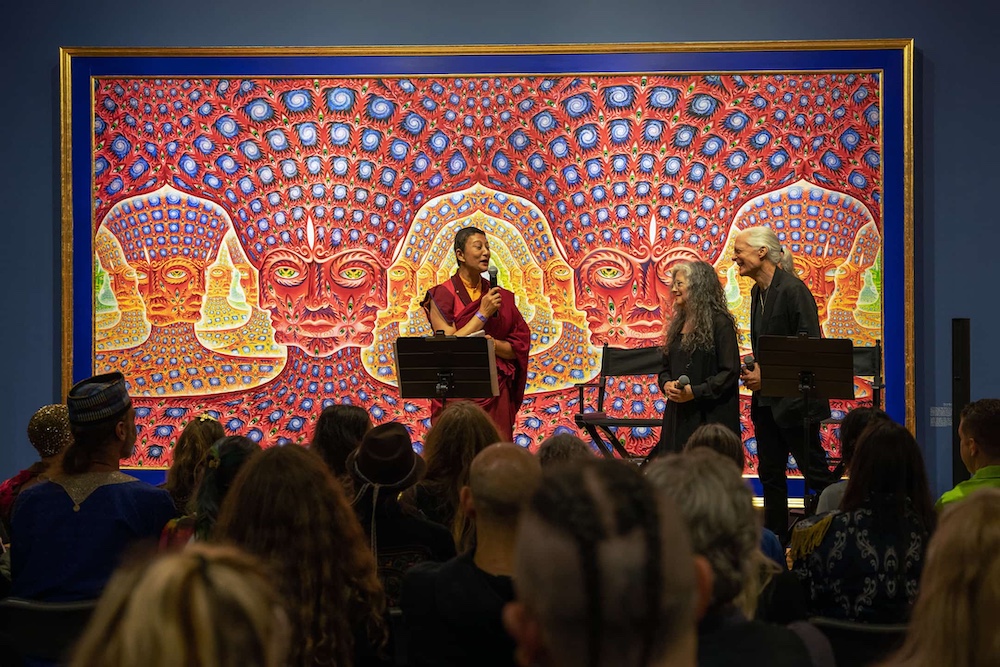
In 2009, the Chapel of Sacred Mirrors—known as CoSM—opened its physical doors in Wappingers Falls, New York. The facility represents the fullest expression of Grey's vision of art as a participatory, devotional experience. As president of CoSM's board of directors, she oversees programming that extends far beyond traditional gallery operations. CoSM functions simultaneously as exhibition space, performance venue, interfaith church, and ceremonial ground—a hybrid institution that defies easy categorization.
The site houses Alex Grey's Sacred Mirrors series, life-sized paintings depicting the human body across material, energetic, and spiritual dimensions. But Allyson's role extends well beyond that of curator or administrator. She is the organizational architect, managing the complex infrastructure required to sustain a living institution dedicated to consciousness expansion through art. Her work includes overseeing rotating exhibitions of visionary art from diverse practitioners, developing educational programming, and maintaining the physical spaces that allow art to function as both aesthetic object and ritual tool.
Grey's own painting practice continues alongside her institutional work, maintaining its commitment to pattern, structure, and contemplative engagement. Her abstract canvases employ color gradation and geometric repetition to create visual fields that reward sustained attention. Unlike representational sacred art that depicts specific iconography or narrative, Grey's work operates through formal means—the relationships between lines, the transitions between hues, the rhythm established through repeated marks.
This approach positions her within a lineage of artists who have sought to make the invisible visible through abstraction, from Hilma af Klint's spiritualist paintings to Agnes Martin's grids of transcendence. Yet Grey explicitly frames her work within the context of sacred art and consciousness exploration, rejecting the secular framework that often accompanies minimalist abstraction. Her paintings are intended as tools for meditation and gateways to altered states of awareness.
CoSM has become a pilgrimage site for a particular cultural constituency: those drawn to psychedelic experience, consciousness exploration, transformational festivals, and alternative spirituality. Full Moon ceremonies, musical performances, and workshops attract visitors who see art as inseparable from spiritual practice. In this sense, Grey has helped create infrastructure for a community often marginalized within both mainstream religious institutions and the conventional art world.
Her significance lies in this bridging work—between high art and countercultural spirituality, between the solitary studio practice and collective ritual, between the permanent collection and the living ceremony. She has demonstrated that visionary art need not remain confined to individual canvases or temporary exhibitions but can anchor ongoing communities of practice.
As the art world increasingly recognizes previously marginalized forms of spiritual and visionary art, Grey's decades-long commitment to building institutional frameworks for this work appears prescient. She has created not just paintings but the conditions for art to function as she believes it should: as a transformative force in individual consciousness and collective life. In an era of fragmented communities and depleted public ritual, her vision of art as a gathering place for meaning-making continues to resonate, offering a model for how aesthetic practice might serve needs that transcend the gallery wall.