
Where to Start with Allyson Grey: A Beginner's Guide
Begin at the Chapel of Sacred Mirrors
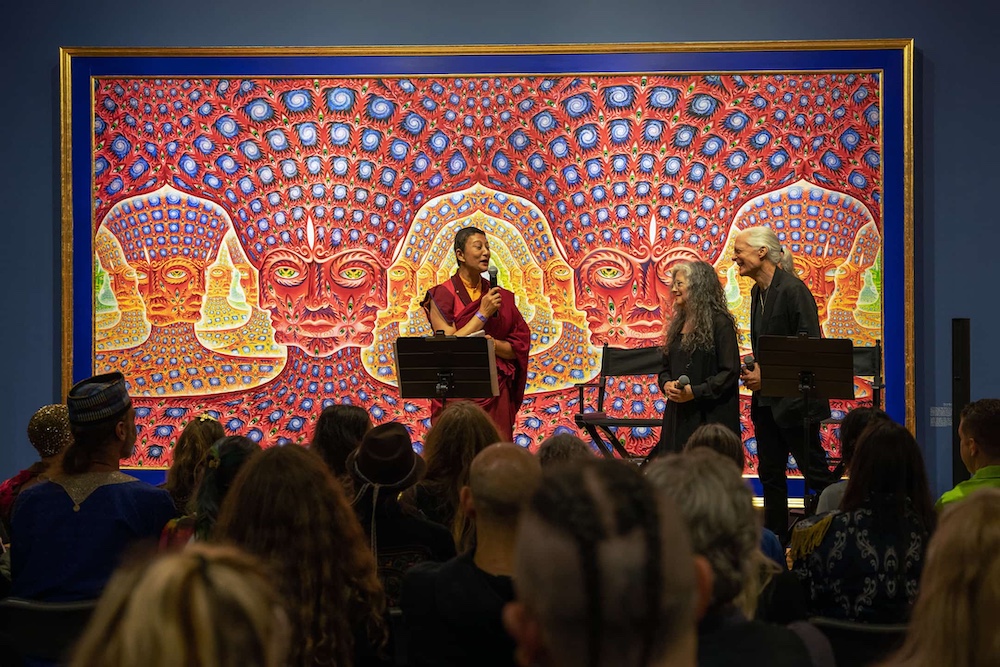
Your entry point is a pilgrimage—virtual or physical—to CoSM in Wappingers Falls, New York. This is not a museum visit. It's a participatory art sanctuary where Allyson Grey's social sculpture becomes tangible. If you can't make the trip, start with CoSM's online tours and documentation of the physical space. Here you'll encounter Allyson's work in its intended context: not as gallery objects but as devotional environments that activate community and consciousness.
The Chapel represents her core conviction that art-making is inseparable from world-making. Her geometric paintings line spaces designed for meditation, full moon ceremonies, and interfaith gatherings. This context matters. Seeing an Allyson Grey painting in isolation is like reading sheet music without hearing the orchestra.
After CoSM: Three Next Steps
First, study her "Order" and "Chaos" painting systems. These are the formal backbone of her practice. "Order" works feature meticulous grids and serial patterns—think color gradations mapped onto geometric scaffolding. "Chaos" pieces retain structure but introduce rupture and spontaneity. Together they form a philosophical system: the interplay of cosmos and entropy, discipline and release. Look closely at how she uses repetition not for minimalist coolness but for meditative absorption.
Second, investigate her writing and talks on social sculpture. Allyson positions herself within Joseph Beuys' tradition of the artist as social architect. For her, the canvas is just one substrate. CoSM itself—its governance structure, ritual calendar, volunteer community—is the larger artwork. Understanding this dissolves the artificial boundary between her "art" and her "activism."
Third, explore how her practice diverges from Alex Grey's. Where Alex renders mystical visions of bodies, energy systems, and entities, Allyson works through abstraction and pattern. This isn't decorative geometry—it's an alternate route to the numinous. Her lines and grids function as mantras, tools for quieting the narrative mind.
What to Expect on First Encounter
Don't anticipate psychedelic spectacle or representational mysticism. Allyson's visual language feels quiet, even austere. The initial response is often confusion: "This is sacred art?" Yes. But it requires time. Her paintings demand sustained looking. The experience is cumulative, built through the slow recognition of relationships between cells in a grid, subtle color shifts, the rhythm of repetition.
Expect to feel invited rather than overwhelmed. Her work creates thresholds, not spectacles—spaces to enter and inhabit rather than images to decode.
Common Misunderstandings
Beginners mistake her abstraction for merely formal experimentation. This isn't art-for-art's-sake geometry. Every grid is a cosmogram, a map of universal order. The spiritual intent is primary.
People underestimate the radicalism of her social practice. Founding and sustaining an interfaith church organized around visionary art is not a hobby project. It's a decades-long commitment to building alternative institutions where art functions as genuine ceremony.
Her work gets overshadowed by Alex's. Allyson is not the sidekick. Her vision for CoSM and her painting practice constitute distinct, essential contributions to contemporary sacred art.
When This Work Lands Hardest
Allyson Grey's work finds you when you're ready to move beyond consumption toward participation. It resonates during transitions: when you're building community, seeking structure after chaos (or vice versa), or asking whether creativity can be a spiritual path rather than personal expression. It speaks to those disillusioned with institutional religion but hungry for ritual. And it hits when you realize that making art and making a life are the same project.
Your One-Week Starter Plan
Day 1-2: Explore CoSM's website and social media. Watch tour videos, read the mission statement, study images of Allyson's paintings in situ.
Day 3: Research her Order/Chaos painting systems. Sit with high-resolution images for 10 minutes each. Notice what sustained attention reveals.
Day 4-5: Read interviews with Allyson about social sculpture and CoSM's founding vision. Understand the Chapel as her primary artwork.
Day 6: Compare her aesthetic directly with Alex Grey's. Articulate the difference in your own words.
Day 7: If possible, plan a visit to CoSM. If not, consider: What would your own "chapel" look like? What community practice could you build?