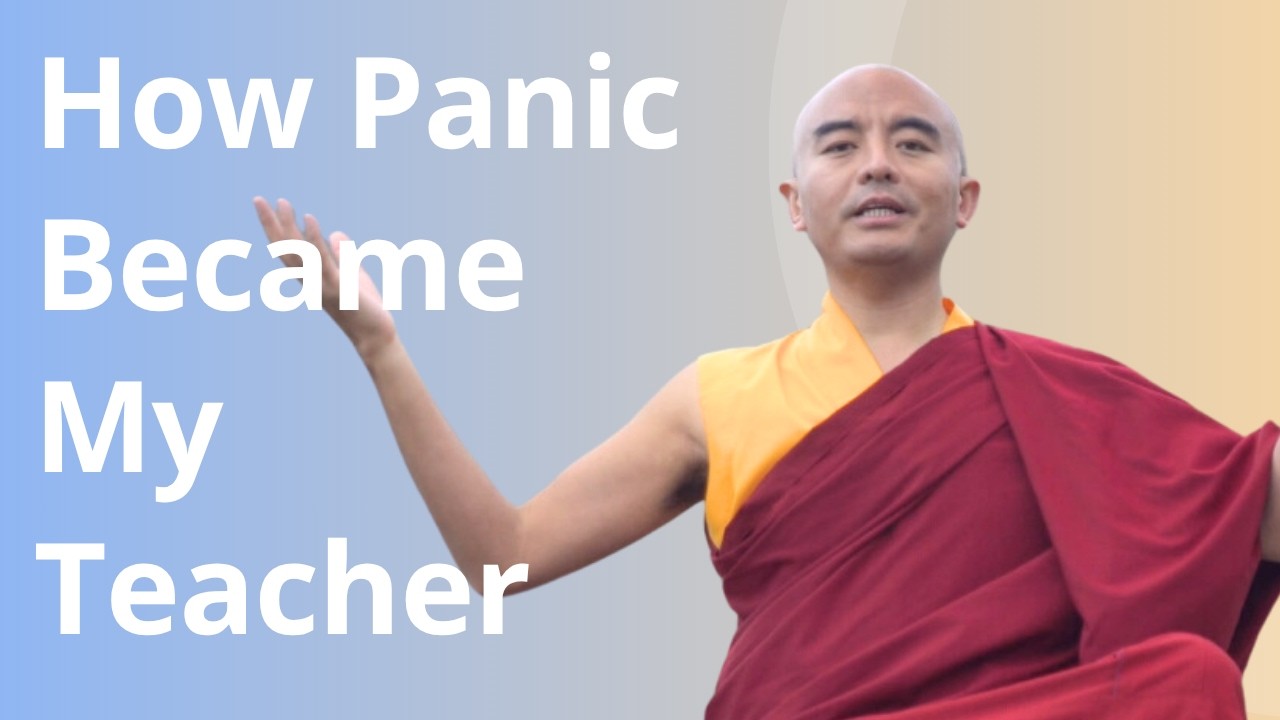
Picture the moment. The heart is climbing, the breath has gone shallow, and a voice inside says only one thing: make this stop. Almost everyone knows that reflex. In a two-minute teaching, Yongey Mingyur Rinpoche takes that reflex apart. His argument is that the effort to banish panic, worry, or anxiety often feeds the very thing we are fighting, and that the way out runs in the opposite direction from where most of us are pushing. Drawing on his own panic attacks as a child, he describes a three-stage shift: from trying to get rid of panic, to greeting it, to using it as a support for meditation. What follows unpacks each stage, why the logic holds together, and where the limits of the idea lie.
The teaching opens with its thesis, stated flatly:
"Don't try to get rid of panic. If you try to get rid of panic, panic become bigger." (Mingyur Rinpoche, YouTube teaching, 0:00)
What makes this more than a slogan is the second layer he identifies. Panic is one experience. The reaction to panic is another. He says he came to see that "the panic of panic is stronger than panic," and then names the mechanism directly: "The fear of panic, aversion of panic, that makes panic bigger actually." (0:09–0:21)
Consider what that means in practice. A racing heart is alarming on its own. But if every sensation is met with a silent verdict, this is dangerous, this must not be happening, I have to stop it, then the body receives a signal that the situation is an emergency. The attempt to escape the feeling becomes evidence that the feeling is a threat. The resistance adds fuel. This is the loop Mingyur Rinpoche describes, and it explains why the harder someone pushes against panic, the more total it can seem.
The insight is not that panic is pleasant or that the body's alarm is imaginary. It is that the struggle against the experience is a separate, often larger, source of suffering than the experience itself.
Having seen the loop, he began to learn meditation and tried a different approach. In his words: "what I did is, 'Hello, panic. Welcome.'" (0:27–0:30) He reports the result plainly: "Actually, it helps. When I say, 'Welcome to panic.' The intense is diminishing. I was quite happy." (0:33–0:43)
The move here is subtle. He is not telling himself the panic is fine, and he is not asking it to leave. He is changing the stance from opposition to acknowledgment. Instead of treating the surge as an enemy to be defeated, he treats it as a visitor who has arrived. That shift removes the second layer, the aversion, and the first layer, the sensation, often loses intensity when it is no longer being fought.
Readers who have lived with anxiety will recognize how counterintuitive this is. Welcoming a feeling of dread sounds like giving it permission. Mingyur Rinpoche's point, as stated in the teaching, is that the permission is exactly what releases the grip.
This is the most honest part of the teaching, and it deserves attention. He does not present the greeting as a finished realization. He describes the trap that comes next: "So, the next time what I'm doing is, 'Hello, panic. Welcome.' If I say welcome, then you will not come back again, right?" (0:52–0:60)
He catches the flaw himself. The welcome is being used as a bargain, a way to make panic leave. "So, in a way, it become circle again, like dog chasing tail. Like fake fake welcome." (1:02–1:07) Then the twist: "But even though that is fake welcome, it helps." (1:07–1:12)
This matters for anyone trying the idea. A welcome offered in order to get rid of something is still a strategy, and strategies can circle back into resistance. Mingyur Rinpoche's account suggests the practice is not about getting the words perfectly sincere before beginning. Imperfect, even self-serving greetings can loosen the original grip, and the deeper shift arrives through repeated practice. The teaching frames this as movement, not arrival.
From there, he describes a progression in what he uses as an anchor. "So, then I begin to learn meditation and then let panic come, let the panic go, but I was discovering more and more about awareness, love and compassion, wisdom behind the panic. The essence of the panic." (1:14–1:27)
Then the sequence becomes clear: "At the beginning, I use breathing as support for meditation, sound as support for meditation. But in the end, panic become support for meditation." (1:33–1:44)
Anyone who has learned meditation will recognize the logic of a support. Beginners typically rest attention on the breath or on a sound, returning to it each time the mind wanders. Mingyur Rinpoche's claim is that panic can join that list, not as a problem standing in the way of practice, but as the object the attention rests on. Once that happens, he says, "awareness become bigger than panic. So, panic is supporting awareness, almost like to remember the awareness." (1:46–1:58)
The word "remember" is worth pausing on. Panic, in this framing, does not have to be eliminated for awareness to grow. It becomes a reminder to notice, the thing that brings the mind back to the present moment with each surge.
He offers an image to describe the new relationship: "And sometime what we call when you see the river, you are out of river. When you see the panic, you are out of panic. But at the same time, panic still there." (1:58–2:10)
The metaphor points to a shift in vantage point. When you are inside a river, you are carried by its current and cannot see its shape. Stepping onto the bank lets you observe the water, including its force, without being swept away. Mingyur Rinpoche says the same can happen with panic. The panic is not gone. It is still there, sometimes strongly. But the observer is no longer identical with it.
That distinction is at the center of his whole approach. The suffering is not only the sensation; it is the sense of being fully inside it, with no space around it. Awareness creates that space.
He closes with the line that gives the teaching its title: "My panic really become my friend, my teacher." (2:10–2:18)
It would be easy to read this as a neat conclusion, but the speech itself does not resolve every question. It does not say panic disappears, and it does not offer a timeline. What it offers is a direction: stop treating the experience as an enemy to defeat, notice what it reveals, and let it serve as a point of return.
A practical note from the editors, not from the teacher: this is a brief teaching, and panic attacks can be serious. Anyone experiencing frequent or severe panic should involve a qualified health professional alongside any contemplative practice. Mingyur Rinpoche's account is a personal one, and it is offered as his experience.
This clip is a short excerpt of a longer teaching. The full version is available at youtu.be/HUfcPiuMzdU. For readers who want to learn meditation under his guidance at their own pace, the Joy of Living Meditation Program is listed at joy.tergar.org, along with Vajrayana study and online events on the Tergar site. Start with the three stages described here: notice the resistance, try a welcome even if it feels imperfect, and then observe whether the panic can become a point of return for your attention rather than only something to escape.