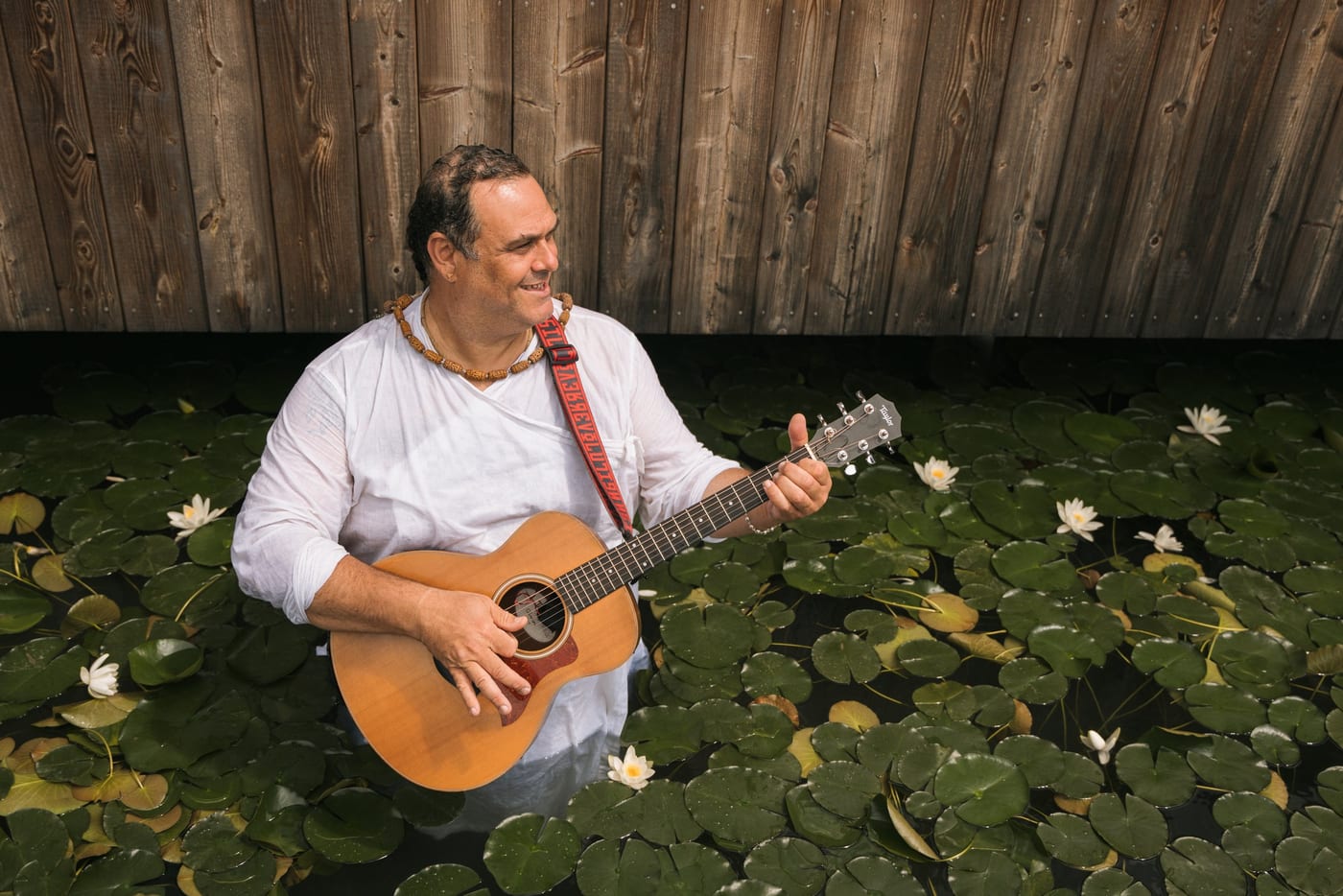

Songs for the Kula arrived on June 14, 2021, as a four-track release. Spotify classifies it as a single, which fits a catalog where short releases arrive far more often than full albums. It belongs to the stretch after Nine Islands (2019) and alongside Love (2022), when Gaura Vani was moving between studio records and smaller, focused drops. This is not a sprawling statement. It is a compact offering, and the word "kula," often understood as a community or family of practitioners, suggests that the music is meant for gathering rather than display.
That fits the larger arc of his life. He was raised by monks in temples from the age of four, steeped in mantra and ritual as daily routine. He rebelled in his teens, acted in Hollywood alongside Michelle Pfeiffer, Denzel Washington and Ethan Hawke, and then spent roughly two decades touring and recording. The catalog is the record of that non-linear path, and a short release like this one shows the devotional center without the scaffolding of a concept album.
The core of Gaura Vani's music is the human voice carrying Sanskrit mantra and bhajan lines, with emphasis on repetition and the names of the divine rather than melodic showmanship. Expect that here: call-and-response instincts, a communal feel, and pacing that asks you to settle in rather than be entertained. The first listen can feel slower than expected. The repetition is part of the design.
I can't itemize the instrumentation track by track, because the available record does not list it for this release. Spotify credits or gauravani.com are the places to confirm who plays what. What can be said is that his world has long included tabla, sarod and mrdanga (khol) through his ensemble As Kindred Spirits, and that kirtan as a form is shaped more by communal singing than by any single instrument. Treat those as context for his wider work, not as a personnel list for these four tracks.
I won't name individual tracks here. The track titles for this release are not in the verified record, and guessing would do you a disservice. Instead, here is how to approach the four-song sequence: listen for the way the opening establishes the room, how repetition builds a collective pulse in the middle, and how the final piece releases that energy rather than escalating it. With only four tracks, the whole thing works as one arc, and Spotify's track listing will give you the titles to follow along.
The work sits in the bhakti tradition, the devotional path centered on love for the divine expressed through song. Kirtan and bhajan are the two working vocabularies, with Sanskrit as the default language. The public record names no specific guru lineage or sampradaya, so the honest claim is the temple upbringing and the practice that came from it. Within the modern chant scene, he has shared stages with Jai Uttal and Krishna Das, which places this release in a recognizable circle of kirtan artists, though his own range, from solo devotional recording to the East-West fusion of As Kindred Spirits to festival kirtan with The Juggernauts, is wider than most.
This release leans toward the intimate end of that range. It is not the loud, crowd-driven festival side of his work.
This suits a listener already curious about bhakti who is willing to hear chant as a sung, communal practice rather than background atmosphere. It will land well for someone who has a sitting or yoga routine and wants a short, repeatable devotional piece, or for someone drifting away from a community and wanting to feel the idea of one. Its brevity is a virtue for newcomers who find a twenty-track compilation daunting.
It is a poor fit for anyone wanting electronic beats, remix-style kirtan or constant variation. Listeners unfamiliar with Hindu names and Sanskrit will face a learning curve, and those who want strictly orthodox temple sound may find his broader career a departure from liturgical purity.
Play it start to finish, without shuffle. Four tracks fit comfortably into a single sitting, so evening is ideal, once the day's noise has dropped. Headphones will reward you if you want to hear the voices and the repetition up close. If you have a practice, a cushion, a candle or a quiet room, use it as the frame and let the sequence run uninterrupted. Try singing along on the second pass. The music is built for participation, and the repetition is an invitation as much as a texture.
If this release resonates, the natural next steps are Meditation & Mantra (2023) for practice-oriented listening, or the compilation Kirtan: The Bhakti Yoga of Chanting Mantras (2018) for a wider survey of the chant side.