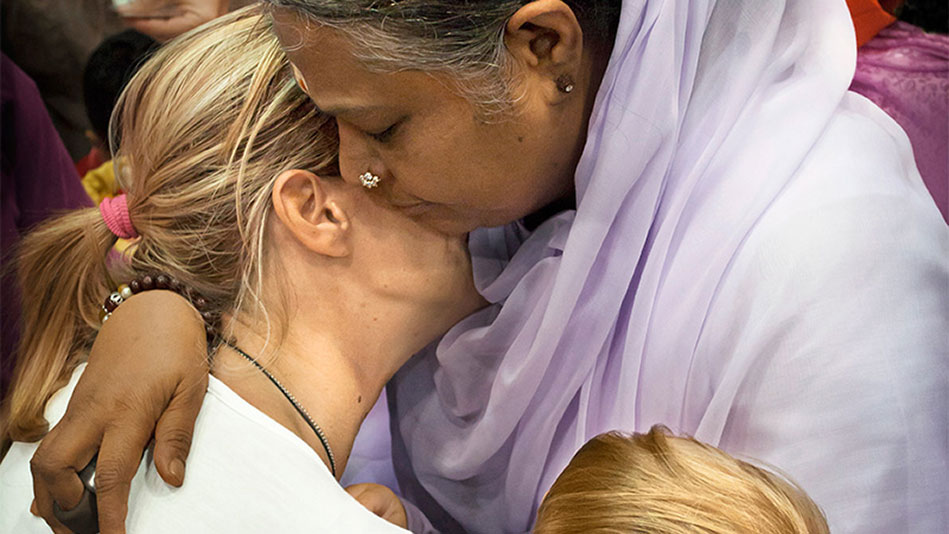
The Transformative Power of a Smile
Amma's assertion that "to smile is to spread love" invites us to consider the profound simplicity of a smile as a conduit for love and connection. In a world often marked by division and strife, this statement serves as a gentle reminder of the power we hold in our expressions. A smile, often overlooked, can transcend barriers, foster understanding, and create a ripple effect of compassion. It is not merely a facial expression; it is an invitation to share warmth and kindness with others.
Delving deeper, we recognize that a smile is an embodiment of the heart's openness. It reflects an inner state of joy and acceptance, suggesting that love is not a finite resource but rather something that multiplies when shared. When we smile, we are not just engaging in a social nicety; we are participating in a sacred act of connection that can uplift both the giver and the receiver. This understanding elevates the act of smiling from a simple gesture to a profound spiritual practice.
The image / the metaphor
At its core, Amma's quote paints a vivid picture of the act of smiling as a deliberate choice to engage with the world through love. The verb "to smile" evokes a sense of agency; it suggests that we have the power to influence our surroundings positively. The imagery of spreading love conjures a sense of movement, as if love is a seed that, once planted, can flourish and grow in the hearts of others. This metaphor invites us to consider how our expressions can serve as vessels for deeper emotional and spiritual truths.
Moreover, the metaphor extends beyond the physical act of smiling. It speaks to the essence of our interactions and the energy we bring into our relationships. A smile can be seen as a bridge, connecting us to others in a shared experience of humanity. In this way, Amma's words encourage us to cultivate an inner landscape rich with love, which we can then express outwardly, creating a harmonious environment that nurtures both ourselves and those around us.
In the speaker's tradition
Amma's teachings are deeply rooted in the bhakti tradition, which emphasizes devotion and love as pathways to spiritual realization. In bhakti, the act of loving others is seen as a reflection of our love for the divine. This interconnectedness aligns with concepts such as dharma, where fulfilling our responsibilities with love and compassion becomes a sacred duty. The act of smiling, therefore, can be viewed as an expression of bhakti, a way to honor the divine presence in every individual we encounter.
Furthermore, the notion of kenosis, or self-emptying, resonates with the idea of spreading love through a smile. By allowing ourselves to be vulnerable and open, we create space for love to flow freely. In the Bhagavad Gita, the concept of selfless action is emphasized, suggesting that when we act without attachment to the fruits of our actions, we embody love in its purest form. Thus, Amma's quote can be seen as an invitation to practice this selflessness, allowing our smiles to become a reflection of our inner devotion.
Living the teaching
Consider a modern scenario where this teaching can take root: a busy urban environment where people often rush past one another, absorbed in their own worlds. In such a setting, a simple smile can serve as a powerful antidote to isolation. Imagine a commuter on a crowded train who, amidst the sea of faces, offers a genuine smile to a fellow passenger. This small act can break the monotony of the day, creating a moment of shared humanity that can uplift spirits and foster a sense of community.
In a more personal context, think about a challenging moment in a relationship, perhaps during a disagreement. Instead of allowing tension to escalate, a smile can serve as a reminder of the love that underlies the connection. By choosing to smile, even in difficult times, we signal our willingness to engage with compassion rather than conflict. This practice not only transforms the immediate interaction but also nurtures the relationship over time, reinforcing the bonds of love and understanding.
A reflection
As we contemplate Amma's profound statement, we are invited to reflect on the nature of our own expressions. How often do we consciously choose to smile, and what impact does that choice have on our interactions with others? In a world that can sometimes feel heavy with burdens, let us consider how our smiles can become beacons of love, illuminating the paths we walk together. What would it mean for you to embrace the practice of smiling as a daily expression of love?