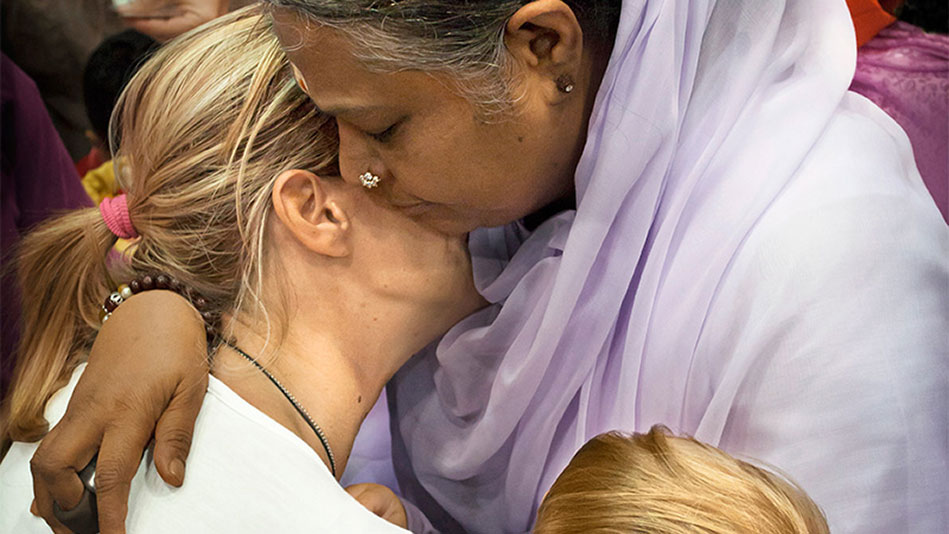
Amma's profound assertion that "Love is the bridge between God and the soul" invites us to contemplate the essential role of love in our spiritual journey. This quote encapsulates the idea that love serves as a vital connection, transcending the boundaries between the divine and our innermost selves. It emphasizes that through love, we can experience a deeper communion with the divine, suggesting that our spiritual aspirations are not merely abstract concepts but are rooted in the warmth and intimacy of love.
In a world often marked by division and disconnection, this teaching resonates with a timeless truth: love is not just an emotion but a transformative force that can unite us with the divine essence. It beckons us to explore how love manifests in our lives, urging us to recognize its power to bridge the perceived gap between our human experience and the divine reality. This exploration is not only relevant to our spiritual lives but also to our everyday interactions, reminding us that love is the thread that weaves together our existence.
The image / the metaphor
The metaphor of love as a bridge evokes a vivid image of connection and passage. A bridge serves as a means to traverse a divide, symbolizing the journey from the mundane to the sacred. The choice of the word "bridge" implies that there is a distance to be crossed, a separation between the soul and God that love can help to overcome. This imagery invites us to envision love as a dynamic force that facilitates movement, allowing us to traverse the often turbulent waters of life and reach a place of divine union.
Diving deeper into this metaphor, we can see that a bridge is not merely a structure; it is a pathway that requires both intention and effort to traverse. Love, in this sense, is an active engagement, a conscious choice to connect with the divine and with others. It suggests that the journey to God is not a solitary endeavor but one that is enriched by our relationships and our capacity to love. This understanding transforms our perception of love from a passive feeling to an active, life-giving force that propels us toward spiritual awakening.
In the speaker's tradition
Amma's teachings are deeply rooted in the bhakti tradition, which emphasizes devotion and love as the primary means of connecting with the divine. In bhakti, love is not merely an emotion but a spiritual practice that cultivates a profound relationship with God. This tradition teaches that through acts of love and devotion, we can experience a sense of surrender, or kenosis, allowing us to empty ourselves of ego and open our hearts to divine grace. The concept of bhakti embodies this surrender, inviting practitioners to engage in a loving relationship with the divine that transcends the self.
In the context of bhakti literature, we can draw parallels to texts such as the *Bhagavad Gita*, where love and devotion are central themes. The Gita speaks of surrendering to God with love, emphasizing that such surrender leads to liberation and unity with the divine. This echoes Amma's assertion that love is the bridge, as it is through love and devotion that we can dissolve the barriers that separate us from our true nature and the divine essence. The teachings of bhakti remind us that love is not just a feeling but a transformative practice that leads us toward spiritual fulfillment.
Living the teaching
Consider a modern scenario where this teaching can be applied: a person grappling with feelings of isolation in a bustling city. Amidst the chaos, they encounter a stranger in need—a lost traveler or a person struggling with their burdens. In that moment, the act of extending kindness and compassion becomes a bridge of love, connecting them not only to the other person but also to a greater sense of purpose and belonging. This simple act of love serves as a reminder that even in our most isolated moments, we can find connection through the love we share with others.
Another application of this teaching can be found within the dynamics of personal relationships. Imagine a couple facing a challenging moment, where misunderstandings have created a rift between them. By consciously choosing to approach each other with love and empathy, they can bridge the gap of hurt and miscommunication. This practice of love—listening, understanding, and forgiving—becomes a transformative force, allowing them to reconnect and deepen their bond. In both scenarios, love acts as the bridge that facilitates healing and unity, reinforcing the idea that love is essential for spiritual and relational growth.
A reflection
As we reflect on Amma's profound statement, we are invited to consider the role of love in our own lives. How can we cultivate love as a bridge to connect more deeply with ourselves and the divine? This question encourages us to explore the ways in which we express love, both towards ourselves and others, and to recognize the transformative power it holds in our spiritual journey. In contemplating this, we may find new pathways to deepen our connection with the divine and with the world around us.