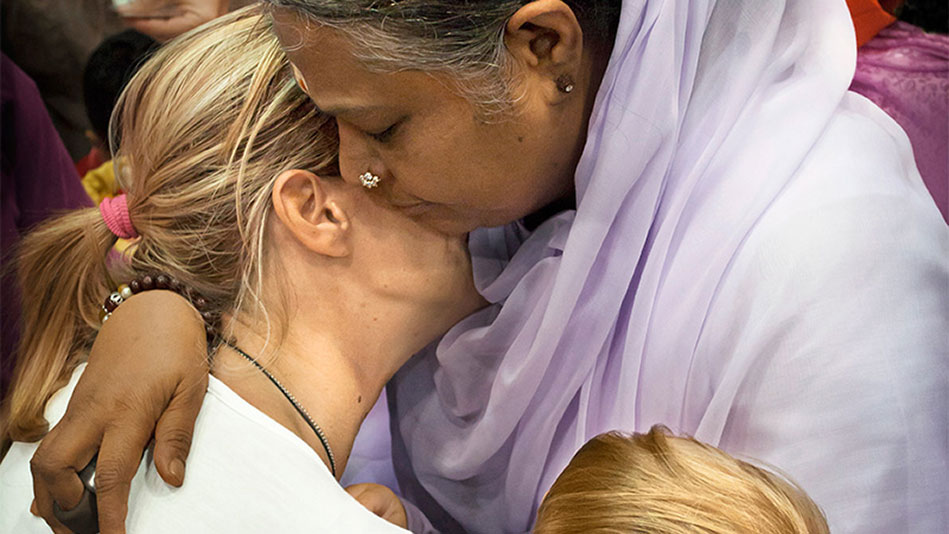
Amma's profound assertion, "In the heart of a child of God, there is no fear," invites us to explore the essence of fearlessness that resides within our spiritual core. This statement speaks to the innate purity and trust that characterizes a childlike heart, one that is untainted by the burdens of worldly anxieties. In a world often overshadowed by fear and uncertainty, understanding this truth becomes essential for our spiritual journey, as it encourages us to return to a state of innocence and openness.
Delving deeper, we recognize that this quote is not merely an observation but a call to action. It challenges us to cultivate a heart that mirrors that of a child—one that is fearless, trusting, and full of wonder. In doing so, we are invited to confront the fears that inhibit our growth and to embrace a more profound connection with the divine. This exploration of fearlessness is not just a personal endeavor; it is a communal invitation to foster a world where love and trust prevail over fear and doubt.
The image / the metaphor
At its core, Amma's quote evokes a vivid image of a child's heart—innocent, open, and unguarded. The phrase "heart of a child of God" conjures a sense of divine belonging, suggesting that within each of us lies a sacred space untouched by the fears that often plague adulthood. The choice of the word "fear" is particularly striking; it encapsulates the myriad anxieties that can cloud our perception and inhibit our ability to love freely. In this context, the heart becomes a metaphor for our true essence, a place where divine love resides, unblemished by the trials of life.
Going deeper, we can interpret the metaphor of the child’s heart as a representation of our spiritual potential. Just as a child approaches the world with curiosity and trust, we too can learn to navigate life with a sense of wonder and openness. This perspective invites us to shed the layers of fear that accumulate over time, allowing us to reconnect with the pure love that is our birthright. In this way, the heart of a child serves as a guiding light, illuminating the path toward a fearless existence rooted in divine love.
In the speaker's tradition
Amma's teachings are deeply rooted in the tradition of bhakti, which emphasizes love and devotion as pathways to experiencing the divine. Within this framework, the concept of fearlessness is closely linked to the idea of surrender—an essential aspect of bhakti. By surrendering our fears and anxieties to the divine, we open ourselves to the transformative power of love, allowing it to permeate our hearts and dispel the shadows of doubt. This act of surrender, or kenosis, mirrors the self-emptying love that characterizes the relationship between the devotee and the divine.
Furthermore, the notion of fearlessness resonates with the concept of sunyata, or emptiness, found in various spiritual traditions. In recognizing that our fears often stem from attachments and illusions, we can cultivate a sense of freedom that allows us to experience life more fully. This aligns with the teachings of the Bhagavad Gita, where Krishna encourages Arjuna to act without fear, grounded in the understanding of his divine nature. By embracing our identity as children of God, we can transcend the limitations imposed by fear and step into a more expansive reality.
Living the teaching
Consider a modern scenario where this teaching can be applied: a young person facing the daunting prospect of a job interview. The anxiety that accompanies such situations can be overwhelming, often rooted in fear of rejection or failure. However, by embodying the heart of a child, this individual can approach the interview with a sense of curiosity and openness, viewing it as an opportunity for growth rather than a potential source of fear. This shift in perspective allows them to engage authentically, fostering a connection with the interviewer that transcends the superficialities of the situation.
In relationships, the teaching of fearlessness can manifest in moments of vulnerability. Imagine a couple navigating a difficult conversation, where fear of conflict might otherwise inhibit honest communication. By embracing the heart of a child, they can approach the dialogue with trust and openness, recognizing that their love for one another is stronger than any fear that may arise. This practice of fearlessness not only deepens their connection but also creates a safe space for growth and understanding, allowing their relationship to flourish in the light of love.
A reflection
As we contemplate Amma's words, we are invited to reflect on our own hearts. What fears do we carry that prevent us from fully embracing our divine nature? In what ways can we cultivate a childlike heart, one that trusts in the goodness of life and the presence of love? By engaging with these questions, we can begin to unravel the layers of fear that obscure our true essence, allowing the light of our inner child to shine forth and guide us on our spiritual journey.