Embracing the Divine in Every Heartbeat
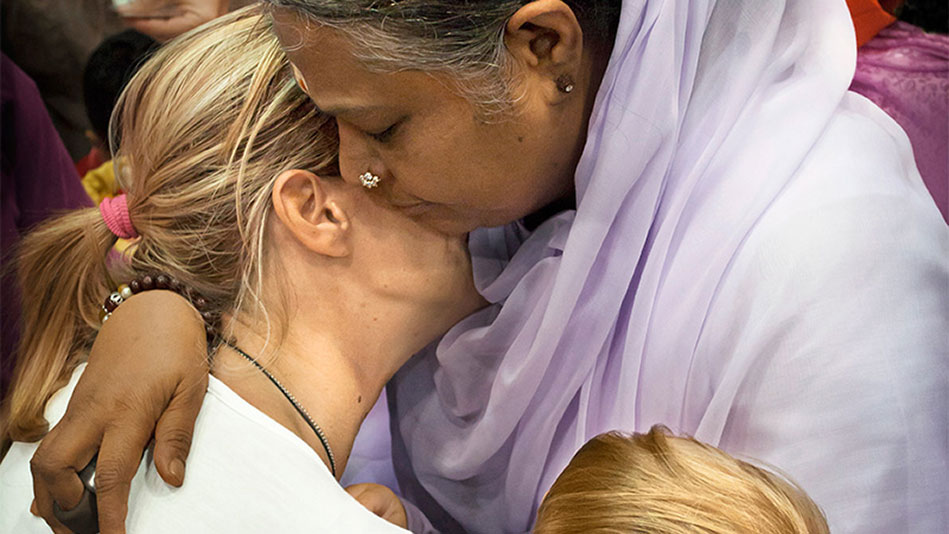
Amma's exhortation to "Children, love everyone. Serve everyone. See God in all" encapsulates a profound spiritual directive that transcends mere ethical behavior. It invites us to cultivate an expansive heart, one that recognizes the divine essence in every individual we encounter. This teaching is not just a call to action; it is a transformative lens through which we can perceive the world, urging us to dissolve the boundaries of separation and embrace a more unified existence.
In a world often marked by division and strife, Amma's words resonate with a timeless urgency. They challenge us to rethink our relationships with others and ourselves, urging us to embody love and service as foundational principles of our lives. This perspective not only enriches our personal experiences but also contributes to the collective healing of our communities, reminding us that the divine is not an abstract concept but a living reality present in every interaction.
The image / the metaphor
The imagery in Amma's quote is both simple and profound, evoking a sense of universal kinship. The verbs "love" and "serve" are active, demanding engagement and participation in the world around us. To "see God in all" is an invitation to shift our perception, to look beyond the surface and recognize the sacredness that resides within every being. This perspective transforms our interactions, encouraging us to approach others with compassion and reverence.
Diving deeper into the metaphor, we find that love and service are not merely actions but expressions of a deeper spiritual truth. When we love and serve, we align ourselves with the divine flow of existence, participating in the interconnected web of life. This interconnectedness is a reminder that our actions ripple outward, affecting not only those we directly engage with but also the larger tapestry of humanity. In this way, Amma's teaching becomes a call to embody the divine qualities of love and service in our daily lives.
In the speaker's tradition
Amma's teachings are deeply rooted in the bhakti tradition, which emphasizes devotion and love for the divine as the path to spiritual realization. Concepts such as dharma, the moral order of the universe, and bhakti, the loving devotion to God, are central to understanding her message. In bhakti, the act of serving others is seen as a direct expression of one's love for God, reinforcing the idea that to love and serve humanity is to honor the divine presence within each person.
Moreover, this teaching resonates with the notion of kenosis, or self-emptying, found in various spiritual traditions. By letting go of our ego-driven desires and embracing a life of service, we create space for the divine to manifest through us. This aligns with the teachings of the Bhagavad Gita, where selfless action is celebrated as a means to attain spiritual liberation. In this context, Amma's words serve as a reminder that our spiritual journey is intertwined with our relationships with others.
Living the teaching
Consider a modern scenario where this teaching can take root: a busy urban environment where individuals often rush past one another, absorbed in their own lives. In such a setting, Amma's call to "love everyone" can manifest in small yet significant ways, such as offering a smile to a stranger or assisting someone in need. These seemingly minor acts of kindness can create ripples of compassion, transforming the atmosphere around us and fostering a sense of community.
In a more personal context, this teaching can be applied within our relationships, especially during challenging moments. When faced with conflict or misunderstanding, remembering to "serve everyone" can shift our approach from defensiveness to openness. By choosing to respond with love and understanding, we not only honor the other person but also nurture our own spiritual growth. This practice encourages us to see beyond our differences and recognize the shared humanity that binds us all.
A reflection
As we contemplate Amma's profound invitation, we might ask ourselves: "In what ways can I embody love and service in my daily interactions?" This question invites us to reflect on our current relationships and the opportunities we have to see the divine in others. By engaging with this inquiry, we open ourselves to a deeper understanding of our interconnectedness and the transformative power of love.