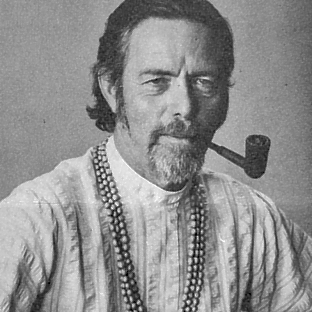
The Universe Within: Embracing Our Cosmic Nature
Alan Watts once remarked, "The body is the universe in miniature," a profound assertion that invites us to explore the intricate relationship between our physical existence and the vast cosmos. This statement serves as a reminder that our bodies are not merely vessels but rather reflections of the universe itself, encapsulating its mysteries and energies. Understanding this connection can deepen our appreciation for life and foster a sense of unity with all that exists, urging us to transcend the illusion of separation that often plagues our modern consciousness.
In a world that frequently emphasizes individualism and materialism, Watts' insight challenges us to reconsider our identity and place within the grand tapestry of existence. By recognizing that our bodies embody the universe, we are encouraged to cultivate a sense of reverence for our physical form and the life it houses. This perspective not only enriches our personal experience but also invites us to engage with the world around us in a more holistic and interconnected manner, fostering compassion and understanding in our interactions with others.
The image / the metaphor
At first glance, the imagery in Watts' quote evokes a sense of wonder and curiosity. The phrase "the body is the universe in miniature" suggests a microcosm, where every part of the body reflects the whole of the cosmos. This metaphor invites us to visualize our physical form as a complex system, intricately woven with the same energies and elements that compose the stars, planets, and galaxies. The verbs chosen—"is" and "in"—indicate a state of being and inclusion, emphasizing that our existence is not separate from the universe but rather an integral part of it.
Diving deeper into the metaphor, we can explore the implications of viewing our bodies as a microcosm. This perspective encourages us to see ourselves as living expressions of the universe's creativity and intelligence. Just as the universe is in constant flux, so too is our body, undergoing transformations and adaptations throughout our lives. By embracing this dynamic nature, we can cultivate a sense of harmony with the rhythms of existence, recognizing that our physical experiences are reflections of the greater cosmic dance.
In the speaker's tradition
Alan Watts, a prominent figure in the exploration of Eastern philosophies, particularly Zen Buddhism, invites us to consider the interconnectedness of all things. Within this tradition, concepts such as sunyata (emptiness) and dharma (the natural order of the universe) resonate with the idea that our bodies are not isolated entities but rather manifestations of a greater reality. The notion of kenosis, or self-emptying, further complements this understanding, as it encourages us to let go of the ego and embrace our unity with the cosmos.
In his works, Watts often draws upon the teachings of Zen masters, who emphasize the importance of direct experience over intellectual understanding. For instance, in the Zen text "The Heart of the Buddha's Teaching," Thich Nhat Hanh speaks of interbeing, the idea that all phenomena are interconnected and interdependent. This aligns with Watts' assertion, as recognizing our bodies as the universe in miniature invites us to experience the profound unity that exists beneath the surface of our individual lives.
Living the teaching
Consider a modern scenario where this teaching can be applied: a busy urban environment where individuals often feel disconnected and overwhelmed. In such a setting, one might find solace in the practice of mindfulness, taking a moment to breathe deeply and connect with their body. By acknowledging that their physical presence is a reflection of the universe, they can cultivate a sense of peace and belonging, recognizing that they are not merely a solitary figure in a crowd but a vital part of the larger cosmic whole.
Another application of this teaching can be found in relationships. When faced with conflict or misunderstanding, remembering that our bodies embody the universe can help us approach the situation with empathy and compassion. By recognizing the shared humanity and interconnectedness that exists between ourselves and others, we can navigate difficult moments with greater understanding, fostering deeper connections and healing within our relationships.
A reflection
As we contemplate Watts' assertion that "the body is the universe in miniature," we are invited to reflect on our own experiences of unity and interconnectedness. How can we cultivate a deeper awareness of the cosmic nature within ourselves and others? In what ways can this understanding transform our daily lives and relationships, allowing us to live more fully in harmony with the universe? Let this question guide your contemplation as you explore the profound implications of being a living embodiment of the cosmos.

