



What is Rebirthing?
Rebirthing, also called rebirthing-breathwork, is a breathwork method in which a person breathes in a continuous, connected pattern, with no pause between inhale and exhale. A trained facilitator usually guides the session. A session typically lasts 60 to 90 minutes. The aim is to bring attention to physical sensations, emotions and memories that surface during the breathing and to let them pass without being suppressed. The practice is sometimes called conscious connected breathing, though that name now covers several related methods.
If you are asking what rebirthing means, the term has two uses. In the breathwork tradition it refers to this breathing method. In clinical psychology it can also refer to “rebirthing therapy,” a different and discredited practice described under misconceptions below. The two are unrelated in method and should not be confused.
Origins & lineage
Rebirthing was developed in the United States by Leonard Orr (1937–2023). He began teaching it in California in the early 1970s. Orr said the method grew out of his own experiences of deep relaxation and breathing, including an experience in a warm bath. He first built his theory around the idea that the trauma of birth leaves a lasting imprint. That idea has precedents in Otto Rank’s The Trauma of Birth (1924) and in Arthur Janov’s primal therapy. Orr later de-emphasized birth re-enactment and described the breath itself as the main tool.
Sondra Ray, an early student, helped popularize the method. Her book I Deserve Love (1976) and her co-authored Rebirthing in the New Age (1977, with Orr) brought it to a wide audience. Orr also developed related teachings on spiritual purification and what he called the “death habit.” He set these out in Breaking the Death Habit (1998). Many practitioners find these ideas controversial, and others set them aside.
Rebirthing belongs to the same period as Stanislav and Christina Grof’s holotropic breathwork. The two methods are distinct. Holotropic breathwork uses faster breathing, evocative music and a sitter-and-breather structure. Rebirthing tends to use a gentler, relaxed rhythm.
How it’s practiced
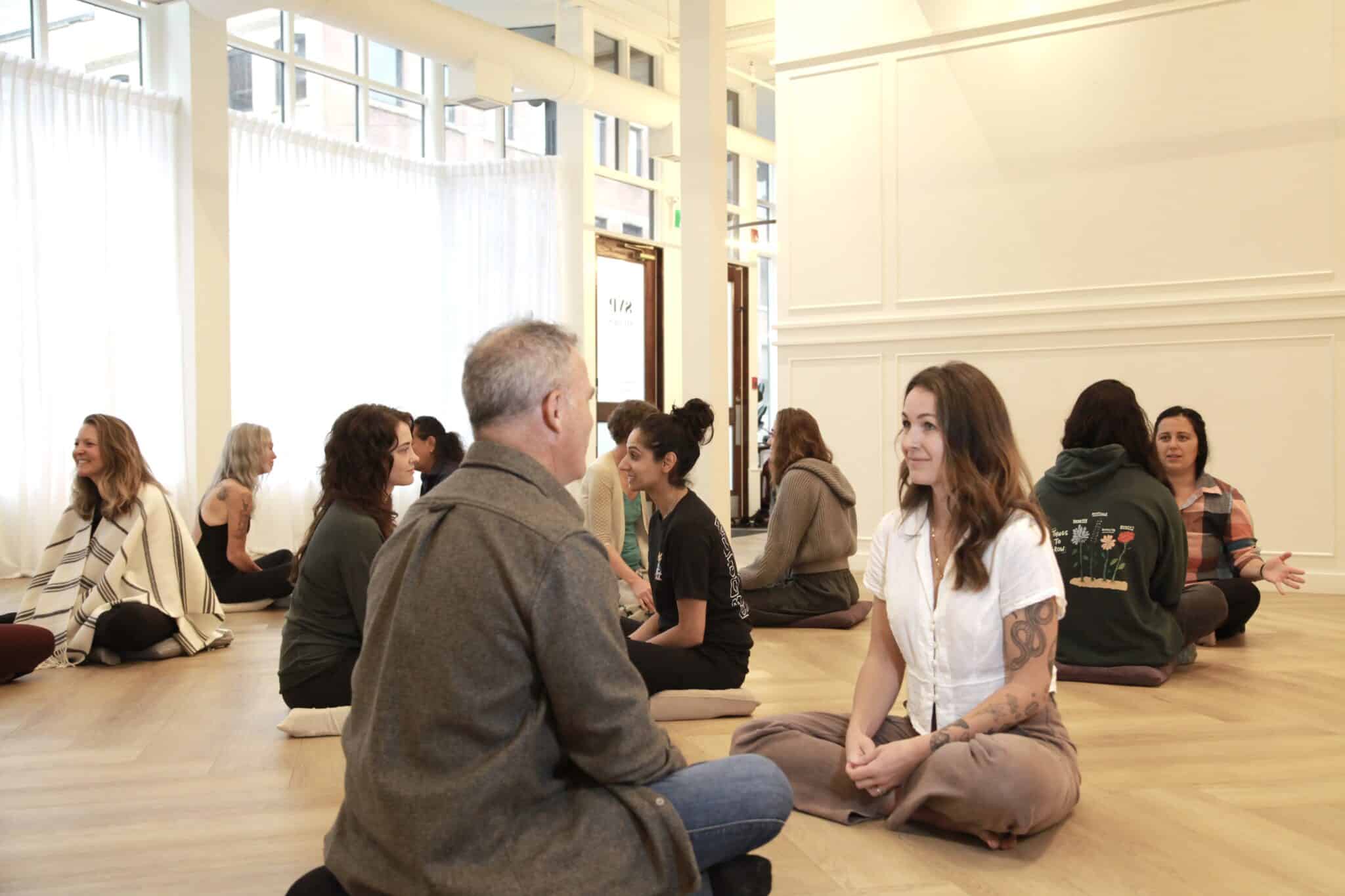
Sessions are usually done lying down, often with a facilitator present throughout. The breath is circular. The inhale is active and the exhale is relaxed and unforced, with no gap between them. The mouth or nose may be used, depending on the teacher. Pace and depth are adjusted to the person.
Common experiences include tingling in the hands and face, muscular tension or tetany, warmth or coolness, emotional release, and vivid imagery. The facilitator’s role is to coach the rhythm, keep the person safe and help them stay with what arises. Many teachers also offer a conversation before and after the session.
The physiology is partly understood. Sustained overbreathing lowers blood carbon dioxide and raises blood pH, which can produce the tingling and cramping sensations. Whether these effects are what produce any lasting psychological benefit is debated.
Rebirthing today
Rebirthing is now taught under several names, including rebirthing-breathwork, conscious connected breathing, integrative breathwork and transformational breath. Seekers meet it through individual sessions, group classes, weekend workshops and residential retreats. Some practitioners offer guided audio recordings, though many teachers advise against doing intense breathing alone. Trainings for facilitators vary widely in length and rigor, and no single body sets a universal standard.
Common misconceptions
- It is not rebirthing therapy. In the 1990s, some attachment-therapy practitioners used a coercive technique in which a child was wrapped in a blanket or sheet and made to “emerge” while adults pressed against them. In 2000, ten-year-old Candace Newmaker died during such a session in Colorado. Her death led to legal restrictions in Colorado and some other US states. Breathwork rebirthing involves no restraint and no physical compression.
- It is not literal re-living of birth. Some practitioners treat birth memories as meaningful, but there is no scientific evidence that the method retrieves actual birth memories.
- It is not medically proven. Research is limited, and claims about treating trauma or illness are not supported by strong clinical trials.
- It is not risk-free. People with epilepsy, serious cardiovascular conditions, severe psychiatric conditions, glaucoma or pregnancy are commonly advised to consult a physician first.
How to begin
For rebirthing for beginners, the usual starting point is a single session with an experienced facilitator, either one-to-one or in a small group. Ask the teacher about their training, how they handle strong emotional responses and what health screening they use. For reading, Sondra Ray’s I Deserve Love and the Orr and Ray book Rebirthing in the New Age are the foundational texts, though they reflect the 1970s New Age movement. A first session is best treated as an experiment, with no fixed expectations.