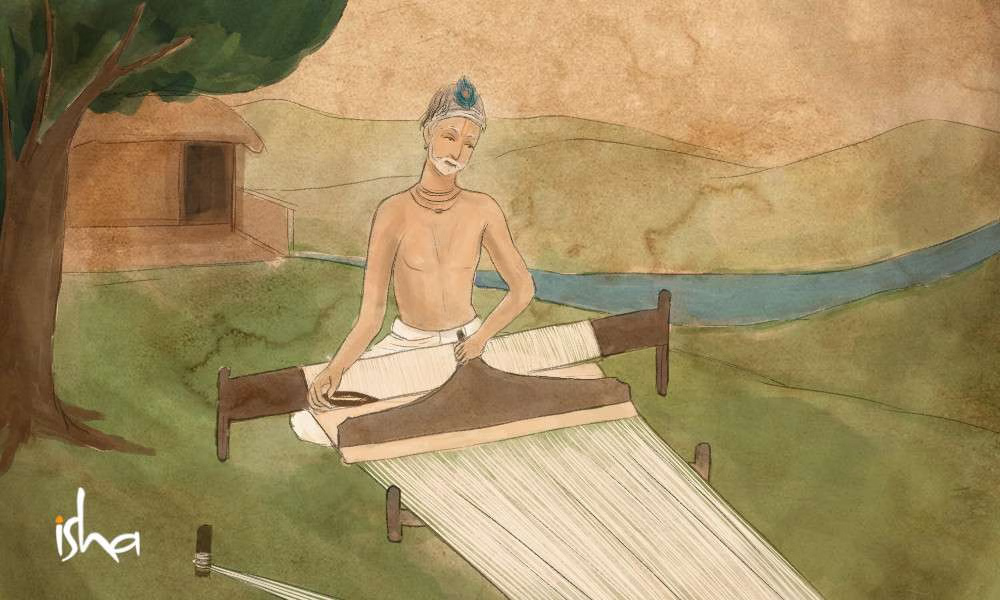
Kabir's poignant assertion, "In the home of true love there is no day and no night," invites us into a realm where the conventional markers of time dissolve in the presence of profound affection. This statement speaks to the essence of love that transcends the ordinary, suggesting a state of being where dualities fade away. In a world often governed by the ticking clock and the relentless march of time, Kabir's words remind us of a deeper, more expansive experience of connection that exists beyond our daily routines and societal expectations.
To grasp the weight of Kabir's insight, we must consider the nature of true love as he perceives it. This love is not merely an emotional attachment or a fleeting passion; it is a transformative force that engulfs the lover and the beloved in a shared existence. In this sacred space, the distinctions between day and night, joy and sorrow, self and other blur, leading to a profound union that reflects the essence of the divine. Such a love is timeless, inviting us to explore the depths of our own hearts and the interconnectedness of all beings.
The image / the metaphor
Kabir's imagery of a home devoid of day and night evokes a sense of sanctuary, a place where the rhythms of life are suspended. The choice of words like "home" suggests warmth, safety, and belonging, while the absence of day and night symbolizes a state of eternal presence. This metaphor paints a picture of love as a refuge from the chaos of the external world, where the lovers exist in a perpetual state of communion, free from the constraints of time. It is a vivid reminder that true love is not bound by the limitations of our earthly existence.
Diving deeper into this metaphor, we can see that the absence of day and night also signifies a release from duality. In many spiritual traditions, including Kabir's, the experience of duality is often seen as a source of suffering. By transcending these oppositions, love becomes a unifying force that dissolves barriers and fosters a sense of oneness. This timeless love is akin to the concept of 'fana' in Sufi thought, where the self dissolves into the beloved, revealing the underlying unity of all existence.
In the speaker's tradition
Kabir's teachings are deeply rooted in the bhakti tradition, which emphasizes a personal, devotional relationship with the divine. In this context, love is not merely an emotion but a spiritual practice that leads to union with the divine essence. Concepts such as 'bhakti'—devotion—and 'kenosis'—the self-emptying love—are central to understanding Kabir's perspective. His poetry often reflects the idea that through surrendering the ego and embracing love, one can experience a state of 'sunyata,' or emptiness, where the self merges with the infinite.
A relevant text that echoes this sentiment is the "Bhagavad Gita," where the notion of selfless love and devotion is explored. In Chapter 12, Krishna speaks of the path of devotion as a means to attain union with the divine, emphasizing that true love transcends the dualities of existence. Kabir's assertion resonates with this teaching, as both highlight the transformative power of love that leads to a timeless state of being, free from the constraints of worldly concerns.
Living the teaching
Consider a modern scenario where this teaching might resonate: a couple navigating the complexities of life together. Amidst the demands of work, family, and societal expectations, they find moments of connection that transcend the ordinary. In these fleeting instances—perhaps during a shared silence or a spontaneous act of kindness—they experience a glimpse of that timeless love Kabir speaks of, where the pressures of time and responsibility fade away, leaving only the purity of their bond.
A reflection
As we contemplate Kabir's profound insight, we are invited to reflect on our own experiences of love. In what ways have we encountered moments where time seemed to stand still, where the essence of love enveloped us in a timeless embrace? This contemplation encourages us to seek out and nurture those connections that transcend the ordinary, reminding us that true love is not just an emotion but a pathway to a deeper understanding of ourselves and our place in the universe.
