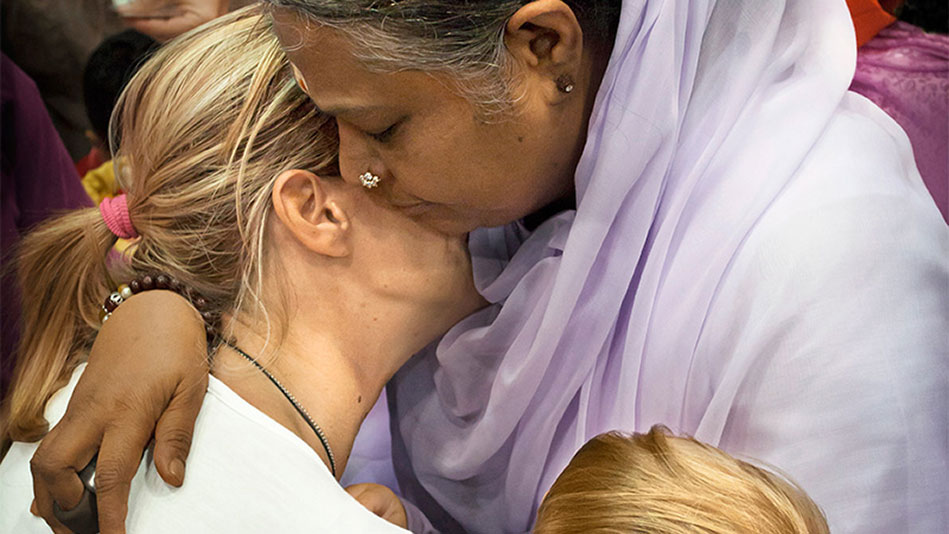
Amma's profound assertion, "Service of the world is worship of God," invites us to reconsider the very essence of worship itself. In this statement, she elegantly intertwines the act of serving others with the spiritual act of honoring the divine. This perspective challenges conventional notions of worship, suggesting that our interactions with the world and its inhabitants are not merely duties but sacred expressions of our devotion. By embracing this understanding, we elevate our everyday actions to a form of spiritual practice, thereby enriching both our lives and the lives of those around us.
Delving deeper, we find that Amma's words resonate with the essence of bhakti, the path of love and devotion. This path emphasizes the importance of surrendering oneself to the divine through acts of love and service. In a world often marked by division and self-interest, Amma's teaching serves as a reminder that our true connection to the divine is manifested through our relationships with others. By serving the world, we not only fulfill our dharma but also cultivate a profound sense of unity with the divine presence that permeates all existence.
The image / the metaphor
At first glance, the imagery in Amma's quote evokes a sense of duality: the world and God, service and worship. The verb "service" implies action, engagement, and a willingness to contribute to the well-being of others. In contrast, "worship" often conjures images of ritual, prayer, and personal devotion. Yet, Amma's statement blurs these boundaries, suggesting that the act of serving others is not separate from, but rather an integral part of, our relationship with the divine. This imagery invites us to see the sacred in the mundane, to recognize that every act of kindness is a prayer, every moment of compassion a hymn.
In the speaker's tradition
Amma's teachings are deeply rooted in the tradition of bhakti, which emphasizes love and devotion as pathways to spiritual realization. Within this framework, the concepts of dharma and selfless service (seva) are paramount. Dharma refers to one's duty or righteous path, while seva embodies the spirit of selfless service to others. By intertwining these concepts, Amma highlights that fulfilling our dharma through acts of service is not only a moral obligation but also a spiritual practice that brings us closer to the divine. This understanding aligns with the notion of kenosis, or self-emptying, where one relinquishes the ego to serve a higher purpose.
Moreover, the idea of seeing the divine in all beings is echoed in various spiritual texts. For instance, the Bhagavad Gita teaches that all actions performed with a sense of surrender to the divine are considered yoga, or union with God. In this light, Amma's assertion can be seen as a modern interpretation of ancient wisdom, encouraging us to recognize that our interactions with the world are imbued with sacred significance. This perspective invites us to engage in our daily lives with a sense of reverence and purpose, transforming ordinary moments into opportunities for divine connection.
Living the teaching
Consider a modern scenario where this teaching can be applied: a community struggling with food insecurity. In such a situation, individuals can come together to organize food drives, soup kitchens, or community gardens. These acts of service not only address immediate needs but also foster a sense of belonging and interconnectedness. By engaging in these efforts, participants embody Amma's teaching, recognizing that their service to the community is a direct expression of their worship of the divine. This collective action not only uplifts those in need but also enriches the lives of those who serve, creating a cycle of love and compassion.
Another application of this teaching can be found in personal relationships, particularly during challenging moments. Imagine a conflict with a loved one, where misunderstandings and hurt feelings have created distance. By approaching the situation with a mindset of service—listening deeply, offering forgiveness, and seeking to understand the other person's perspective—we can transform the conflict into an opportunity for growth and healing. In this way, the act of serving our relationships becomes a form of worship, allowing us to honor the divine presence within ourselves and others, even amidst difficulty.
A reflection
As we contemplate Amma's profound statement, we are invited to reflect on the ways in which our daily actions can embody our spiritual beliefs. How can we transform our service to the world into a genuine expression of worship? This question encourages us to examine our intentions and actions, prompting us to seek opportunities for service that resonate with our values and deepen our connection to the divine. In this exploration, we may discover that the path to spiritual fulfillment lies not in isolated rituals but in the loving engagement with the world around us.