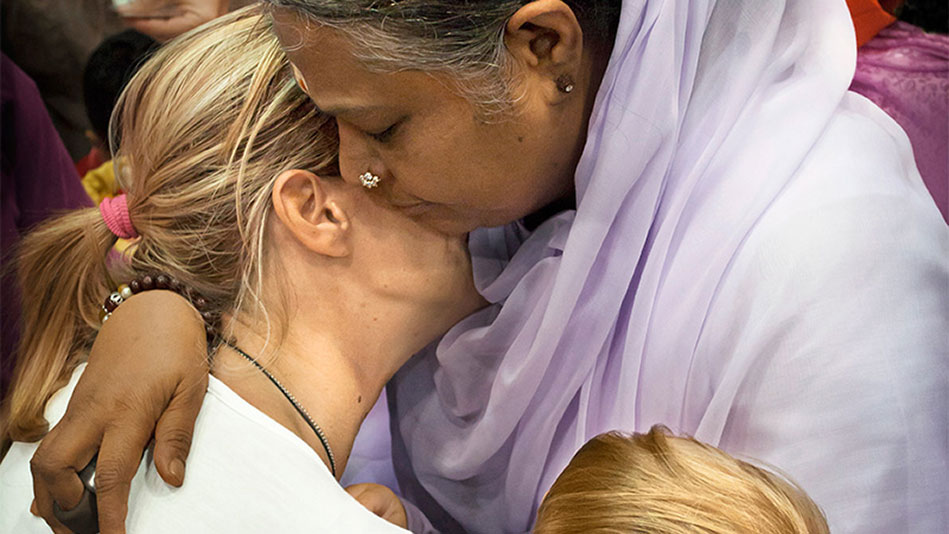
Amma's assertion that "pure love is the medicine for every wound" invites us to consider the profound healing potential inherent in love. This statement resonates deeply in a world often marked by suffering, division, and emotional pain. By framing love as a remedy, Amma encourages us to explore the transformative power of love in our lives, suggesting that it can mend not only personal wounds but also the collective scars of humanity.
In a society that frequently prioritizes material success and individual achievement, Amma's words serve as a gentle reminder of the importance of emotional and spiritual well-being. Love, in its purest form, transcends the superficial and reaches into the depths of our being, offering solace and healing. This perspective challenges us to rethink our understanding of love—not merely as an emotion but as a potent force capable of fostering connection, understanding, and ultimately, healing.
The image / the metaphor
At first glance, the imagery in Amma's quote is strikingly simple yet profoundly evocative. The phrase "pure love" conjures an image of untainted, unconditional affection, while "medicine" suggests a remedy that can heal physical or emotional wounds. The verb "is" implies a direct equivalence, elevating love to a status where it becomes synonymous with healing. This metaphor invites us to visualize love as a salve, soothing the raw edges of our pain and suffering.
Diving deeper into the metaphor, we can see that love operates on multiple levels. It is not merely a passive balm but an active agent that requires engagement and vulnerability. Just as medicine must be administered to be effective, love must be expressed and received to fulfill its healing potential. This dynamic interplay between giving and receiving love underscores the relational nature of healing, suggesting that our wounds can only be truly addressed through connection with others.
In the speaker's tradition
Amma's teachings are deeply rooted in the bhakti tradition, which emphasizes devotion and love as pathways to spiritual realization. In bhakti, love is not just an emotion but a form of divine expression, a manifestation of the relationship between the devotee and the divine. Concepts such as dharma, or righteous living, and kenosis, the self-emptying love exemplified by figures like Christ, resonate with Amma's assertion that love is a healing force. This tradition teaches that through acts of love and devotion, we can transcend our individual suffering and connect with a greater universal love.
In the Bhagavad Gita, for instance, the idea of surrendering to divine love is central to the path of bhakti. The text encourages practitioners to cultivate a loving relationship with the divine, suggesting that such devotion can alleviate the burdens of life. This aligns with Amma's perspective, as both emphasize that love—whether directed towards God or fellow beings—serves as a powerful antidote to the wounds we carry.
Living the teaching
Consider a modern scenario where this teaching might resonate: a friend has just experienced a significant loss, leaving them feeling isolated and heartbroken. In this moment, the application of Amma's wisdom becomes clear. By offering pure love—through presence, listening, and compassion—we can act as a healing balm for their wounds. This act of love not only supports the grieving individual but also fosters a deeper connection between friends, illustrating how love can bridge the gap created by suffering.
Another application of this teaching can be found in the context of romantic relationships. Imagine a couple facing a conflict that has left them feeling hurt and misunderstood. By consciously choosing to approach each other with pure love—seeking to understand rather than to blame—they can begin to heal the rift between them. This practice of love, rooted in empathy and compassion, transforms the relationship, allowing both partners to emerge stronger and more connected.
A reflection
As we contemplate Amma's profound assertion that "pure love is the medicine for every wound," we are invited to reflect on our own lives. In what ways can we cultivate and express pure love in our interactions with others? This question encourages us to consider not only how we can heal ourselves through love but also how we can be agents of healing in the lives of those around us.