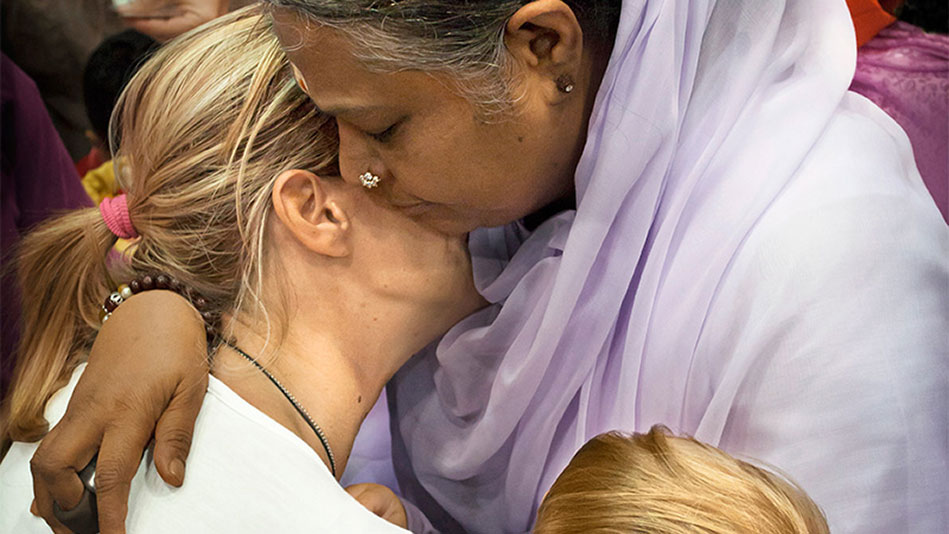
In the profound words of Amma, "Anger is born of weakness. Patience is the strength of the strong." This statement invites us to explore the intricate relationship between our emotional responses and our inner strength. It suggests that anger, often perceived as a powerful reaction, is, in fact, a manifestation of vulnerability. Understanding this dynamic is crucial in our journey toward emotional maturity and spiritual growth, as it challenges us to reconsider how we respond to life's adversities.
Moreover, Amma's insight encourages us to cultivate patience as a virtue that signifies true strength. In a world that often equates power with aggression, this perspective offers a refreshing lens through which we can view our interactions and conflicts. By recognizing that patience is not merely the absence of anger but a deliberate choice rooted in strength, we can begin to transform our emotional landscape and foster more harmonious relationships with ourselves and others.
The image / the metaphor
At its core, Amma's quote presents a striking dichotomy between anger and patience. The imagery of anger as a product of weakness evokes a sense of fragility, suggesting that when we react with fury, we are not standing firm but rather crumbling under pressure. The verbs chosen—"born" and "strength"—imply a natural process of emergence and growth. Anger, in this sense, is not a sign of power but rather a signal of our inability to cope with our emotions, while patience emerges as a cultivated quality that requires effort and resilience.
Diving deeper into the metaphor, we can see that patience is likened to a fortress, a stronghold that protects us from the tumultuous storms of anger. It is a conscious choice to remain grounded, to breathe through the heat of the moment, and to respond with clarity rather than react impulsively. This imagery invites us to envision patience as a skill that can be developed over time, much like a muscle that strengthens with consistent practice. In this light, we begin to understand that true strength lies not in the ability to lash out but in the capacity to remain calm and composed amidst chaos.
In the speaker's tradition
Amma's teachings are deeply rooted in the bhakti tradition, which emphasizes devotion and love as pathways to spiritual realization. Within this framework, the concepts of dharma and kenosis resonate profoundly with her assertion about anger and patience. Dharma, or righteous duty, encourages individuals to act with integrity and compassion, while kenosis, the act of self-emptying, invites us to relinquish our ego-driven impulses, including anger. In this context, patience becomes a manifestation of our commitment to living in alignment with our higher selves, transcending the limitations of our emotional reactions.
Furthermore, the notion of sunyata, or emptiness, complements Amma's perspective by highlighting the importance of letting go of attachments that fuel anger. When we cultivate a sense of emptiness, we create space for patience to flourish, allowing us to respond to life's challenges with grace. A relevant text that echoes this sentiment is the Bhagavad Gita, where Lord Krishna advises Arjuna to act without attachment to the fruits of his actions. This teaching reinforces the idea that strength lies in our ability to remain steadfast and patient, even in the face of adversity.
Living the teaching
Consider a modern scenario where this teaching can be applied: a heated discussion at work where differing opinions clash. In such moments, it is easy to succumb to anger, feeling justified in our frustration. However, if we embrace Amma's wisdom, we can choose to pause, breathe, and respond with patience. By doing so, we not only preserve our own emotional well-being but also create an environment conducive to constructive dialogue, fostering collaboration rather than conflict.
Another application of this teaching can be found in personal relationships, particularly during challenging moments. Imagine a disagreement with a loved one that escalates into a cycle of blame and resentment. By embodying patience, we can step back and reflect on our feelings, choosing to communicate with empathy rather than defensiveness. This practice not only strengthens our bonds but also cultivates a deeper understanding of ourselves and others, transforming potential discord into an opportunity for growth and connection.
A reflection
As we contemplate Amma's profound words, we are invited to reflect on our own emotional responses. How often do we find ourselves reacting with anger instead of responding with patience? In moments of frustration, can we pause to recognize the underlying weakness that fuels our anger? This contemplation encourages us to explore the depths of our emotional landscape, inviting us to cultivate the strength of patience as we navigate the complexities of life.