The same rose appears differently to everyone who looks at it. A botanist sees Latin nomenclature and the history of a seed. Someone in love sees a gift for their beloved. An artist observes texture and color. A person with allergies sees a threat. To a devotee, it is God's handiwork in the world. The flower does not change. The mind does.
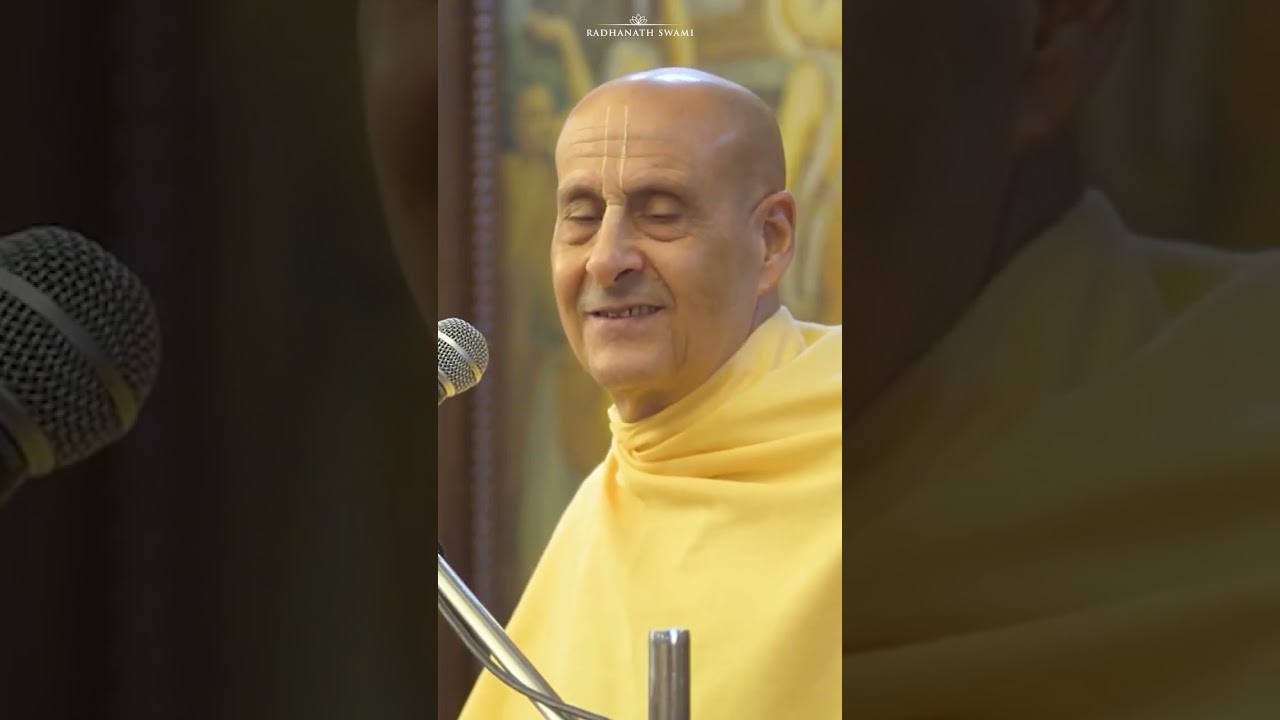
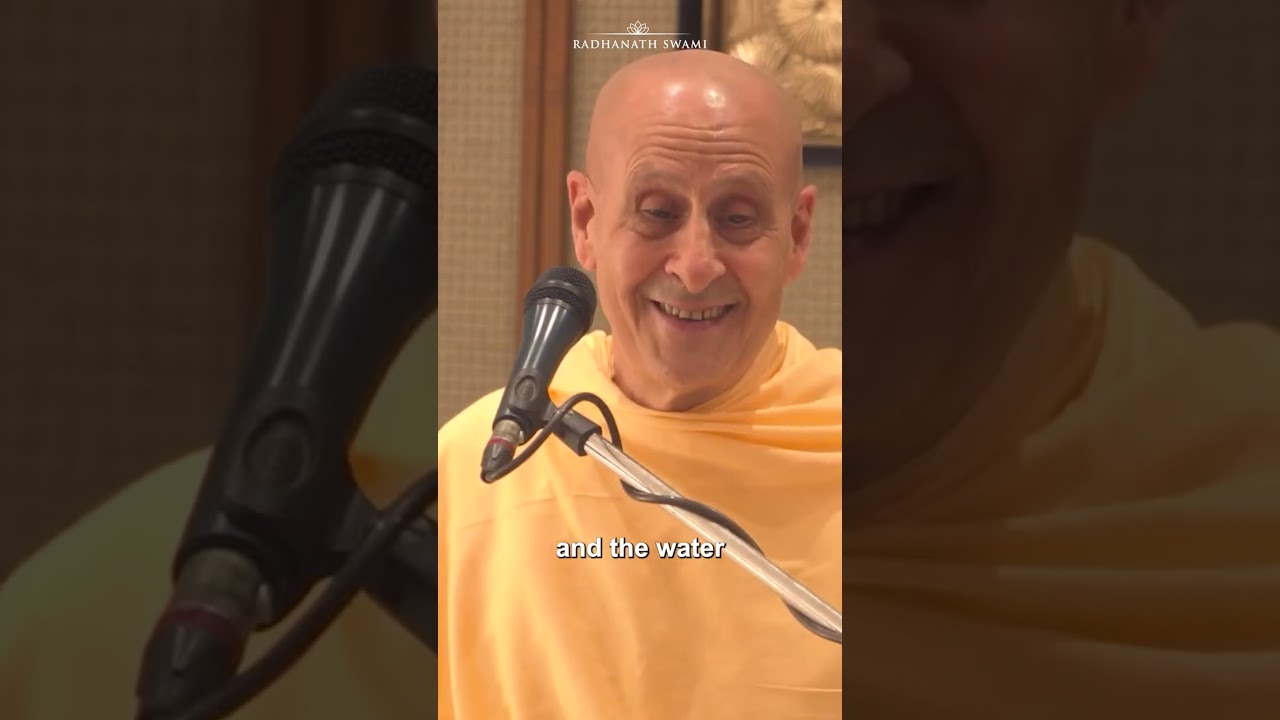
This is the opening insight in a talk by Radhanath Swami, a spiritual teacher in the Bhakti tradition for over five decades, who draws on the ancient Bhagavad Gita to explore one of the most consequential questions in human experience: how do we master perception itself? The Sanskrit word for mind is man—and the Gita offers a paradox that cuts to the heart of spiritual practice. The mind, the text says, becomes one's best friend when controlled, and one's worst enemy when left to its own devices. Not through any external force, but through the lens we choose to look through.
The Colored Glasses Analogy: Why Everyone Sees Differently
Radhanath Swami recalls a teaching from his own guru, Shriapa, that reframes the act of perception. Imagine looking at the world through colored glasses. Green glasses turn everything green. Blue glasses make the world blue. Clear glasses reveal actual color. Yet most of us move through life looking at the same situations, the same people, the same events—seeing them entirely differently because we are not looking through our eyes alone. We are looking through the mind.
In sixty-five years, Radhanath Swami observes, he has never met two people who see anything the same way. Even people with identical eyesight perceive the world differently. The difference lies not in the external world but in the texture of each mind—shaped by experience, education, identity, and the associations we carry. A botanist and a lover and an artist and an allergic person can stand in the same room and occupy entirely different realities, all of them genuine, all of them real to the person experiencing them.
This is not philosophy. It is the basic architecture of consciousness.
Opportunity or Impediment: The Choice That Changes Everything
The implications ripple outward. Because if the mind is the lens, then every situation in life can be seen in two ways: as an opportunity or as an impediment. And this is where the choice becomes crucial. Spiritually successful people—and often successful people in other domains—share a common trait: they see opportunities even in apparent setbacks. They do not deny the difficulty. They reframe the meaning.
Radhanath Swami illustrates this with the story of his own guru's arrival in the West. In 1965, at sixty-nine years old, Shriapa left Vrindavan, a sacred place in India where he had been living, to bring the message of dharma and love of God to the world. He boarded a cargo ship with essentially nothing—only forty rupees that could not be exchanged, a few books, and a heart of compassion. He arrived in America unknown, living in the Bowery, a marginalized neighborhood in New York City. Few people were interested. But within years, he had established a hundred temples, published and distributed hundreds of millions of books and chants, and attracted tens of thousands of disciples and followers.
When asked how he achieved this, Shriapa offered an analogy: a person with nothing wants to start a business. Walking down the road, he sees a dried-up pumpkin—something most people would ignore. He picks it up. Later, he finds a branch. Then a wire. He connects them, creates a musical instrument, and begins a business. "That's the way I started this spiritual society," Shriapa said. "Just whatever I found, I just saw the beauty and the value of it."
This is the alchemy of reframing. The same obstacles that stop others become resources in the hands of someone whose mind is trained to see value rather than only lack.
Unity in Difference: The Body as Teacher
Radhanath Swami shifts to another metaphor, one drawn from the body itself. The human body contains organs of vastly different shapes and functions. The eyes see; the heart does not, yet the heart needs the eyes' information. The pancreas cannot do what the lungs do. Each part is specialized and unique. Yet all these different parts appreciate and recognize the function of every other part. They do not compete. They do not judge. They collaborate.
"When we learn to do that," Radhanath Swami says, "we actually have a healthy mind. We actually can create a healthy society. When instead of being arrogant or fearful of our differences, we learn to value and appreciate our differences—that's a higher level of consciousness that requires a state of mind."
This teaching addresses a specific pathology of modern consciousness: the tendency to flatten difference into threat. In a world saturated with fear and envy and the ceaseless pursuit of desire, differences become sources of anxiety rather than sources of richness. The body knows better. Each organ does not demand to be a kidney. Each organ celebrates what it is and receives the functioning of others.
Beyond Fear: The Child on the Stormy Sea
The deepest teaching in Radhanath Swami's talk centers on the nature of fear itself and how it dissolves in the presence of secure relationship. He recounts a story told to him by a ninety-six-year-old spiritual leader in India—a man who, decades earlier, was a young man traveling on a boat crossing the Arabian Sea.
A massive storm arose. This was the 1930s, long before modern navigation systems. The waves were gigantic. The winds were forceful. The rains pounded down relentlessly. The boat was a small vessel being thrown in every direction, and it seemed certain that everyone aboard would die. Passengers screamed. People held their children. They wept. They were bewildered, unable to do anything.
In the midst of this chaos, my friend saw a small child, about five years old, sitting peacefully. The boy was being pushed around like everyone else, but he remained composed and serene. My friend asked him, "Aren't you afraid?"
The child replied: "I have nothing to fear because my mother is near."
The storm passed. Nobody died. The boat reached its destination. But the story changed the young man's life. He had witnessed something profound: the dissolution of fear not through denial of danger but through a deeper confidence—the presence of someone you trust absolutely.
This is where Radhanath Swami brings the teaching to its spiritual apex. From the perspective of spiritual relationship, when we actually make that connection with God—with the supreme mother, the supreme father—something fundamental shifts in the structure of the mind. Fear no longer dominates. A natural, innate love awakens. We begin to see everything through the lens of presence rather than abandonment. We see connection rather than isolation.
The Architecture of a Transformed Mind
The path Radhanath Swami describes is not about suppressing the mind or achieving some blank state of consciousness. It is about transformation at the level of relationship. The mind remains active, discerning, alive. But it operates from a different root. When we feel that presence—the presence of divine love, the presence of relationship with the ultimate—we rise above hatred and selfish passions. We are still able to see problems and impediments. But we see them now as opportunities for deepening connection, for growth, for the expression of love.
This teaching echoes throughout the Bhagavad Gita, the ancient Hindu scripture that Radhanath Swami references. The Gita does not promise a life without challenges or storms. It offers something more practical: a way of relating to life that does not depend on changing circumstances but on changing the mind itself—or rather, changing the ground from which the mind operates.
The colored glasses remain. But when we see through them in connection with the divine, the colors they reveal are no longer distortions. They become the particular lens through which we are meant to see the world, to serve the world, to love the world.
Where to go from here
The invitation is both simple and radical: notice what colored glasses you are wearing. What associations, fears, desires, and identifications are shaping the way you perceive your situation right now? Can you see the same situation through different eyes? And if you find yourself stuck in a single view, consider whether you are truly connected to a relationship larger than yourself—something or someone you trust to hold you even in the storm.