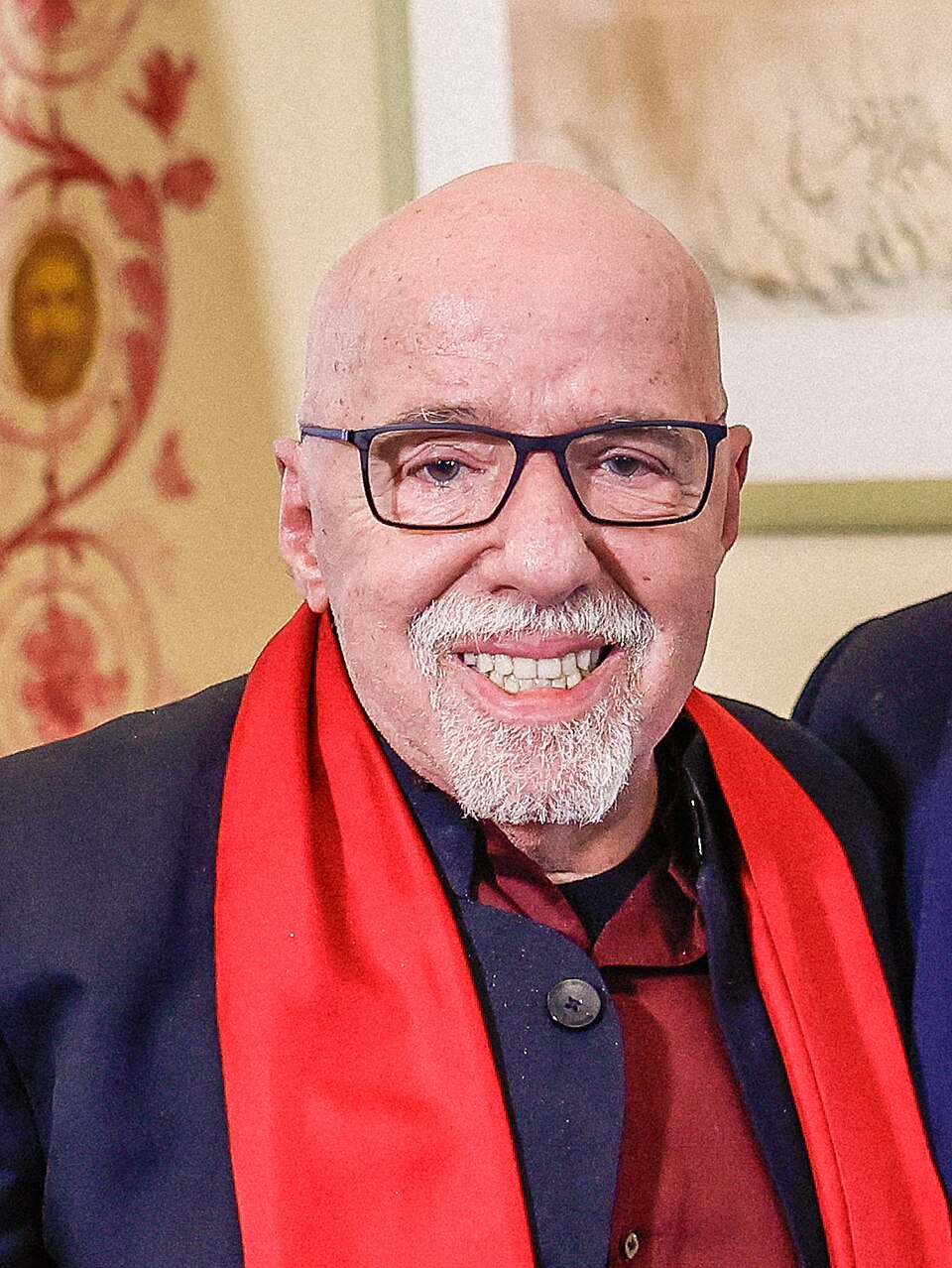
In this collection of reflections, Paulo Coelho frames love not as something to control or understand, but as a wild force that demands risk, acceptance of loss, and freedom. He argues that the worst suffering comes from feeling unloved and uncared-for, while the only true impediment to dreams is fear of failure. Life itself is a train journey where the landscape changes but the motion continues; wisdom means learning to move forward when you can no longer return, releasing what no longer serves you, and recognizing that freedom—like slavery—has a price, paid either with pleasure or pain.
Coelho opens with a stark declaration: "To love is to lose control." This is not poetic exaggeration but a core insight into love's nature. He elaborates that "love is a wild force; when we try to control it, it destroys us; when we try to imprison it, they will only have slaves; when we try to understand it, it leaves us lost and confused." The paradox Coelho identifies is that our attempt to make love manageable—to cage it, to rationalize it, to demand certainty from it—backfires. Control transforms love into slavery, both for the lover and the beloved. Understanding becomes paralysis.
This reflects a deeper philosophical stance: love is not a problem to be solved but a force to be surrendered to. When we stop trying to impose order on love, we stop being destroyed by our own resistance to it. The emotional turbulence of love is not a sign that something is wrong; it is the signature of love's authenticity.
Coelho introduces an uncomfortable truth: "In love, no one can hurt anyone; each person is responsible for what they feel and cannot blame the other." This reframes the victim narrative common in relationship discourse. Rather than viewing ourselves as helpless recipients of another's actions, Coelho suggests that our emotional responses are our own responsibility. This does not erase harm or minimize cruelty; rather, it locates agency within ourselves.
The implication is radical: blaming a partner for your suffering removes your power to change your experience. Accepting responsibility—even for pain—restores agency. This aligns with existentialist thought, where freedom is inseparable from responsibility.
Coelho ranks suffering and concludes that "more than hunger, thirst, unemployment, the suffering of love, the despair of defeat, the worst of all is to feel that no one, but absolutely no one in this world, cares about us." This hierarchy of suffering places existential isolation at the apex. Physical deprivation, romantic heartbreak, professional failure—all pale beside the experience of radical uncaring.
This observation connects to a fundamental human need: the need to matter, to be noticed, to exist in another's awareness. The fear of complete irrelevance appears to be, for Coelho, the deepest fear.
Coelho articulates the necessity of risk: "To love is risky, rejection; to live is risky, to die; to hope is risky, despair; to try these risks and risky failure is a necessity; only he who dares to risk is truly free." Risk is not optional for those who wish to be free. Every meaningful act—loving, living, hoping, trying—contains the possibility of loss. Rejecting these risks means rejecting freedom itself.
This connects to Coelho's broader existential vision: safety and comfort are prisons. True freedom requires vulnerability. The person who never risks never suffers failure, but also never truly lives.
Coelho warns of a point of no return: "Hurry up and live, hurry up, but we always think we have time, but it's not true. One day we realize we've crossed the point of no return, that moment when we can't go back, that moment when we realize we've missed our chance." Life is not infinite; it contains a direction. There comes a time when certain doors close and cannot be reopened.
The antidote is urgency—not frantic anxiety, but a clear sense that action is needed now. Procrastination is a luxury we cannot afford once we recognize our finitude.
Once we have crossed past a point of no return, Coelho offers a pragmatic principle: "When we can't go back, we should only worry about the best way to move forward." Regret becomes useless. The only rational response to an irreversible past is to optimize the future within our remaining reach.
Coelho does not advocate endless persistence. "You have to fight for your dreams, but you also have to know that when some people are on the path to the impossible, it's better to save your energy to explore other roads." This nuance distinguishes his philosophy from toxic positivity. Not every dream is achievable; not every obstacle can be overcome. Wisdom includes knowing when to redirect your energy. The criterion is implicit: when the path becomes impossible—not merely difficult—prudence suggests exploring alternatives.
Coelho observes that "don't waste your time with explanations; people only hear what they want to hear." Communication is not a neutral transfer of information. Each listener filters input through their own wants, fears, and beliefs. You cannot make someone hear you by explaining more thoroughly. This is not because explanation is useless in general, but because the receiver's receptiveness, not your clarity, determines what lands.
The implication: stop trying to convince others into understanding. It's a waste of energy better spent elsewhere.
Coelho identifies the vital element: "It's precisely the possibility of realizing a dream that makes life interesting." Not the certainty of success, but the possibility. Hope and open-endedness are what animate existence. A life without dreams—where all outcomes are predetermined—becomes mechanical.
Coelho is direct: "There's only one way to learn: by doing." Intellectual knowledge remains inert without embodied practice. This explains why "people never learn by listening; they have to discover things for themselves." The teacher's role is not to transmit truth but to create conditions for discovery. The listener must encounter the world and extract meaning from friction with reality.
Coelho introduces a moral distinction: "A mistake constantly repeated is no longer a mistake; it's a choice." The first instance may be error; the second, circumstance; but the third signals intention. Responsibility accrues with repetition. At some point, we stop being victims of our patterns and become agents of them.
Coelho asserts: "It's appalling, it's your example that changes the world, not your opinions." Example is demonstration; opinion is mere assertion. People are moved by what they see worked out in another's life, not by what they hear advocated. This is why moral leadership is embodied, not rhetorical.
Coelho notes a human pattern: "If you're not what people want you to be, people get angry." People have investments in your conformity. When you deviate from their expectations, you disrupt their world. "Everyone thinks they know exactly how we should live." This projection of their own fears and values onto you is nearly universal. The choice to live as yourself rather than as others imagine you should is a choice to accept their anger.
Coelho identifies the root obstacle: "There's only one thing that can make a dream impossible: the fear of failure." Not external circumstance, not lack of resources, not bad timing—but fear. This is both empowering and demanding: it means that the barrier is internal and thus, in principle, addressable.
Coelho acknowledges that "very often in our lives, we see our dreams disappointed and our desires frustrated, but we must keep dreaming, otherwise our soul will" (the sentence breaks off, but the meaning is clear: our soul dies without dreams). The lesson is not that disappointment won't happen, but that it should not extinguish dreaming. The soul requires dreams as the body requires food.
Coelho advocates a discipline of release: "It's so important to let some things disappear, to undo one's… liberate oneself." Things that served you once no longer belong in your life. Holding on out of habit or nostalgia blocks growth. He elaborates: "Clean house, shake off the dust, close the door, change the record, stop being who you were and become who you are."
This requires understanding a hard truth: "You have to understand that nobody plays with a stacked deck. Sometimes you win, sometimes you lose." Life is not rigged in your favor, nor against you. It's a game with both winners and losers. "Don't wait for something to be given back to you. Don't wait for someone to understand your love." Stop waiting for life to compensate you for past losses.
Coelho reflects: "All of life's battles teach us something, especially the ones we lose." Defeat is instructive in a way victory is not. The person who always wins learns little except how to repeat success. The person who fails learns what does not work, what resilience feels like, what adaptation requires.
Coelho observes a spiritual death that precedes physical death: "Right now, many people have given up. He's not bored, he's not crying, he's just waiting for time to pass. They haven't accepted life's challenges, and it no longer challenges them." These people have opted out. They no longer engage with life's questions; they merely endure. This is a living death, and arguably more tragic than physical death because it happens while the body persists.
Coelho redefines loneliness: "Loneliness is not the absence of countryside, but the moment when our soul is free to converse with us and help us decide our lives." Loneliness is not social isolation but inner dialogue. In solitude, the soul speaks. This is not to be fled but to be welcomed, as it creates space for genuine self-knowledge.
Coelho offers a metaphor: "Our life is a constant journey from birth to death. The landscape changes, people change, needs transform, but the train keeps going. Life is the train, it's not the guard." You are not the passive observer of life; you are the journey itself. The external world—landscape, people, circumstances—shifts constantly, but your motion through time continues. Being alive means being in motion, not in control of the destination.
Coelho speaks from hard-won experience: "I don't regret the times I suffered. I wear my scars like medals. I know that freedom is very expensive, as expensive as slavery. The only difference is that you pay with pleasure and with a smile, even when it's a wet smile." Suffering marks the price of freedom. Those who have lived fully carry wounds. But these wounds are evidence of engagement with life, not shame.
Coelho warns: "Of all the weapons of destruction invented by man, the most terrible and the most powerful was the word." Words shape reality. They wound, they inspire, they enslave. This is why example matters more than opinion—actions cannot lie the way words can.
Coelho offers a paradoxical formula: "Happiness is something that multiplies when it is divided." Unlike finite goods, happiness increases through sharing. This suggests that solitary happiness is an oxymoron; genuine happiness is relational and generative.
Coelho defines dignity in terms of character rather than status: "A man's dignity is not measured by the people around him when he is at the height of his success but by his ability not to forget the hands that felt outstretched when they needed them most." Dignity is revealed not by how you treat those who can benefit you, but by whether you remember those who helped you when you were vulnerable. It is measured by loyalty and gratitude when both are inconvenient.
Coelho concludes with this essential claim: "Man will never stop dreaming, dreams are food for the soul, like food without food for the body." Dreams are not luxury; they are sustenance. To stop dreaming is to starve the soul, however much the body persists.
Coelho's reflections are not instructions but invitations to examine your own life. Consider: Where have you tried to control love and found it destroyed? What dream have you abandoned out of fear, and what would it cost to reclaim it? What habits or relationships no longer serve you but linger from inertia? What example are you currently setting through how you live?
These questions do not yield quick answers. They require the kind of solitude Coelho celebrates—time alone with yourself, listening to what your soul is trying to say. The path forward is not given by philosophy but discovered through living, taking risks, failing, and continuing anyway. Freedom is expensive. The question is whether you are willing to pay.


