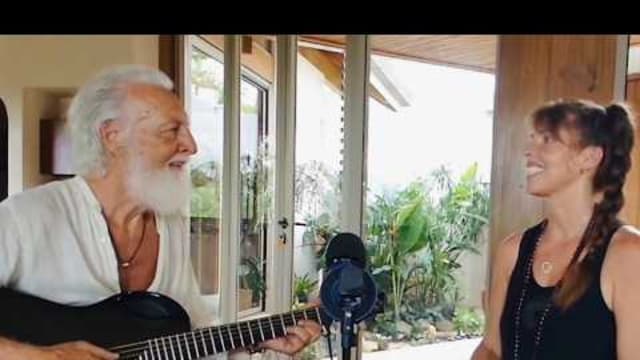
Some music asks for a stage. Mantra asks for a room small enough that the sound can settle into it. In a short session filmed for Bruno Justi's Sounds Two Inspire series, Deva Premal and Miten work in exactly that kind of space: a recording room at Heart Sound Temple in South Pasadena, California, with a single camera, a pair of audio engineers, and a special guest, Krista G of One New Spirit, present for the gathering. The session opens with a song whose refrain tells the listener to trust the heart over the anxious mind, then moves into a performance of the Gayatri Mantra. Taken together, the music and the sparse setting make an argument of their own about what mantra is for.
The video does not begin with a title card or an introduction. It begins with a few seconds of quiet music, and at about five seconds a voice enters with the opening verse. That choice matters. A mantra practice is built on entering sound slowly, and the first lines of this song are sung as if the room were already full of listeners who have been waiting. The verse acknowledges the familiar weight of the day: the past that hangs on your shoulder, the dreams filled with shadows, the days that refuse to shine. Nothing in it is rushed. The singing sits low and open, leaving space between phrases, so the ear has time to follow each word back to its end.
The production follows the same logic. The video's own credits list Garrett Gaston as camera operator and Marko Fazio and Bruno Justi as audio engineers, and the description describes the setting as "a very intimate setting." There is no crowd noise to fill the gaps and no audience applause until much later, when the performance has already drawn the listener in. For a viewer who has never sat in on a live mantra session, that is the first lesson: the room is part of the instrument.
The song's central device is a contrast between two inner voices. At about 1:09 the chorus describes a moment of pressure, when the cold wind blows, the oceans roar, and a force of love or fear knocks at the door. The mind says no. The heart says carry me away. Then, at about 2:08, the same structure returns with the roles nearly reversed: the heart says yes, and the mind says not today.
That reversal is the emotional hinge of the piece. The song does not present the mind as an enemy or the heart as a simple guide; it shows two voices speaking from the same person and trading places. The refrain then resolves the tension with a plain instruction, to listen to your heart, because love will take you all the way. The chorus is repeated enough times that the instruction starts to feel less like advice and more like a practice: a habit of checking, again and again, which of your inner voices is speaking.
The verse at about 2:55 adds a second layer. It concedes that the daily news can be tragic and that tonight may be filled with magic or with trouble, and still the singer says that we carry on into the beauty of each moment and into a love that does not die out. Here the song refuses both denial and despair. It asks the listener to keep moving toward presence, even when the world is hard to look at. For a performer whose work is built on sustained attention, that is a fitting theme.
The session pairs the chorus with the Gayatri Mantra, and the difference between the two forms is worth hearing. A song carries meaning forward through a story: verses, a turn, a return to the chorus. A mantra works more through repetition, keeping the same sound or phrase in circulation so that attention has something stable to rest on. The description of the video states that Deva Premal and Miten share "Calma e Tranquilidade" and the "Gayatri Mantra" in the session, and that the conversation addresses "the healing power of mantras."
The logic of repetition is what makes that healing claim plausible as a practice, even if the video does not spell out the mechanics. When a phrase returns over and over, the mind has less room to build new narratives around it. The listener is not asked to decode the words in the moment; they are asked to stay with the sound. That is why a live setting suits mantra so well. The room holds the repetition, and the singers hold the room.
There is also a difference in what the listener is asked to do. The chorus invites a choice: which voice do you follow? A mantra invites a different kind of listening, one in which the choice is less urgent and the sound itself becomes the place you return to. The two pieces in this session sit on either side of that distinction, which is probably why the pairing works.
The video is presented as the second half of a two-part interview. The Sounds Two Inspire description frames the conversation this way:
"In this interview divided into two parts, Deva Premal & Miten talk about their journey, life purpose and the healing power of mantras."
The transcript available for this session captures mainly the sung material, so the spoken answers about their journey and their sense of purpose are not quoted here. What the video does show is the context in which those conversations happen: a quiet room, a camera that stays patient, and two performers who move from talk into chant without a visible seam. Viewers who want the spoken reflections should watch the full interview rather than rely on a summary of it.
Sounds Two Inspire is built on a simple premise, stated in its own description: a video series "that combines interviews and live music videos that explore the unique journeys that inspire musicians to pursue their creative vocations." This session fits that premise closely. It does not try to be a concert film. It is five minutes and thirty-six seconds of voice, chant, and the small noises of a room, and its power comes from that restraint.
For a reader who has not yet listened to mantra music in this way, the clearest takeaway is practical. Try listening to a repeated chant or a chorus that asks you to choose between voices, and notice what your attention does. Does it chase the story, or does it settle into the sound? The session suggests that the answer is not fixed, and that a room, a voice, and a phrase repeated patiently are enough to shift it.
Start with the full two-part Sounds Two Inspire interview with Deva Premal and Miten, available through the series site at soundstwoinspire.com, where the spoken reflections on journey, purpose, and mantra are given in full. Then listen to the Gayatri Mantra and "Calma e Tranquilidade" in their complete recordings, paying attention to how the repetition changes over time. If the chorus of "Love Will Take Us All the Way" stays with you, return to the moment at about 1:09 when the mind says no and the heart says carry me away, and ask yourself which voice you are listening to today.