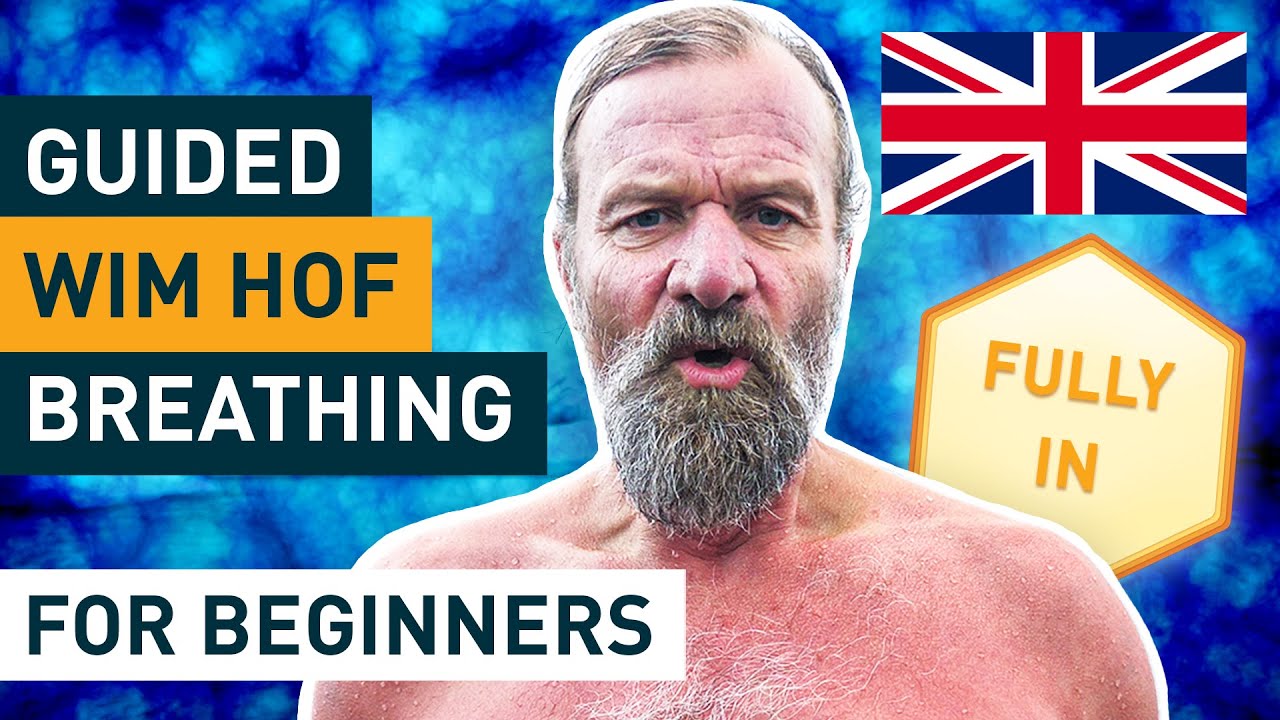
This slow-paced, three-round guided breathing session teaches the foundational Wim Hof Method protocol, designed for beginners or those seeking gentler instruction. Each round follows a pattern of rapid circular breathing followed by breath retention (30 seconds in round one, 60 seconds in round two, 90 seconds in round three), with recovery breathing in between. The method combines hyperventilation-style breathing with extended breath-holding to influence the nervous system, increase oxygen saturation, and activate parasympathetic awareness. Safety is paramount: the practice must be performed in a secure location, never near water or while driving, and always without forcing the body beyond its current capacity.
What is the Wim Hof Method and how does it work?
The Wim Hof Method is a systematic approach to breathing, exposure, and mindset that leverages physiological mechanisms to regulate the nervous system and enhance resilience. The breathing component, which is the focus of this guided session, operates on two primary principles: controlled hyperventilation and voluntary breath retention.
During the hyperventilation phase—the rapid, rhythmic breathing cycles that open each round—practitioners inhale and exhale continuously without pausing between breaths. This cycle, performed at roughly one breath per second, floods the bloodstream with oxygen while expelling carbon dioxide. Wim emphasizes making the breath circular: "To the belly, to your chest and let go / Like a wave / Make it circular / Totally inward and let go." This isn't aggressive breathing; it's a flowing, wave-like rhythm that moves air from the diaphragm through the chest and back out smoothly.
After 30-40 rounds of this circular breathing, practitioners then hold their breath for an extended period. This retention phase creates a mild hypoxic state—a condition where oxygen levels in the blood temporarily drop—which the body perceives and adapts to. The nervous system responds by increasing heart rate awareness, blood oxygenation, and parasympathetic activation (the "rest and digest" response), even though the body is technically under mild stress.
What happens during each of the three breathing rounds?
The session is structured as three progressive rounds, each building in intensity through longer breath-holding periods.
Round One (approximately 0:18–3:00): Begins with 30-40 cycles of circular breathing at a natural, flowing pace. Wim guides practitioners to relax into the rhythm: "No pause between inhalation and exhalation." After the final breath cycle, the instruction is to "stop breathing and hold 30 seconds from now." During this 30-second retention, Wim suggests: "Let the body do what it is capable of / Be aware of your heartbeat / Let the relaxation spread through your toes, and at the base of the neck and head." The emphasis is on awareness, not effort. After 30 seconds of breath-holding, a recovery breath—one deep inhalation held for 15 seconds—resets the system before the next round.
Round Two (approximately 3:00–6:00): Follows the same circular breathing pattern, but the retention extends to 60 seconds (one minute). Wim normalizes the sensations that may arise: "If your hands and toes are vibrating, or your body temperature changes, it's okay / You're doing fantastic." These tingling sensations and changes in body temperature are common physiological responses to the shift in blood pH and oxygen/carbon dioxide balance. He also offers an important permission: "If you need to breathe before I give you the signal, it's okay." This removes the psychological pressure to "hold on" and instead encourages listening to the body's actual needs.
Round Three (approximately 6:00–11:00): The final round extends the breath-holding phase to 90 seconds (1:30 minutes). By this point in the session, the body has warmed to the pattern, and practitioners often report deeper relaxation despite the longer retention. Wim provides encouragement: "Be aware of the blood that is moving through your veins, from your heartbeat / feel / 30 seconds left / You are almost arriving." The cue shifts from just awareness to a gentle acknowledgment of the body's resilience.
Why does Wim Hof emphasize circular breathing over normal breath cycles?
Circular breathing—where inhalation flows seamlessly into exhalation with no pause between—differs from the typical pattern most people use, where breath naturally pauses between the in-breath and out-breath. This circular pattern serves several purposes.
First, it increases the volume and rhythm of air exchange in a sustained way. By maintaining continuous flow without the natural pause, practitioners move more air through the lungs in a given time period, which amplifies the effect on blood chemistry—more oxygen enters, more carbon dioxide leaves.
Second, the continuous, wave-like rhythm creates a meditative anchor. Wim's language—"Like a wave / Make it circular / Fully inward and let go / It just continues"—emphasizes that the breath is not a forceful act but a flowing motion. This reframes the practice from effortful performance to rhythmic surrender, which naturally calms the nervous system even as the breath itself is accelerated.
Third, this pattern primes the nervous system for the subsequent retention phase. The steady rhythm creates coherence in heart rate variability (HRV) and prepares the body to handle the temporary drop in oxygen that follows the breath hold. The parasympathetic nervous system (vagal tone) increases during circular breathing, so when the breath hold triggers a sympathetic response, the system has already been "tuned."
What physiological changes occur during breath retention?
When practitioners hold their breath after the hyperventilation rounds, several measurable physiological shifts take place.
Oxygen saturation initially remains high due to the preceding hyperventilation, but as the hold continues, oxygen levels gradually drop while carbon dioxide builds. This shift activates chemoreceptors (sensory cells that detect blood gas levels) in the carotid artery and brain. The body's typical response to low oxygen is to trigger the "fight or flight" sympathetic nervous system response—increased heart rate, muscle tension, and stress hormone release.
However, Wim's instruction—"Let the body do what it is capable of / Be aware of your heartbeat"—creates a conscious, observing relationship to this stress response rather than a reactive one. By practicing awareness during a mild, controlled stressor (low oxygen), the nervous system learns that this state is not dangerous. Over time and with repeated practice, the nervous system becomes more resilient and better able to remain calm under physiological stress.
The tingling or vibrations many practitioners experience (especially in hands and feet) result from changes in blood pH. When carbon dioxide is exhaled in large quantities, the blood becomes more alkaline, which affects how calcium ions behave in nerve cell membranes, creating the sensation. Wim explicitly normalizes this: "If your hands and toes are vibrating, or your body temperature changes, it's okay."
How does breath retention build from 30 to 90 seconds across the three rounds?
The progressive structure (30 seconds → 60 seconds → 90 seconds) follows a principle of gradual adaptation. After the first 30-second hold, the body has experienced mild hypoxia and has begun to calibrate its response. The recovery breath—a deep inhale held for 15 seconds—allows full reoxygenation and a reset before the next cycle.
By round two (60 seconds), the nervous system recognizes the pattern and enters it with less surprise. Practitioners often report feeling calmer during longer holds because the anticipatory anxiety from the first round is gone; they now have proof that the body can handle it safely. The extension to 60 seconds is manageable for most beginners because the body's oxygen stores, combined with the preceding hyperventilation, are still sufficient.
Round three (90 seconds) represents the challenge point. At 90 seconds, oxygen saturation has dropped meaningfully, and the urge to breathe becomes strong. Wim's permission—"Do you want to prolong the breath holding? Pause the video and continue when you feel like you need to breathe"—acknowledges that this is the limit for many and that exceeding it is unnecessary. The value is not in reaching 90 seconds but in meeting the nervous system's stress response with awareness and calm.
What is the role of recovery breathing between rounds?
After each breath-holding phase, a recovery breath is administered: "Take a deep breath, and hold it for 15 seconds / Exhale in 5, 4... 3... two... and 1." This recovery breath serves as a physiological reset.
The deep inhalation rapidly reoxygenates the blood and restores oxygen to tissues. Holding it for 15 seconds allows this oxygen to be absorbed fully. The slow exhalation (over 5 seconds) activates the parasympathetic nervous system through the vagus nerve, which responds to longer exhalations by down-regulating arousal.
Between the recovery breath and the next round's circular breathing, there is a brief pause. This sequence—stress (hypoxia) → recovery (oxygenation) → reset (calm exhalation) → new cycle—trains the nervous system in a loop: the body learns it can handle temporary stress because relief always follows. This is the foundation of building resilience through the method.
What safety precautions must be taken when practicing Wim Hof breathing?
Wim and his method emphasize safety repeatedly in the video description and throughout practice. The primary risks come from two scenarios:
Shallow-water blackout: Never perform this breathing exercise in or near water—not in a pool, before diving, in a shower, or near a bathtub. The combination of hyperventilation followed by breath-holding can cause oxygen levels to drop so suddenly that consciousness is lost without warning, creating drowning risk. Shallow-water blackout is a real phenomenon and the leading cause of unexplained drowning in trained swimmers.
Loss of consciousness or impaired awareness: Some practitioners may feel lightheaded or dizzy after breath-holding, particularly in early sessions. This is why the practice must always occur seated or lying down, never standing, never while operating machinery or driving, and ideally with supervision, especially for new practitioners.
Gradual progression: The video emphasizes: "Remember to do the exercises without forcing them, increasing gradually and never exceed your limits." This is not a sprint protocol; it is meant to be practiced regularly over weeks and months, allowing the nervous system to adapt naturally. Beginners should not attempt to match the full 90-second hold immediately; starting at 30 seconds and adding 15-30 seconds per week is more appropriate.
How does this slower-paced version differ from other Wim Hof breathing protocols?
This guided session is explicitly designed as a beginner or gentle version. It is slower in cadence, meaning each inhale and exhale takes slightly longer than in the standard protocol. This allows practitioners to:
- Build awareness of the breath without overwhelming the nervous system
- Practice proper circular breathing mechanics before advancing to faster tempos
- Reach more modest breath-holding targets (90 seconds vs. 2+ minutes in advanced protocols)
- Develop comfort and safety in the method before exploring more intense variations
Advanced practitioners may progress to faster breathing cycles (which increase hyperventilation effects more quickly) or longer retention periods, but this 3-round slow protocol is the recommended entry point and remains valuable even for experienced practitioners seeking a restorative, less intense session.
What should practitioners expect to feel or notice during the practice?
Wim guides awareness throughout: "If your hands and toes are vibrating, or your body temperature changes, it's okay. You're doing fantastic. If you need to breathe before I give you the signal, it's okay."
Common sensations include:
- Tingling or vibrations in the hands, feet, and face (from alkaline shift in blood)
- Changes in body temperature—feeling warm or cold flashes (from nervous system activation)
- Heartbeat awareness—hearing or feeling the pulse more distinctly (from the mild stress response)
- Lightheadedness or dizziness—a floating sensation (from temporary oxygen fluctuation)
- Relaxation or euphoria—a calming, grounded feeling after the practice (from parasympathetic rebound)
- Heightened sensory awareness—colors seem brighter, sounds clearer (from nervous system sensitivity)
None of these sensations indicate danger if the practice is performed safely in a seated or lying position. They are the nervous system registering and adapting to the stimulus.
How often should this practice be performed?
While the video itself is a single session, practitioners typically benefit from regular practice. The method is most effective when done 3-5 times per week initially, allowing the nervous system to build consistent adaptation. Some practitioners incorporate it daily, while others find that 2-3 times weekly maintains the benefits once baseline resilience is established.
Each session takes roughly 11 minutes, making it accessible even for busy schedules. The benefits—improved mood, better stress resilience, enhanced focus, and better sleep—often appear within 2-4 weeks of consistent practice.
Where to go from here
This guided 3-round session is a complete, standalone practice and an ideal entry point into the Wim Hof Method. After becoming comfortable with this protocol over 2-4 weeks, practitioners can explore the full online Fundamentals course available on the Wim Hof Method website, which combines breathing with cold exposure and mental training. The free mobile app provides additional guided sessions at varying paces and intensities. For those interested in deeper training, live workshops and in-person retreats are available through the method's official channels.
The key principle underpinning all progression is patience: the method is not a sprint to longer breath-holds but a gradual, safe rewiring of nervous system resilience through consistent, intelligent practice.