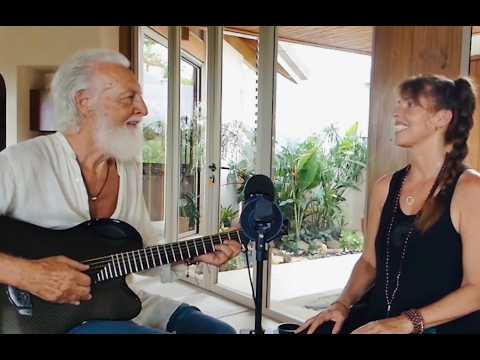
In a room at the Heart Sound Temple in South Pasadena, California, the conversation keeps circling back to the same place: the voice. Filmed for the Sounds Two Inspire series, the second half of Bruno Justi's interview with Deva Premal and Miten moves from life history to philosophy and then, almost without a seam, into the chant itself, with the Gayatri Mantra sung in the room and the questions of a lifetime hanging in the air around it. What the pair lay out in these fourteen minutes is a working theory of mantra: sound as a tool for the body, a practice anyone can start, a sense of joy as the signal that you are on the right road, and a view of generosity as the thing that keeps a life of giving from running dry. It is a conversation that never pretends to have the answers, which is part of why it lands.
Whatisamantra,really,intheduo'stelling?
For the pair, a mantra is not a decorative phrase. It is a sound with a job. Early in the excerpt, one of them makes the point plainly: "for us it comes down to the mantras that's our cure whenever... people come to us whatever questions whatever healing they might need it's in the mantras." That is a bold statement from two people who have built a career on repetition, but the reasoning behind it is practical rather than mystical.
The argument runs like this. The earliest mantras were not invented in a vacuum. The people who developed them had only the body to work with, so they tested what happened when particular sounds were made, what happened when those sounds were combined, and what those combinations did over time. In the interview, the duo describes these first mantras as having been "divinely channeled by some ecstatic souls," a phrase that reflects their own devotional frame. But the method they describe is observational: careful listening to what sound does to a living system.
To make that concrete, they reach for a comparison most Western listeners will recognize. Mantras, they suggest, work something like acupuncture, with different sounds reaching different parts of the body to move energy and promote healing. The analogy is not offered as a clinical claim; it is a way of describing how they experience the practice. Mantras, in their words, are "like ancient sound bites," and they ask listeners to treat them with respect, because they carry a long lineage of human attention.
"You have to approach mantras in a very respectful way because they're like ancient sound bites."
The breadth of their claim is worth noting. They describe mantras for nearly everything: "from sacred lovemaking" to "moving energetic blocks in your life." Whether one takes that literally or as a metaphor for attention, the implication is that sound can be aimed at a particular need, and that the practitioner's job is to find the sound that fits.
Doyouneedagurutofindyourmantra?
This is where the interview turns from traditional transmission to something closer to a democratization of the practice. The duo acknowledge the old model. "In India you might get a mantra whispered to you by your guru," one of them says, "after if you sit with him for a few thousand years or something." Then comes the update: "Now I like to say you can google your mantra." The point is not that the internet replaces a teacher. It is that the search itself is an invitation to start.
Their suggestion is almost disarmingly simple: "let's get together one night a week, let's invite our friends, let's chant mantras together, see what it feels like." They present this as the practical core of what they have. "We don't know much," they say, in effect. "We don't know why we are so happy together after 28 years." What they do know is that the chanting works when people do it together, across languages, without needing to understand the words in a literal sense. The heart, in their framing, is the translator.
There is a striking personal detail here, too. One of them describes discovering mantra as a kind of liberation from the apparatus of conventional songwriting: "suddenly I was free of intros, middle eights, solos." The form that music had required fell away, and what remained was a more open structure of sound and repetition. The other partner, the duo suggests, was in a sense born into this vocabulary, and their voices in combination became something the first partner calls "transformative."
Howdoyouknowyouareontherightpath?
The most useful passage in the excerpt may be the one about money and doubt. In the early years, the interview recalls, the work was financially brutal. They had taken on debt to buy equipment and to pay for the bus that carried them from place to place. At one point, one of them asked the other whether this struggle might be a sign that they should not be doing it at all. The answer offered a different test. "If you are having a good time," the partner said, "you're in the right path."
That is a deceptively simple standard, and the duo treats it as one. Their advice to anyone is to ask what makes them happy and then do more of it. "If madness is your thing, sing, sing mantras, chant mantras. And if it's not your thing, fine. What is your thing?" The question is left open on purpose: dancing, another kind of creativity, nature, silent meditation. For them, mantra was simply "very natural." They grew up with it, and it felt like home. They also acknowledge the trap that comes right after the simplicity, the mind saying that something this easy cannot be worth much. Their answer is to let the simplicity be the point.
There is a rare candor in admitting that the path will have challenges. Still, the duo's image for a well-lived path is not struggle-free. It is "the wind in your back," the sense that "things are moving."
Whatdoesgenerosityhavetodowithabundance?
The interview closes on a theme that ties the sound, the money and the joy together: generosity. Asked to reflect on a life of sharing music across decades, the duo return to a principle they call "fierce grace." Love, they say, "has to come from somewhere real or else it's just so new-agey. It has to really have some blood and guts and balls in it." Love of that kind, they argue, means giving fully, because there is no time to hold back.
"Generosity is the key to abundance. Be generous with your time, with your energy, with everything. And the rest will take care of itself."
Their words to younger listeners are direct. "You've got your life ahead of you," they tell a younger audience, and they urge people to think about the decades ahead in terms of what they will give. "Don't hold back. There's no time. You'll only regret that you didn't." It is a sentiment that makes the mantra practice feel less like a private comfort and more like an orientation toward the world.
Wheretogofromhere
The most useful way to approach this conversation is as an invitation rather than a manual. If the duo's core claims are right, the proof is in the practice: sit with a sound, notice what it does, share it with others, and let joy and generosity guide the next step. The interview is also an honest portrait of uncertainty. "Life is mysterious," they say. "We really don't know anything." That humility is worth carrying into any chant.
To go deeper, watch Part 1 of the interview for the earlier chapters of the story, and listen to the Gayatri Mantra in the video itself, which the duo perform in the room. Then try the one suggestion they make most plainly: gather a few friends, pick a mantra, and see what it feels like.
In the Sounds Two Inspire interview, the duo describe mantras as ancient sound tools whose effects were discovered by observing what sounds do to the body. They compare the practice to acupuncture, suggesting different sounds reach different parts of the body to move energy and support healing.
The duo say that while traditionally a guru might whisper a mantra to a student, today you can find your mantra yourself and be your own guru. They encourage people to gather friends, choose a mantra, and chant together to see how it feels.
Miten recalled that during a financially difficult period, he asked whether struggle was a sign they should stop. The answer offered was that enjoyment is the test: if you are having a good time, you are on the right path, and the duo ask people to do more of what makes them happy.
The duo use 'fierce grace' to describe love that is real and full-hearted, with 'blood and guts' in it rather than being superficial. Their point is that such love means giving 100 percent to life, because there is no time to hold back.
In the interview, they advise listeners to be generous with time, energy and everything else, and say the rest will take care of itself. Their argument is that giving fully is what makes the feeling of abundance come back.
The interview features the Gayatri Mantra as a performed piece, but the duo's broader advice is that anyone can start with a mantra they feel drawn to. They stress simplicity, saying that the practice is easy and that mantras can be sung together without needing to understand every word.