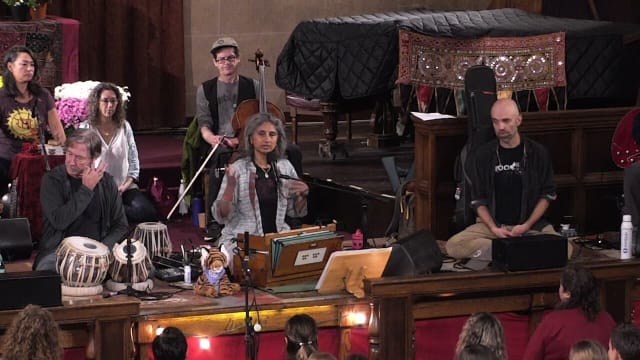
This is a live-streamed Wednesday parayana, a sustained recitation of four Tamil texts that ran for two hours and twelve minutes when it was uploaded on 28 October 2026. The listing names the works (Ekanma Panchakam, Appala Pattu, Anma Viddai and Devikalottaram) and links a Tamil and an English text for anyone who wants to follow the words on the page. The listing carries no commentary, so this article does not pretend to report what was said. Instead it explains the practice the stream embodies: what a parayana is, why it is organized by weekday, and how a listener with no Tamil can still get something real out of two hours of chanted text.
In the Tamil devotional world, parayana means a complete, sustained recitation of a text, read through from start to finish rather than dipped into. The word points to the act of carrying a work through in full, which is different from studying it. A study session asks you to stop, parse, and understand. A parayana asks you to let the whole text move past you in its own order, sometimes for hours, until the sequence itself becomes familiar.
That distinction matters for how you listen. Recitation works through repetition and rhythm. Verses that feel opaque on first hearing begin to sound like landmarks. Refrains return. Certain phrases start to arrive before you expect them. Many traditions that practice group recitation rely on exactly this slow accumulation, and the sound of a room of voices moving through one text together is part of the point, not an incidental feature of it.
The stream is titled "Wednesday Parayana," which signals that the texts are assigned to days of the week. That is a practical design. A fixed rotation means the same works come around again on the same day every week, so the recitation becomes a standing appointment rather than an occasional event. Over months, a devotee hears the same texts in the same slot and begins to hold them in memory in a way a single hearing cannot produce.
The rotation also makes the practice sustainable. A parayana schedule spreads a body of literature across the week so that no single sitting has to carry everything. The Wednesday set is one piece of a larger weekly pattern, and the presence of a downloadable text for each session shows that the ashram expects people to join in and follow along, not only to watch.
The listing gives titles only, so the notes below stay close to what the names themselves say.
- Ekanma Panchakam. The name combines "ekanma," which suggests oneness or a single self, with "panchakam," a term for a set of five. The title alone suggests a compact, five-part form.
- Appala Pattu. "Pattu" is the Tamil word for song. This is a text sung or recited in the register of a song, which is why it sits naturally in a rhythmic, communal recitation.
- Anma Viddai. "Anma" corresponds to the Sanskrit "atma," the self, and "viddai" to "vidya," knowledge. Read together, the title points toward knowledge of the self, the central theme of much of the ashram's teaching tradition.
- Devikalottaram. The name opens with "Devi," the Goddess, which places this text in a devotional register that addresses the divine feminine. Its precise structure is best checked against the printed Tamil.
These translations are offered as orientation, not as a substitute for the texts. A title is a doorway, and the words inside it are what the parayana actually delivers.
Start with the English PDF. The listing links one alongside the Tamil, which means you can read the sense of each section while the voices carry the sound. Do not try to match every word. Follow the sections, notice where the recitation pauses or turns, and let your attention settle on the overall shape of the text.
Listen for the refrains. Parayana texts often repeat lines or closing phrases, and those repetitions are the easiest entry point for a non-Tamil listener. Once you recognize a refrain, you know where you are in the text, and the whole recitation becomes easier to navigate.
Accept the length. A two-hour-plus stream is not meant to be consumed in one attention burst. Many people listen in pieces, returning to the same text on successive weeks. The rotation was designed for that kind of return.
Mostly patience, and a willingness to let meaning arrive slowly. In a culture of quick summaries, a parayana runs the other way. It asks you to stay with a text even when you cannot paraphrase it, on the working assumption that repeated contact does something that understanding alone does not. The 5,207 views the stream had at the time of this writing suggest a small, attentive audience that comes back for this kind of sitting rather than skimming it.
If you take one thing from the Wednesday parayana, let it be this: the practice trusts repetition. The texts are not offered as puzzles to solve once. They are offered to be heard again, week after week, until the sound of them becomes a fixed point in the calendar.
Listen to the full stream once from start to finish, even if you understand only fragments. Then download the English text from gururamana.org (English) and read the sections alongside a second listening. If you read Tamil, the Tamil text is the one to follow in the original. Then make a plan to return the following Wednesday, because the rhythm of the practice is part of what it gives. A parayana is learned by coming back to it.