Matthew Fox begins the way he often does, with a greeting and a passage. In a short October 2021 video, the Christian mystic and author opens his daily meditation by reading a line from Thich Nhat Hanh: that Christianity will recover its most valuable jewels when it recovers the insight of interbeing, of non-duality, and of what Fox calls the apophatic divinity. Fox does not treat the line as a slogan. He treats it as a diagnosis, and as an invitation to return to the medieval German mystic Meister Eckhart, whose teaching on a God beyond all names was the center of a chapter he wrote in his book Mystic Warrior for Our Times. The result is a six-minute meditation that works as a compact introduction to one of the oldest tensions in Christian thought: the difference between speaking of God in light and speaking of God in darkness.
Fox defines the word at the outset: "apophatic" means "without light," the darkness. It belongs to the via negativa, the way of negation, in which theology proceeds by saying what God is not rather than what God is. Fox sets this against its counterpart, the cataphatic tradition, which he describes as the God of Light, the one who celebrates the light in all things. The two are not enemies, in his telling. They are a pair that must be held together.
He makes the point concrete in the most ordinary way. "I'm looking right now at the sunny sky, with sunny clouds," he says at about the two-minute mark, "and there's beauty in that, there's the Divine in that." Cataphatic faith is the faith that finds God in that sky. But Fox insists there is a second dimension, the one that recognizes what our language cannot hold. "The Divinity is beyond all words and language," he says, and this is where Eckhart enters.
Fox reads Eckhart at length, and the passages he chooses are blunt. Eckhart calls God "superessential darkness that has no name and will never be given a name." Fox quotes him saying God "is without name, and is a denial of all names." The point, as Fox reads it, is not that God is absent but that God is so near to the soul that the soul's own categories cannot grasp God. He quotes Eckhart on the ground of the soul: "where the ground of God and the ground of the soul are one ground."
The most striking claim Fox draws out is about language itself. Eckhart, as Fox quotes him, says that "all the names the soul gifts to God are derived from her own understanding," and that "the deficiency lies in language." Our words are not wrong so much as they are ours. They reflect the mind that speaks them. The mystic's response is not to abandon speech but to hold it loosely.
Eckhart goes further in the passage Fox quotes most often: "Whatever one says that God is, God is not. That is what one does not say of God, rather than what one says. God dwells in the light which is inaccessible." Fox's gloss is that whenever we talk about God, "we have to stammer." The stammer is not a failure of nerve. It is the honest posture of anyone who has glimpsed something that exceeds the sentence.
Here Fox turns from the medieval text to the modern nation. He observes, with a sharpness that is characteristic of his public work, that religion becomes self-deceiving when it stamps "In God we trust" on its coins, its dollars, and its "MX missiles and the rest, because we really don't know who God is." The line is not an attack on faith. It is an argument for humility about the claims we make in God's name.
Fox pairs Eckhart with Thomas Aquinas, who, as Fox notes, preceded Eckhart. "We don't know who God is; we know who God is not," Fox quotes Aquinas as saying, "and God is not like us, although we are called to be like God." The two thinkers converge on the same discipline. Theology is not a map of God. It is a practice of knowing the limits of the map.
Fox then widens the lens beyond the church. "Science too is now beginning to wrestle with the mysteries of nature," he says, pointing to the basic questions physics has not settled: what matter is, how matter relates to light, and, as he puts it, "matter and spirit for that matter." The humility he asks of theologians, he suggests, is one that secular inquiry also needs. Awe is not a religious private property.
One of the most useful moves in the video is the way Fox connects silence to awe, and awe to art. Quoting Eckhart again, he reads: "The most beautiful thing a person can say about God consists in that person's being silent from the wisdom of an inner wealth. So be silent, and do not flap your gums about God." Fox's language is rough on purpose. The line in Eckhart's own sermons is meant to puncture the idea that spiritual confidence means talking more. Fox adds that to the extent we "flap our gums about God, you are lying." He says the sin is not in speaking, but in speaking as though the matter were settled.
Silence, for Fox, is not the end of the response to awe. It is the first movement. "We go 'hmm,'" he says, and then, eventually, "we may respond to awe with creativity, with dance or music or poetry, because these are other ways to utter our experiences, our deepest experience." That sequence matters to anyone who has sat through a long Christian liturgy or a long kirtan. Silence makes room, and then the body and the voice take up what the mind cannot put in propositions.
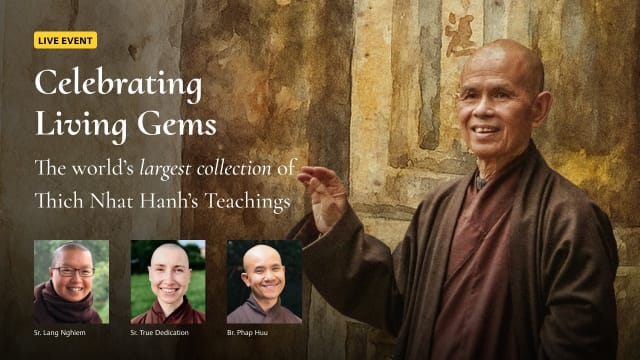
"If we can bring into Christianity the insight of non-duality, we will radically transform the way people look on the Christian tradition, and the valuable jewels in the Christian tradition will be rediscovered."
This is the claim that gives the video its edge. Thich Nhat Hanh, in Fox's reading, is not saying Christianity has nothing of value. He is saying the valuable things have been covered over, and that they can be found again. Fox agrees about the diagnosis and takes it personally: "He's suggesting, of course, that they've been lost. We have to discover them, rediscover them." The jewels, he says, are "to be found in the depth of contemplation and wisdom that mystics like Meister Eckhart articulate for us."
The argument is one of recovery rather than replacement. Fox does not ask Christians to adopt Buddhism. He asks them to find, within their own tradition, the strands that already speak the language of non-duality. The thread he pulls is Eckhart's insistence that the ground of God and the ground of the soul are one ground. Read this way, the Buddhist concept of interbeing, which the video names but does not unpack at length, and the Christian apophatic tradition arrive at the same recognition: the separation we feel between self and divinity is not the deepest fact.
Fox ends not with an argument but with an invitation. Thich Nhat Hanh, he says, "invites all of us to get to our own levels of depth and be the mystics that we are called to be, speaking from a place of mystery." It is a generous closing, and it reflects the posture of the whole video. The mystic is not a special class of believer. The mystic is anyone willing to stammer honestly.
The video is short, but it rewards slow attention. Start with the Eckhart passages Fox reads aloud and read them again on paper, slowly, noticing where the sentences refuse to resolve. Then look at the Aquinas line beside them, and ask what it would mean for your own religious language to admit that "we know who God is not." If you want the fuller argument, Fox's chapter on Eckhart and Thich Nhat Hanh, titled "The Apophatic Divinity," is the place he develops it at length. For the Thich Nhat Hanh side of the conversation, begin with his own writing on interbeing, which Fox points to as the bridge. The jewels, if Fox is right, are not new. They are old things we have stopped looking at, and the practice of silence he describes may be the first way back to them.