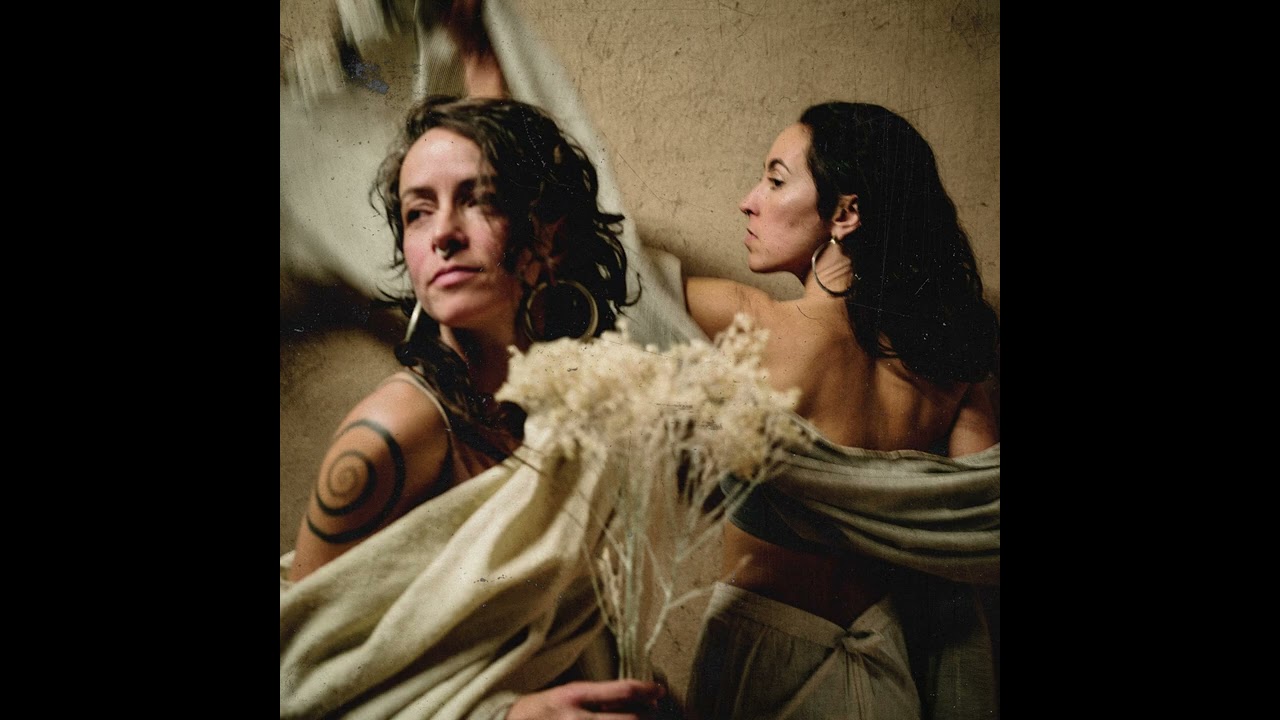
Some songs arrive as a single image and then spend four minutes proving it. "The Touch of Spirit," the new single from Peia, is one of them. Posted as an official audio release on October 2, 2026, it is built from a handful of lines: a pearl waiting to be freed from its shell, a lily that needs a "wild darling," a moon that will not come through a door. Its refrain asks for a kind of contact that words cannot supply. Read closely, the lyrics make a small, deliberate argument about how the sacred gets in. It does not come through the front door of language. It comes through the window, by breath and by skin. What follows is a reading of that argument, using only the lyrics published with the video and the sung passages visible in its transcript.
The song's most concrete scene arrives a little over a minute in, at 1:34 in the video. "At night I open the window / and ask the moon to come." It is an ordinary gesture made ritual: a person alone in the dark, unlatching a window, speaking to something far away and enormous. The next line is the emotional hinge of the whole track: "Come press your face against mine." The moon is not asked to shine on the singer. It is asked to come close, to press its face against hers, to make the distance physical.
That shift from light to contact is the first clue to the song's logic. A moon that only illuminates is a distant object. A moon that presses its face against yours is a presence you can feel. The track keeps returning to that second kind of encounter.
The chorus states the premise before any image appears. The opening lines, sung at 0:19 in the video, are:
"There is some kiss we want / With our whole lives / The touch of spirit on the body."
(Lyrics as published in the video description.)
Two phrases carry the weight. "With our whole lives" describes a longing that is not occasional or polite; it is the organizing desire of a life. And "the touch of spirit on the body" puts the sacred where most spiritual writing is reluctant to put it: on the skin. The song does not speak of spirit as something that hovers above the body or leaves it behind. Spirit, here, is something that touches. The refrain repeats the phrase, so the listener cannot treat it as decoration.
This is the spine of the piece. Much devotional music aims at transcendence, a lifting away. "The Touch of Spirit" aims at arrival, a meeting in the body. Its ambition is smaller on paper and more radical in practice: the holy is something you can be touched by.
Between the chorus and the window scene sit two images that work like nature studies. "Seawater begs the pearl / to break its shell." And "lily, how passionately / it needs some wild darling."
Both describe a closed form that is being asked to open. The pearl is sealed inside a shell, and the sea, which is pictured as pleading, wants it to break free. The lily is shown as hungry, almost desperate, for something wild to answer it. In each case the outside force is not violent. It begs, it needs. The song frames opening as something the world desires alongside the person who is shut in.
A note for listeners: the published lyrics read "Seawater begs the pearl." The auto-generated transcript in the video renders the line as "Still water begs the pearl." The description's text is the authoritative version here, and the difference matters. Seawater is moving, restless, tidal. Still water is a mirror. The published word puts the pull of the sea at the center of the image.
The most repeated phrase in the track is also its simplest: "Breathe into me." It appears four times in the published lyrics, each time sung in the transcript at a slightly different point in the arrangement. Where the chorus argues and the verses describe, the breath line simply asks.
Breath is the most intimate exchange two living bodies can make. Its inclusion here is not accidental. If the song is about spirit touching the body, the breath is the mechanism: the thing that passes from one person into another without passing through language. Repeating it four times does not develop an idea so much as stay inside one. The lyric stops explaining and waits.
In the transcript, the singer adds sustained, wordless ornament during these repetitions, shifting from speech-like phrasing into sung tone. That move is a small piece of evidence for the song's thesis. When the words run out, the voice keeps going.
The central couplet of the song is the one the title seems to be pointing toward, though the title itself says "touch." At 2:54 in the video, the singer begins:
"Close the language door / And open the love window / Close the language door / And open the love window / The moon won't use the door / Only the window."
(Lyrics as published in the video description.)
Here the song makes its boldest move. Language is pictured as a door: a formal entrance, a way in that everyone uses and that comes with rules, customs, and expectations. The moon refuses it. The moon, a figure of the sacred, enters only by the window, the opening that is less official and more personal. The instruction is to close the door of words and open the love window instead.
There is a paradox here worth naming. The song uses words to argue against the primacy of words. But the couplet is not hostile to language so much as it ranks it. Words can frame the approach; they cannot be the way the moon comes in. That reading fits the rest of the track, which spends most of its time in image and breath and the wordless ornament of the sung "Ooo" passages. The lyric has, in effect, closed its own door and left the window open.
The structure is simple and cyclical. The chorus, with its "kiss we want" premise, opens the track. Two imagistic stanzas follow, one of natural longing (pearl and lily), one of nocturnal invitation (window and moon). The breath refrain comes next, then the language-door couplet, and the track returns to the chorus.
The transcript shows the arrangement's seams. Its many [music] markers indicate that the vocal breathes between phrases, and the wordless passages (the "Ooo" sections marked in the description) sit between lyrical stanzas as connective tissue. Near the end, the transcript captures a variant of the closing section: "There is some kiss in your sweet heart. Remember all the touch you speak of. The body." The published lyrics return to "There is some kiss we want," so the variant reads as a slight rewording in performance, shifting the address from a collective "we" toward a more direct "your." That shift is worth hearing for yourself.
The song ends where it began, on the touch of spirit on the body. It does not resolve so much as come back around, which suits its subject. A touch is not a conclusion. It is something you return to.
The video's description tags the track #folk, #indiefolk, #appalachia, #singersongwriter, and #folksongs, and links to Peia's Instagram, Facebook, and website, peiasong.com. Those tags place the song in a lineage of American singer-songwriting where plain language and direct address carry spiritual weight. The material provided does not include biography, recording credits, or interviews, so this piece does not make claims about how the song was made. What the lyrics show is a writer comfortable with intimacy, willing to let a single image carry a whole stanza, and more interested in how a touch feels than in how it is explained.
The fastest way into "The Touch of Spirit" is to listen to it once with the lyrics open, then again with your eyes closed. Notice where the voice moves from words into ornament, and where the breath line stops being a phrase and becomes a rhythm. If you want to take the song's argument into your own practice, try its one concrete instruction: at night, open a window, and say something to the moon that you would not say through a door. The song's own ending suggests the touch is what you are actually listening for. The single is available now through the link in the video description.