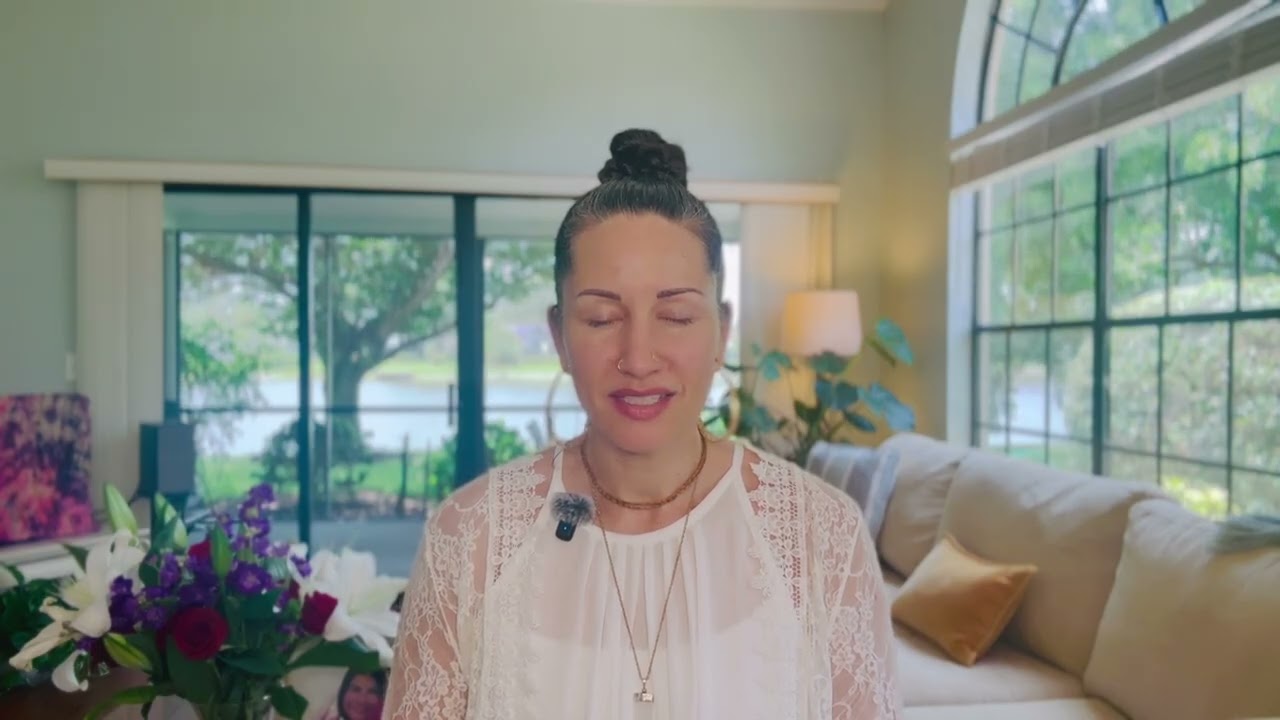
Within the first fifteen seconds, a calm voice asks you to unclench your jaw. Then it asks you to relax your shoulders and open your heart. There is no incense in the frame, no bell, no ambient drone. Just a teacher talking you into a seated position before the day has properly started. That is the opening of a twelve-minute morning meditation by Amanda Sellers, published on her channel in July 2020. The practice moves in a deliberate arc: it settles the body, steadies the breath, walks the listener through ten first-person affirmations, and each affirmation is followed by a question meant to be answered in your own head, or in a notebook. It closes with the hands over the heart and the arms raised toward the sky. The whole thing is a small, complete ritual of intention-setting, built on the idea that a day is shaped less by what happens to you than by the statements you make to yourself before it begins.
Most guided meditations spend their opening seconds on logistics, and this one is no exception. Sellers asks the listener to get seated, soften the eyes, release the jaw, drop the shoulders. The instructions are physical before they are mental. That ordering matters. Tension in the face and shoulders is the body's way of carrying yesterday into today, and the meditation asks you to put that down before you attempt anything with your mind.
She also offers a claim about why morning sitting matters. "When we sit up in the morning, we are draining our lymphatic system and letting our body know that we are ready to embrace the day ahead," she says in the video (0:24). It is a striking statement, and it is worth reading as her framing rather than as established physiology. The video does not cite a study for it. What the framing does accomplish is to give the physical act of sitting up a symbolic weight: getting out of bed and sitting upright becomes a signal, to yourself, that the day has begun.
Then comes the breath. She asks you to take a deep breath in and out, to focus on it, and to sit "with purpose." The instructions are sparse on purpose. There is no counting pattern, no visualization of light. The breath is simply the anchor that holds you still long enough for the affirmations to land.
The core architecture of the practice is a repeating unit: a numbered first-person statement, a short explanation, and a question. Take the first one. "I am thankful. Today. Right now. In this moment, is a gift." The explanation follows: "That's why we call it the present." Then she asks, "What are you grateful for?" That question is the piece that transforms recitation into reflection. A listener who only repeats "I am thankful" has done something mildly pleasant. A listener who stops to find a specific answer has done something closer to inventory, taking stock of what is actually there.
The timestamps reinforce the design. The gratitude affirmation begins around 1:25 and the next one does not begin until around 2:18, which leaves close to a minute of space after the question. The video leaves room for you to think. For someone trying this for the first time, that gap is where the practice actually happens.
Each of the ten affirmations follows this pattern, and the questions are not generic. They ask you to name a concrete act of service, to picture your "ideal self" in specific situations, to write down a goal, to identify an unhealthy choice you will leave out. The affirmations are the frame; the questions are the picture inside it.
Affirmation four is the one that most directly challenges a common assumption about happiness, and the speaker is blunt about it. "Many people think I will be happy when, when I'm richer, thinner, have a relationship, etcetera," she says (4:03). Then the turn: "But we must cultivate happiness now. If we can't create happiness in our lives now, no matter what goals we achieve, we will not be happy."
"Act now how you want to feel. How can you be happy in this moment? What makes you happy? Do more of that."
Amanda Sellers, morning meditation video (4:31)
The idea is not that goals are worthless. Affirmation eight, as it happens, is about loving goals. The argument here is about sequencing. If happiness is postponed until a condition is met, the condition keeps moving. The practice asks you to locate a small, present source of contentment and to do more of it, rather than to wait for a larger arrangement of circumstances to deliver it.
The fifth affirmation pushes the same logic into imagination. "Visualization and imagination is life's preview," Sellers says (5:12). She asks the listener to "crystallize a very clear image of your best self": how that person acts, how they handle a hard conversation, what their day looks like, who they spend time with. The image is meant to be specific and repeated daily. You are not just wishing to be someone; you are rehearsing what that someone does.
A meditation that stayed purely in the mind would be easy to dismiss as wishful. Sellers keeps pulling the attention back into the body. The sixth affirmation, "I love to move my body," is grounded in a claim she makes plainly: "Fighting off depression and anxiety starts with moving the body." She adds an observation about posture: "When we are depressed, we hunch, our physiology changes." The remedy she offers is modest. Move on a daily basis, stand tall, and ask yourself what kind of exercise speaks to you.
The food affirmation, which the spoken count skips over, follows the same logic of daily choice. "Our bodies are temples," she says, and then, "Every small choice you make makes up your life. Choose wisely." The questions are concrete: what unhealthy choices will you leave out today, and what will you add? These are not diet prescriptions. They are prompts to notice a pattern and make one small adjustment. As with the other affirmations, the practice is built on the premise that accumulated small decisions, not one dramatic change, are what a life is made of.
Readers who are managing a depressive or anxiety condition should treat the claims about movement and mood as the speaker's perspective, and work with a clinician for anything medical.
Affirmation eight contains the video's most specific factual claim. "People are 42 percent more likely to achieve their goal when they write them down," Sellers says (8:01). The video does not name a source for that figure, and a listener who wants to rely on it should look up the underlying research before repeating it. The surrounding advice is more practical and more useful regardless of the statistic: dream up a goal too large to see the route to, then break it into smaller, attainable daily steps. The first is a sense of direction; the second is a sequence of actions you can complete before lunch.
The commitment affirmation, number nine, goes deeper into habit. "Your daily habits make up your life. Your attitude attributes to your personality. You can raise the thermostat on who you are." The metaphor is domestic and useful: a thermostat is not a dramatic switch but a setting you adjust gradually. Sellers acknowledges the obvious difficulty, that you will not always feel like making the best choices. Her answer is repetition: "the more you can commit to these affirmations, you will see your life begin to change" (9:35).
The tenth affirmation turns the lens outward and then back in. "I surrender and let go of control and expectations. No matter how hard I try, I cannot control what others think or do. So I focus on myself." It is the most compact statement of the practice's underlying logic. The meditation has spent its length asking you to shape your own attention, your choices, your image of yourself. It ends by naming the limit of that project: other people are not yours to manage.
"No matter how hard I try, I cannot control what others think or do. So I focus on myself. I find peace in moments. I use my words wisely."
Amanda Sellers, morning meditation video (10:14)
The question that follows asks what you can surrender today "to cultivate more joy in your life." For many listeners, that question will be the most uncomfortable one in the sequence, and that discomfort is probably the point.
The practice does not simply stop. Sellers tells the listener they are "charged and ready," then asks them to be proud of having taken the time to get aligned. She offers an unforced affirmation of worth, "You are one of a kind amazing," before instructing the listener to place both hands over the heart and "lock in that goodness we have just created." Then the arms rise in a V toward the sky, reaching "as high as you can" to feel "the energy of the sun surging through you" (11:25). The ending is physical again, bookending the opening instruction to relax and open the heart. The body starts the practice and finishes it.
- Watch it once with a notebook. Pause, or simply notice, the question after each affirmation. Write down the answers that come first, even if they feel small.
- Pick one affirmation for the week. The series is long. Choosing one, such as the happiness-now or surrender affirmation, gives the practice a single point of focus.
- Check the claims that matter to you. The lymphatic framing, the 42 percent figure, and the statements on movement and mood are the speaker's assertions. Verify anything you plan to rely on.
- Keep the sequence. The channel's description invites viewers to save the video and play it every morning. The arc, from body to breath to intention to closing gesture, is designed to be repeated.
- Explore further if the format appeals. The video description links a ten-day meditation course from the creator, for listeners who want a longer structure.