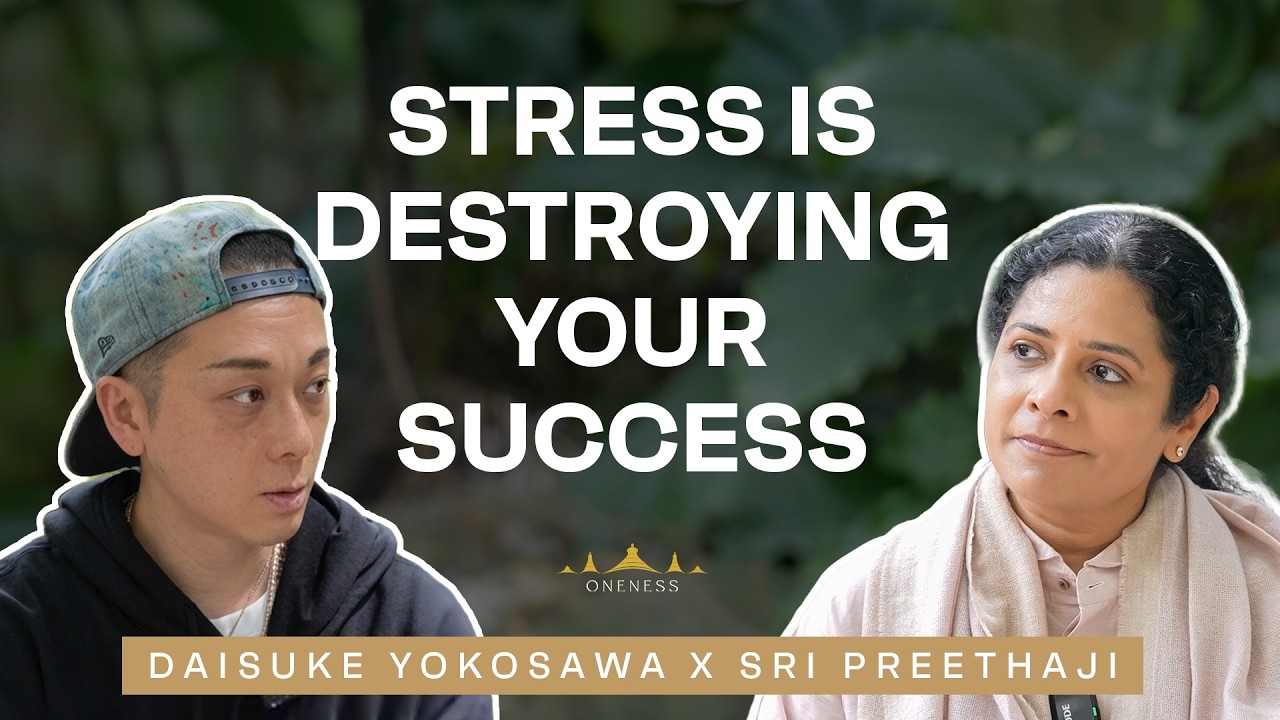
Sri Preethaji & Sri Krishnaji address a cultural paradox: many people treat suffering and struggle as sources of strength, motivation, and character-building. This talk questions that assumption, proposing instead that your highest potential emerges not from pain or fear, but from living rooted in calm, joy, and authentic connection. The teaching invites listeners to examine why they cling to hardship narratives and how transcending suffering—rather than being driven by it—unlocks genuine thriving.
Why Do We Treat Suffering as a Path to Strength?
In many cultures and personal development frameworks, suffering is framed as noble. Struggle is seen as the crucible of character. Hardship becomes a badge of honor—proof that you've sacrificed, worked hard, or earned your success. This narrative runs deep: "No pain, no gain." "What doesn't kill you makes you stronger." "Suffering builds resilience."
Sri Preethaji & Sri Krishnaji's teaching invites a direct question: Why do we cling to this story? The answer lies partly in conditioning. Many people inherit cultural and familial beliefs that equate pain with purpose, or struggle with spiritual depth. Others use suffering as a kind of identity—if I've endured enough pain, I am worthy, I am real, I have earned the right to exist. Suffering can become a strange comfort because it feels familiar, even when it hurts.
But there's a subtler issue at work. When you define yourself by struggle, you unconsciously preserve the very conditions that keep you struggling. You become invested in staying small, limited, or afraid—because stepping out of that role feels like losing your story, your meaning, your justification for being.
What Gets Lost When Fear and Anger Drive Your Life?
The teaching distinguishes between being driven by pain and being resilient through difficulty. There is a crucial difference. When fear or anger becomes your fuel, you remain in a reactive state. Your nervous system stays activated. Your decisions come from contraction, not clarity. You move toward things not because they align with your deepest values or vision, but because you're running away from something else—rejection, failure, poverty, abandonment.
Living this way has a cost, even when it appears successful. The achievement or security you gain from fear-based motivation is fragile because it rests on continued vigilance, continued threat-scanning. You cannot relax into your wins. You cannot trust that you're safe. The moment external pressure lifts, the system collapses because there was no internal coherence, only external pressure masquerading as drive.
Similarly, anger as a motivator keeps you locked in opposition. You're defining yourself against something—a rival, an injustice, a critic—rather than toward something you genuinely want to create. This is exhausting and limiting. Your energy goes into defending, fighting, proving—not building, imagining, connecting.
How Does Joy and Calm Change What You're Capable Of?
The core teaching proposes a radical inversion: your best life, your truest potential, emerges when you operate from a baseline of peace and joy rather than pain and urgency. This isn't about denying challenges or becoming passive. It's about the neurological and psychological ground from which you make choices and take action.
When you're rooted in calm, your prefrontal cortex—the part of your brain responsible for planning, creativity, wisdom, and genuine problem-solving—is available. You can see the whole board, not just the immediate threat. When you're rooted in authentic connection—to yourself, to others, to what matters—your actions align with your values rather than your wounds. You move toward what you love, not away from what you fear.
Joy, in this context, is not frivolous pleasure or denial of pain. It's a quality of aliveness and coherence. It's what you feel when your actions are in harmony with your deepest sense of what's real and true. People often assume joy is fragile or fleeting, but the teaching suggests that genuine joy—rooted in peace and connection—is actually more stable and enduring than the highs of achievement driven by desperation or anger.
What Does It Mean to Transcend Rather Than Be Driven By Pain?
Sri Preethaji & Sri Krishnaji distinguish between two relationships with suffering. In the first, you use suffering as fuel. You internalize the pain and try to transform it into productivity, proof, or power. This is still being driven by suffering—it's just a more sophisticated version. The pain remains at the root; you're just building a tower on top of it.
In the second, you transcend the pain. This means you metabolize the experience. You learn what it has to teach you—resilience, compassion, wisdom, humility—but you don't keep it as your operating system. You integrate it and move on. You become free from the need to prove yourself through hardship. You can face difficulty without collapsing into identity with the difficulty.
This is not spiritual bypassing—pretending the pain didn't exist. It's genuine transformation: you've been through fire, and the fire changed you, but you are not still on fire. You can now choose your path from freedom rather than from wound.
Why Is Calm a Better Foundation Than Urgency?
Urgency creates a kind of trance. It feels productive—you're moving, acting, achieving. But urgency also narrows perception. It keeps you focused on the immediate crisis, unable to see longer-term patterns or deeper truths. A life built on chronic urgency is fragmented. You're always in reaction mode, never in creation mode.
Calm, by contrast, is spacious. It allows you to hold complexity. It allows you to notice what you're feeling, what you actually want, what's truly important. From a calm baseline, you can still move with speed when needed, but you're not permanently activated. You can rest. You can reflect. You can make choices that align with your whole self, not just your survival mechanism.
The teaching suggests that many high achievers believe their success came from urgency and stress, when actually it came from some inner quality—intelligence, creativity, determination—that they happened to exercise while stressed. If they could harness that same quality from a place of calm, they would be even more effective, and they would enjoy the journey.
How Does Connection Shift What You're Motivated To Do?
When you're isolated in your struggle, suffering can feel deep and meaningful. But isolation also locks you into a narrow frame. Connection—to other people, to a larger purpose, to the interconnected nature of life itself—naturally shifts your motivation. From connection, you don't fight for yourself alone; you work for something larger.
This doesn't mean losing ambition or drive. It means your drive is informed by relationship. You want to succeed not to prove your worth to yourself, but because your success contributes to something or someone beyond yourself. You want to grow not because you're afraid of stagnation, but because your growth makes you a better partner, parent, friend, creator, citizen.
From authentic connection, suffering loses some of its grip on identity. You're not the person who suffered; you're a person who is loved, who loves, who belongs. That's a radically different starting point.
Where to Go From Here
The practical challenge of this teaching is this: if suffering has been your motivational fuel, stepping away from it can feel destabilizing. Who are you if not the person who overcame? What drives you if not fear? These are real questions worth sitting with, not dismissing.
One entry point is to notice, without judgment, where pain and urgency show up in your life. Notice when you're moving toward something you love versus away from something you fear. Notice the quality of your nervous system—are you relaxed and clear, or contracted and reactive? Over time, you can begin to experiment with small actions rooted in calm and joy rather than fear and urgency. You don't have to abandon your goals; you're just changing the ground they grow from.
The deeper invitation is to examine your belief system around suffering. What stories do you hold about what pain means? What does suffering prove about you? What would it mean to let go of those stories and discover who you are beyond them? This is not a quick fix; it's a genuine inquiry that may unfold over months or years. But the teaching suggests that the life you build from that inquiry—rooted in peace, joy, and authentic connection—will be more alive, more aligned, and more genuinely strong than anything fear could construct.