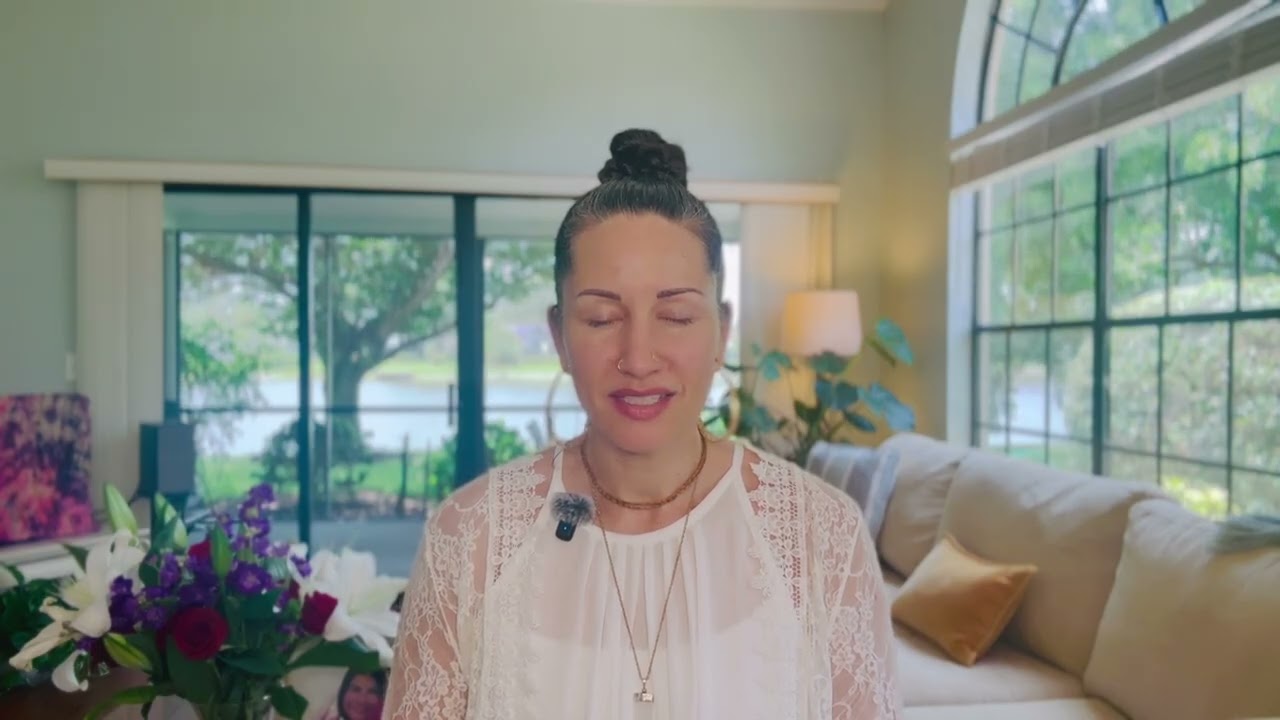
Four minutes into a short video, Danielle LaPorte is reading her own inner monologue out loud, and it is not the monologue most people expect from a spiritual teacher. "I should meditate more. I should meditate more deeply. I should pray with my heart on fire more often." The list escalates: retreat more, give up worldly pleasures, renounce, shave the head, get the kid out into the world. Then it turns on the teachers she has learned from, who she says are "much better at letting go" and "much more diligent," and therefore "further along the path." The talk, which LaPorte published in March 2021 and which the video's description identifies her as a Super Soul 100 member presenting, is about how the ego disguises itself as spiritual aspiration, why that disguise is so hard to catch, and the compact mantra she uses to interrupt it. Its core claim is tight: the ego runs two opposite scripts, inflation and inadequacy, and on a spiritual path both scripts can wear the robes of devotion.
The first thing worth noticing is how reasonable the voice sounds. "I should meditate more" is not an obviously harmful thought. Neither is "I could have been kinder." Most seekers would nod along. LaPorte's point is that the content of the thought matters less than its posture. Each line is a verdict against the self, delivered from a position of already being behind. The meditation is never quite enough, the prayer never quite fervent enough, the kindness never quite sufficient.
She frames this as a counterfeit of aspiration. Aspiration, in its healthy form, pulls you toward something you love. The ego version pushes you away from where you are, and it uses the vocabulary of growth to do it. That is why she describes it as "insidious and tricky." It does not announce itself as the enemy of your awakening. It presents itself as your most dedicated student.
LaPorte acknowledges the common picture first. "We often have this association with the ego that it's about inflation and arrogance and superiority complex, and that is definitely part of the ego trip." Most people can spot that version: the guru posture, the quiet contempt for those who are "less evolved." But she then names the second channel. In the video, at about 1:44, she says the ego "can manifest in two ways either through this superiority narrative or the inferiority narrative."
The two are mirror images, and that is the useful insight. Her own example shows how the superiority script can hide inside humility. "I'm not as involved, I'm not as dedicated, as all the people that I have learned from... they are further along the path." On the surface this is modest. Underneath, it is still a ranking, still a comparison, and still a way of placing the self on a ladder. Inferiority and superiority are both comparisons; they simply pick different ends of the same ladder. Once you see that, the question stops being "am I arrogant or humble?" and becomes "am I measuring myself against someone?"
She also gives the ego's underlying agenda, which is less about personality than about separation. Around 1:22, LaPorte says the ego is "about keeping us asleep," trying "to just build illusions on top of illusions" that are "separate from our soul" and "disconnected from each other." In this framing, both inflation and self-attack keep you locked inside a self-image. Neither lets you rest in what you already are.
This is the part of the talk that makes it useful for anyone who has ever been proud of a practice. LaPorte's warning is direct: "If you identify as a person who's like on a spiritual path, you're committed to being more conscious and being of service to the world, the ego is just going to use that." The commitment itself becomes material for the ego to work with.
Her description of the ego's method is strikingly specific. It is "looking for any way in." It does not need a crude temptation. It can use your sincerity. If you want to be closer to God, the ego will tell you that you are not, and that you must "work so much harder." The path becomes another arena for proving worth, and proof is never finished.
There is a practical lesson for practitioners here. If your spiritual life has started to feel like a checklist with you as the failing student, that feeling is itself information. The inner critic has not left the room; it has taken up meditation.
LaPorte takes the argument into ordinary longing, which is where most readers will recognize themselves. "You want romantic love in your life," she says, and the ego "is gonna tell you all the reasons you were not deserving and all the reasons why that dream is never gonna come true." With financial abundance, the script becomes "why you're not worthy and why you gotta hustle." The sequence is the same each time: a want appears, and the ego attaches a verdict of unworthiness to it.
Her key line is about indiscrimination. "The ego will go out directly after" any desire, "doesn't matter what level of desire, aspiration, low level desire, high level aspiration, emotion and feeling, virtue." It is "gonna look for that hook." Nothing is too sacred to be used. Even a virtue, once you cling to it, can become a hook. The practical implication is that you cannot solve this by screening your desires for purity. The ego will find a handle on whatever you hold.
LaPorte's response is not to argue with the voice. Her work, as she describes it, is "whenever that voice comes up, that I'm not enlightened enough," to "diligently rush in with compassion." The word "rush" matters. She is describing a reflex, a quick and warm turn toward the self, not a slow analysis of why the critic is wrong.
The medicine she offers is short enough to memorize. In her words, at about 3:25: "I'm doing the best that I can to be a holy being in human form, and I've got love in me anyway." She adds the clause that makes it a practice rather than a platitude: "If I meditate lightly, I celebrate that."
"I'm doing the best that I can to be a holy being in human form, and I got a love on me anyway. Even if I don't meditate that deeply, and if I meditate lightly, I celebrate that." (Danielle LaPorte, in the video, around 3:25)
Notice what the mantra does and does not do. It does not deny that you have room to grow, and it does not demand that you feel enlightened. It accepts the actual size of your effort. It also reverses the ego's logic. The ego says a light meditation proves you are failing. The mantra says a light meditation is worth celebrating. Both sentences are about the same sitting; only one of them is a weapon.
A workable way to use it: when you catch a "should" that sounds spiritual, pause and ask whether it is pulling you toward love or ranking you against someone. If it is ranking, say the mantra, slowly, and let the effort you actually made count. You do not have to win the argument with the voice. You only have to stop obeying it for the length of one breath.
The video is brief, and its strength is its candor. It is worth watching the full sermon LaPorte points to at daniellelaporte.com, and her daily reflection prompts on Instagram at @daniellelaporte, if you want more of the material in her own voice. The description also links two resources that pick up the same thread. "The lie of inadequacy" (youtube.com/watch?v=fns86Axbk8U) deals with the inferiority side of the ego, and her WORTH mini-course, on her shop site, is framed around moving from ego critique to what she calls your Divine Value.
The larger takeaway is simple to state and harder to practice. The ego does not need you to be unspiritual. It only needs you to measure yourself. Watch for the "should," watch for the ranking, and when you catch them, offer yourself the one sentence LaPorte keeps coming back to: you are doing the best you can, and there is love in you anyway.