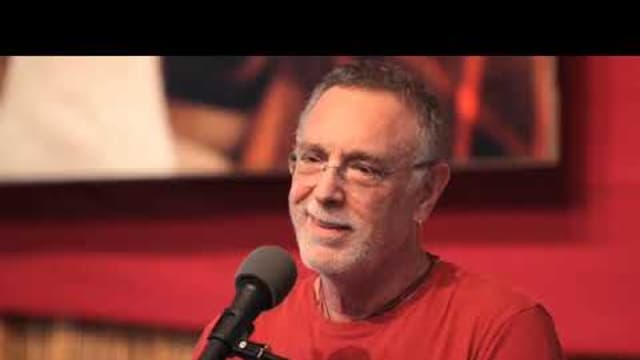
In a two-and-a-half-minute excerpt from a talk by Sri M, published by The Satsang Foundation, the teacher makes a claim that sits at the heart of the Shakti tradition: that Shiva, the principle of pure consciousness, cannot act at all without Shakti, the living power that moves through creation, and that awakening this energy inside a person is what begins a transformation from ordinary human life toward something divine. He anchors the claim in a fire ritual, in the opening verse of Adi Shankara's Soundarya Lahari, and in a picture of energy rising through the body to the crown. What follows walks through those ideas one at a time, so that a reader who never presses play still understands what is being said, why it matters within the tradition, and where its edges are.
He opens with a concrete image rather than an abstraction. Imagine a homa, the sacred fire offering, about to be performed. The ground is prepared, the ritual vocabulary is in place, and the fire pit, the havankund, is what gives the rite its physical form. Sri M's point is that the structure is useless without it: "Without the Havankund, no homa can be done physically also." (0:09)
From that image he moves to the larger claim. "Even in this way, the Shakti is very important for us." (0:15) The analogy does a lot of work. The fire pit is not decoration; it is the place where the offering becomes real. Shakti, in his telling, plays that role for the divine. Without it, the sacred is present in name but not in action.
The clip's central statement is that "Shivam cannot be touched without the activation of the Shakti." (0:04) Shiva here stands for the still, unmoving ground of reality, and Shakti for its dynamic power. The traditional picture is of a principle that knows and rests, and a power that moves. Sri M is saying that the first without the second is inert.
"Which means, without Shakti, Shiva has no function to perform." (Sri M, 0:54)
He describes the original arrangement of things as a state of balance, which he calls the state of Shivam. In the Vaishnav tradition, he notes, the same condition is named Ananta Shayana, a kind of rest on the infinite. Shiva, in that picture, is also in a form of repose. Only when Shakti is awakened does activity begin. For a reader new to this material, the useful way to hold this is as a relationship rather than a hierarchy: consciousness and energy are two faces of one reality, and the teaching emphasizes that the energy is the part that moves anything at all.
Sri M makes a deliberate correction to a common assumption. "People associate Shankara only with Advaita Vedanta and so on," he says, "but he also wrote the Soundaraya Lahiri." (0:27 to 0:32) He adds that Shankara had, in his view, many experiences of these energies. This matters because Shankara is most often read as the great philosopher of non-dual Vedanta. Sri M is pointing to a devotional and experiential side of the same figure, one in which the goddess Shakti is not an idea but a living presence.
The verse he recites opens the work. He reads it in Sanskrit, beginning: "Śivaḥ śaktyā yukto yadi bhavati śaktaḥ prabhavituṃ." He then gives its sense in his own words: without Shakti, Shiva is unable to do anything, so how could anything at all happen in the world without her? The verse turns on humility. The poet asks what merit he has to call upon the goddess, even though gods such as Hari, Hara and Virinchi also praise her. Sri M renders the question directly: "What Punya have I done to call upon you?" (1:58) That posture of unworthiness, paired with the claim that the goddess is the source of all action, is the emotional key to the whole tradition of Shakti worship.
Here the talk turns from cosmology to practice. Sri M describes the kind of person who can awaken the energy: someone with "deep devotion," who knows "how to operate the energies," and who loves the energy enough to make it dance and rise "up the path to the Sahasrara," the crown of the head. Such a practitioner sits, places attention on that rising, and something shifts. In his words, "the rejuvenation takes place, the transference of a human into a divine being begins." (2:24 to 2:33)
The claim is ambitious, and Sri M states it plainly: "Once it is awakened, even though physically you are human, you are no longer just ordinary." (2:37) He then adds the line that carries the spiritual weight of the piece: "There is something else going on inside, always, constantly." (2:43) The implication is that the change is not a single event but an ongoing interior reality, one that a person lives alongside ordinary life rather than leaving it behind.
The excerpt is short, and it does not lay out a step-by-step method. A reader should take it as a statement of what a living tradition believes about its own practice, delivered by a teacher to a listener who already has context. The description beneath the video points viewers to a separate page on Kriya Yoga and its frequently asked questions, which is a useful next place to look if the practical side interests you. It is also worth noticing the distinction the talk makes between the principle and the power, and between the idea of the divine and the lived experience of it. Those two layers are where most of the depth lives.
Read this way, the clip is less a set of instructions than an invitation to see energy as the medium through which the sacred becomes active. Sri M's fire-pit analogy stays with you because it is so physical: the altar is ready, the rite is correct, and still nothing happens until the fire is lit.
If this excerpt has opened a question, the most direct next step is the Soundarya Lahari itself, the hundred-verse hymn attributed to Adi Shankara, which begins with the verse Sri M quotes. Read the opening verses slowly alongside a translation, and notice how often the poem moves between Shiva's stillness and Shakti's agency. The Satsang Foundation's channel also carries longer talks, question-and-answer sessions and dialogues with Sri M, which develop many of these themes at greater length than a two-minute clip allows. Approach them as you would any living teaching: with curiosity, with attention to your own experience, and with the patience the tradition itself seems to ask for.