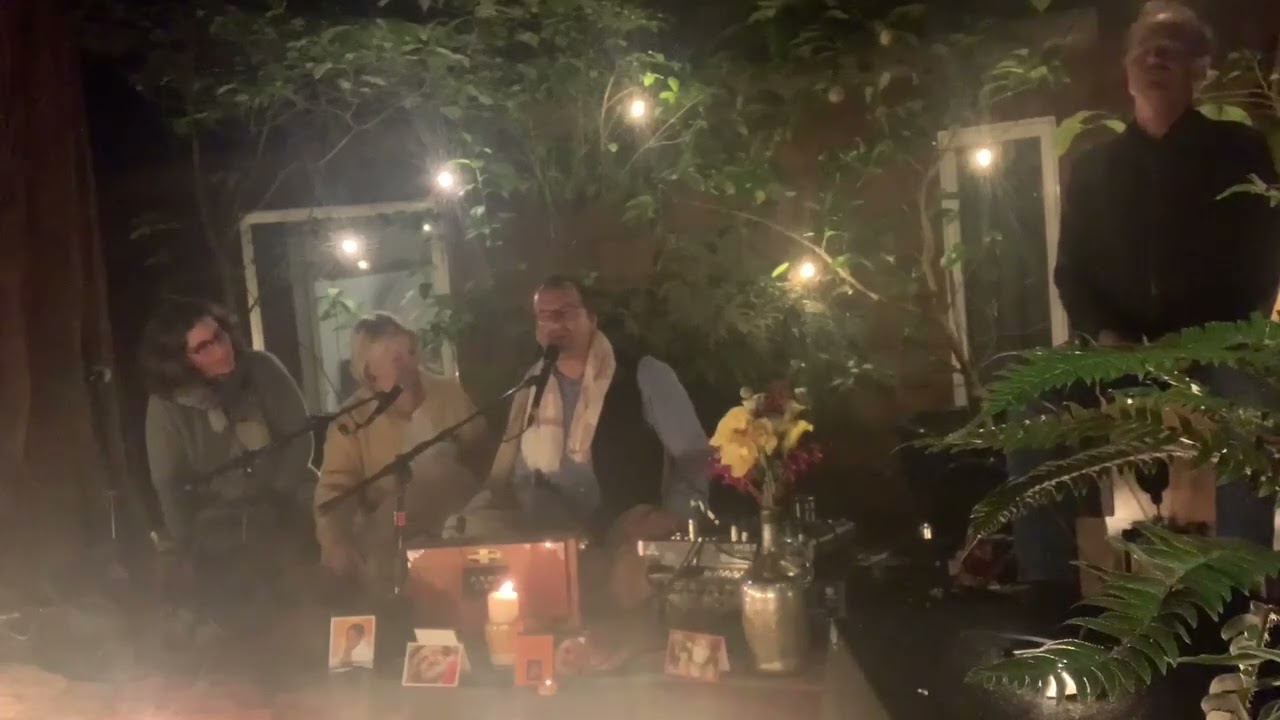
A four-minute recording sits in the vast digital library of yoga music. "Tantroktam Devi Suktam (Edit)" — composed by Jaya Lakshmi and performed by Ben Leinbach — streams as part of a collection titled Yoga Music Mantras & Chants, Vol. 2: Sanskrit Chants for Yoga Class. Over fifty thousand people have encountered it since its upload to YouTube in 2015. Most likely, they found it exactly as you might: searching for something to settle the mind, to structure a home practice, to add texture to a meditation cushion or studio setting. What arrives is not a lecture or explanation. It is pure sound — Sanskrit syllables arranged in melodic form, sustained by the deep drone of a harmonium. This kind of recording occupies a peculiar and specific space in contemporary spiritual culture. It exists at the precise intersection where ancient liturgical form meets modern wellness infrastructure, where sacred tradition and commercial distribution coexist without erasing each other.
A Sanskrit chant is not background music, though it's often used that way. In its proper context, it is a structured engagement of voice, attention, and meaning. Traditionally, chanting serves specific functions: invoking divine presence, stabilizing the mind over time, transmitting teaching through sound and rhythm, creating resonance within a community gathered together in real time. The practice assumes that the human voice is not merely producing air vibrations but engaging something deeper — aligning the body's energy, activating subtle perception, creating conditions for transformation.
Sanskrit carries particular sonic properties that modern languages do not. Each syllable moves the tongue and palate in specific ways. Each sound, in Hindu and yogic philosophy, corresponds to subtle energy and consciousness. The pronunciation itself is understood as a form of knowledge. When you chant Sanskrit, your mouth creates shapes that English-speaking people rarely make. Your breath organizes differently. The ear encounters phonetic combinations that don't exist in modern speech. This difference is not incidental. It is core to why chanting Sanskrit differs fundamentally from singing a pop song or even chanting in English.
Yet the recording of "Tantroktam Devi Suktam" exists as a fixed audio artifact — a preservation of one interpretation, one voice, one harmonium player's touch, one chosen tempo, one arrangement. A recording allows you to encounter the form without needing a live teacher, without needing to know Sanskrit pronunciation yourself, without needing a community gathered in shared space. This is genuinely democratizing: the chant becomes accessible to someone in a studio or bedroom anywhere on earth. It is also, in some ways, a flattening. The infinite reproducibility means no adaptation happens, no responsive teaching, no living transmission in the moment.
The harmonium — that accordion-like keyboard instrument with bellows — is not an ancient Hindu instrument. It arrived in India through European colonial trade during the nineteenth century. Yet within a remarkably short historical span, it became the primary accompaniment for devotional music, particularly North Indian kirtan (call-and-response devotional singing). This is an extraordinary fact about cultural adaptation: a foreign instrument, imported under the conditions of colonization, was absorbed, mastered, and transformed into something inseparable from Hindu spiritual music.
Why did this happen? The harmonium allowed a single musician to carry both melody and drone simultaneously. It was portable, relatively affordable, and acoustically suited to temple and ashram spaces. More importantly, musicians who devoted themselves to the instrument discovered its capacity for depth. A skilled harmonium player doesn't simply provide accompaniment. The instrument becomes an extension of breath and emotion, capable of sustaining tones that shimmer with microtonal variation, of holding drones that seem to open the listener's chest, of knowing when to move and when to hold still.
The drone itself merits close attention. In a recording like this one, the harmonium's drone functions as an anchor — a baseline frequency upon which the melody floats. That drone is never neutral. It structures the listener's nervous system, establishing a reference tone that the ear and body can settle into naturally. This is why a four-minute chant recording played on repeat during a yoga class creates an atmosphere that a playlist of pop or even classical music cannot easily replicate. The constancy of the drone, combined with the repetition of Sanskrit syllables, builds an acoustic container — a sonic environment designed to support specific states of consciousness.
Yoga Music Mantras & Chants, Vol. 2 represents a specific approach to the intersection of yoga, sound, and contemporary spirituality: the rendering of sacred chants into studio recordings designed to support yoga classes and personal practice. This is neither traditional kirtan — which happens live, often in call-and-response, in gathered community — nor is it yoga asana instruction or teaching. It is its own genre: a studio-produced artifact meant to function as support, scaffold, and atmosphere.
Most people first encounter yoga music in a studio setting, during savasana (final relaxation pose) or during opening or closing group chanting. The studio purchases a license or downloads a recording; the teacher presses play; the music creates sonic continuity across many practitioners' visits — a kind of through-line. Some teachers use these recordings to deepen their own personal practice at home. Sound healers play them in meditation rooms. People recovering from trauma or illness use them as part of their healing work.
The existence of such recordings reflects something genuine: the desire to engage with chants without needing a teacher physically present, to support independent practice, to create beauty and sacredness in secular space. But it also reflects the modernization and partial commercialization of yoga — the translation of a complex, embodied, philosophical discipline into wellness product, downloadable file, studio session. Both things are true simultaneously. The recording is a real gift and also a commodification. Neither truth cancels the other.
When you sit with a chant recording, whether actively or as ambient sound, something specific happens neurologically and experientially. The repetition of syllables creates a scaffold for attention. The mind, which normally jumps between past regrets and future anxieties, has something to latch onto. The Sanskrit syllables don't need to make sense to your thinking mind; they function through sound itself.
The harmonium's drone does similar work at a deeper level. A steady, low-frequency tone has been shown to slow brainwave activity and reduce activation in the amygdala — the brain's alarm center. Over time, repeated listening to droned sound creates a calming effect that extends beyond the listening session itself. The body begins to associate that sonic quality with safety, with permission to relax. This is why people report that encountering yoga music — even briefly, even passively — shifts their nervous system state.
The combination of these elements — repetitive Sanskrit, harmonium drone, specific melody — creates what might be called a sonic technology. That word, "technology," might seem cold or reductive. But it's accurate. These are tools, refined over centuries, designed to reliably produce particular effects in consciousness. A recording like "Tantroktam Devi Suktam" is an application of that technology, made portable and accessible.
If you press play on "Tantroktam Devi Suktam," what you receive is one musician's interpretation of a chant form, recorded, edited, and shared. It doesn't require you to understand Sanskrit translation, to hold belief in Hindu cosmology, or to identify as a yoga practitioner. It requires only that you have ears and some degree of openness to what organized sound can do.
Most people engage with such recordings in two modes. One is active listening — sitting in meditation or during a formal yoga practice, allowing the chant and harmonium to guide attention deliberately. The other is ambient — playing the recording while moving through other tasks, letting it create a sonic environment without demanding full focus. Neither mode is wrong or less valid. Both are legitimate uses of the recording. It's designed flexibly, to serve multiple purposes.
What's distinctive about encountering this music now, in 2026, is that it exists in a rich ecosystem. You can find thousands of yoga music recordings, kirtan albums, Sanskrit chant collections. You can watch videos of live kirtan performances. You can find books about the meaning of specific chants, teachers who can guide pronunciation, online communities discussing these practices. A recording that would have been impossibly rare to access fifty years ago is now instantly available. What you choose to do with that access is entirely your own.
If this kind of recording resonates with you, several directions are worth exploring. One is deeper study — learning Sanskrit pronunciation, meaning, and the philosophical contexts from which these chants emerged. Another is seeking out live kirtan experiences, which happen in ashrams, yoga studios, music venues, and spiritual festivals. A third is investigating the harmonium as an instrument, perhaps even learning to play it yourself. Many contemporary teachers offer harmonium lessons, both online and in person.
You might also explore the broader lineage of yoga music — listening to classic recordings, reading about the history of kirtan in America, understanding how sacred sound has been adapted across cultures and centuries. Or you might simply allow recordings like this one to be a consistent part of your daily practice, letting the chant's effect accumulate over time. The recording exists now, a small but real gesture toward making ancient sacred sound accessible to modern practitioners. What you do with that sound — how you listen, how you practice, what it awakens in you — belongs to you.